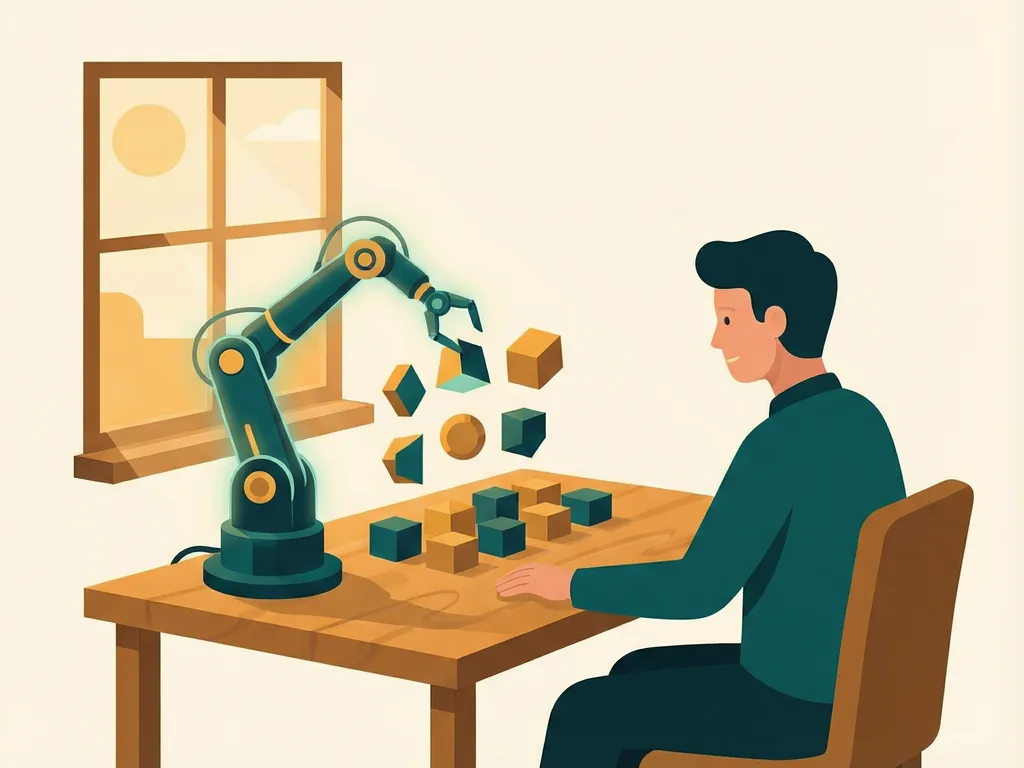
AI agents promise to do multi-step work on their own. This topic looks at what actually works today: real automations, no-code agent builders, coding agents and the guardrails you need before letting an agent touch your email, files or spreadsheets.
Software company Simplex integrated ChatGPT Enterprise and Codex into its engineering workflow to cut development time. ChatGPT Enterprise supports design exploration, documentation, and code assistan…
OpenAI announced plans to acquire Ona, whose secure, persistent cloud environments will strengthen its Codex coding agent. The deal addresses a key limitation of agentic coding—ephemeral sessions that…
Tired of re-explaining your brand voice, report formats, or coding standards to ChatGPT? This tutorial introduces ChatGPT skills—reusable modules that package instructions, reference files, and workfl…
GPT-Rosalind is a large language model purpose-built for life sciences research, offering enhanced biological reasoning, medicinal chemistry expertise, genomics analysis support, and experimental work…
This guide provides sales reps with five practical ChatGPT workflows covering account research, meeting preparation, personalized outreach emails, and pipeline reviews. Each workflow includes copy-pas…
OpenAI's Codex is reshaping knowledge work by moving from answering questions to completing multi-step tasks. The Next Era of Knowledge Work report shows how AI agents accelerate research, make data a…
AI agents that take real actions face unique security risks like prompt injection and social engineering. This article explains ChatGPT's defense strategy: constraining risky actions through confirmat…
Amazon Bedrock's Stateful Runtime gives AI agents persistent orchestration, built-in memory, and secure code execution across multi-step workflows. It removes the need for DIY state management with da…
The Admin plugin for ChatGPT Work and Codex unifies workspace administration into a single conversational interface. Admins can analyze usage patterns, manage members and roles, fine-tune permissions,…
OpenAI and Figma have launched an integration connecting Codex, OpenAI's coding agent, directly to the Figma canvas. Developers gain context-aware coding help based on actual designs, while designers …
AP automation company Stampli used ChatGPT Work to transform its product development and launch processes, cutting product launch time by 68%. By integrating AI into daily workflows, teams accelerated…
The Codex App Server lets developers embed an AI coding agent directly into their applications via a bidirectional JSON-RPC API. Unlike one-shot prompt services, it supports ongoing conversations wher…
GPT-5.3-Codex is a Codex-native AI coding agent built from the ground up for long, real-world engineering tasks. Unlike chatbots adapted for code, it combines frontier-level coding performance with ge…
OpenAI built an internal AI data agent that turns plain-language business questions into reliable data analysis. GPT-5 handles reasoning and planning, while Codex writes and runs code to process datas…
Kaggle Game Arena is a dynamic benchmark that evaluates large language models through competitive games rather than fixed Q&A tests. By placing models in head-to-head environments such as Chess, Poker…
OpenAI has launched the Codex app for macOS, a native hub for AI-assisted software development. It lets developers run multiple coding agents simultaneously, manage parallel workflows, and handle long…
GPT-5.5 is OpenAI's newest language model, built to handle complex, multi-step work with less hand-holding. It targets coding across larger projects, sustained research reasoning, and data analysis sp…
This article explains how the Codex CLI agent loop works under the hood. It covers the iterative cycle of receiving context, deciding on actions, executing tools, and observing results. It highlights …
This article explores how NVIDIA uses ChatGPT Work, OpenAI's enterprise collaboration platform, to boost productivity across its global teams. It covers three key benefits: automating repetitive manua…