
Every automation engineer should know these microservices best practices.
n8n advises clear service boundaries, retries, circuit breakers, API gateways, and observability to keep microservices resilient.
Key Takeaways
- Define microservice boundaries around clear business capabilities so services remain independently deployable and avoid coordinated failure cascades.
- Control inter-service communication with asynchronous patterns, retries with backoff, error workflows, and isolation techniques to prevent one dependency from blocking or overwhelming others.
- Use an API gateway as a stable client entry point while ensuring the gateway itself is replicated and load-balanced to avoid becoming a single point of failure.
- Make distributed failures visible through tracing, centralized logging, and workflow execution inspection so teams can quickly identify which service or request path broke.
n8n Guides Teams to Keep Microservices Resilient With API Boundaries
Meta description: Learn how clear service boundaries, API gateways, retries, circuit breakers, and n8n workflows help teams keep microservices resilient when dependencies fail.
Tags: Microservices, API Gateway, n8n, System Resilience, Observability
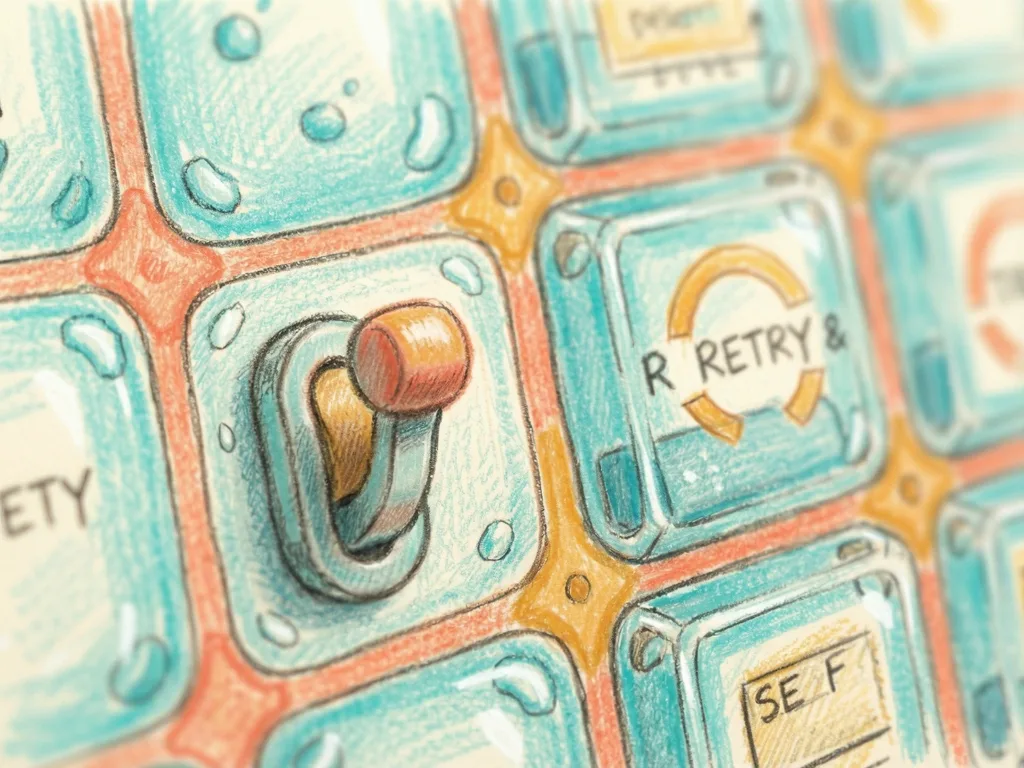
Featured image: abstract friendly illustration of an API gateway, service nodes, retry loops, and observability panels; no real people, no logos, no text.

n8n outlines microservices architecture best practices for engineering teams that already split applications into small services. The core warning: a failed API or unavailable database should not trigger a chain reaction. The guidance gives readers a practical way to control service boundaries, service-to-service calls, API routing, and failure visibility.
Draw service boundaries around business capabilities
A microservices architecture breaks an application into independent services that communicate through APIs. Boundaries should follow a distinct business capability. Domain-driven design groups related logic into a bounded context, a defined part of the business with its own rules, language, and data. The single responsibility principle reinforces this: each service owns one capability.
An order service can handle order creation and status, while a payment service handles charging and refunds. Separate responsibilities make services independently deployable, so changing payment logic does not force unrelated releases. If services share responsibility, a small change may force API updates, data moves, and coordinated deployments across several services.
In n8n, sub-workflows can separate service-specific orchestration into smaller reusable workflows. Each sub-workflow owns its service-calling logic and error handling, making failures easier to isolate.
Control how services call each other
Once services depend on one another, communication becomes a failure surface. A healthy service can still fail if a dependency times out, rejects a request, or becomes temporarily unavailable. Synchronous communication makes one service wait for another, so a slow dependency can delay the caller. Asynchronous communication can reduce that dependency by placing work on a message queue for another process when it is ready. That design keeps the wider system working when one dependency has a problem.

A circuit breaker watches repeated failures and stops sending requests after a threshold, letting the caller fail fast and giving the dependency time to recover. n8n’s error workflows provide workflow-level failure handling instead of a stateful circuit breaker. Configure an error workflow in Workflow Settings; if the main execution fails, n8n runs it from the Error Trigger to log the failure or start recovery logic.
Retries suit transient faults such as timeouts or rate limits, but immediate retries can pressure a struggling service. Exponential backoff increases the delay after each failed attempt. Retry On Fail sets a maximum number of tries and a fixed waiting period; for increasing delays, teams can use a loop and the Wait node.
A bulkhead pattern isolates one failing part so it cannot consume resources other tasks depend on. If Service A becomes unresponsive, requests to Services B and C can still use their own resources.
Route traffic through an API gateway
As service count grows, clients calling each microservice directly create coordination issues. A checkout app may need separate web addresses for Orders, Inventory, Payment, and Shipping services. If one service moves or changes its API, every client that calls it may need updating.
An API gateway gives clients one entry point. The gateway receives a request, decides which services should handle it, and forwards it to the right place. It keeps internal structure behind a stable interface, so services can change without exposing every change to clients.
The gateway itself must be resilient. If every request passes through one gateway, that instance can become a new single point of failure. Multiple instances or regions and load balancing can direct traffic to another gateway if one becomes unavailable.

Make failures visible across services
Finding the failure source is harder in microservices because one request can cross several independently running services. If a checkout request moves through inventory, payment, and fulfillment, a final error does not immediately show which service failed or what happened to the data. In monolithic architecture, most logic runs inside one larger app, so one set of logs is often enough.
For distributed systems, teams can use distributed tracing to follow one request across services and centralized logging to bring separate logs into one searchable data store. n8n is an AI-native, source-available workflow automation platform that orchestrates calls across APIs and services in visual workflows, with code when needed.
After a Redis event, n8n checks acceptable error rates, then calls two related microservices sequentially and removes the Redis key on success. On failure, it increments an Error Key; too many errors within a pre-defined time-to-live window stops the workflow.
In the Executions view, users can inspect previous workflow runs, follow each execution path, and check inputs and outputs at each node to see where data changed or a call failed. They can also load data from a previous execution back into the editor to debug and rerun it. If the app uses message queue brokers such as RabbitMQ, Redis, Kafka, or others, n8n can read and send messages through the same channel as the rest of the system.
Resilience works best when teams design for failure proactively: deciding how services communicate, where failures should stop, and how to identify unfinished requests. Microservices still own their business logic and infrastructural resilience. n8n can add a visible orchestration layer around service calls through Hypertext Transfer Protocol (HTTP) calls, branching, retries, and failure handling. Teams can explore n8n’s guide to event-driven microservices, self-host n8n, or try n8n Cloud for free.





Comments (0)