
NVIDIA Nemotron 3.5 Super Vision-Language Enables Specialized Agents Through Multimodal Reasoning
NVIDIA Nemotron 3.5 Super Vision-Language is an open 120B multimodal model for enterprise agents, boosting reasoning, tool use, and efficiency.
Key Takeaways
- NVIDIA Nemotron 3.5 Super VL is an open 120B mixture-of-experts vision-language model with 12B active parameters per token, built for enterprise agents that combine reasoning, tool use, and multimodal understanding across text, images, documents, and video.
- It supports specialized multistep workflows such as coding, web research, document intelligence, cybersecurity, and video understanding, helping teams avoid splitting context across separate text and visual models.
- NVIDIA provides open customization resources, including NeMo libraries, supervised fine-tuning, low-rank adaptation, reinforcement learning, and open datasets, enabling domain-specific post-training for industries such as finance, healthcare, and cybersecurity.
- Reported production and benchmark results highlight strong multimodal agent performance, including 80.8% on CharXiv, top-tier OCRBench v2 positioning, and claimed enterprise gains in throughput, accuracy, cost, and latency.
Meta description: NVIDIA Nemotron 3.5 Super VL is an open multimodal 120B mixture-of-experts model for enterprise agents, with 12B active parameters per token.
Tags: NVIDIA Nemotron 3.5 Super VL, enterprise AI agents, multimodal models, inference efficiency
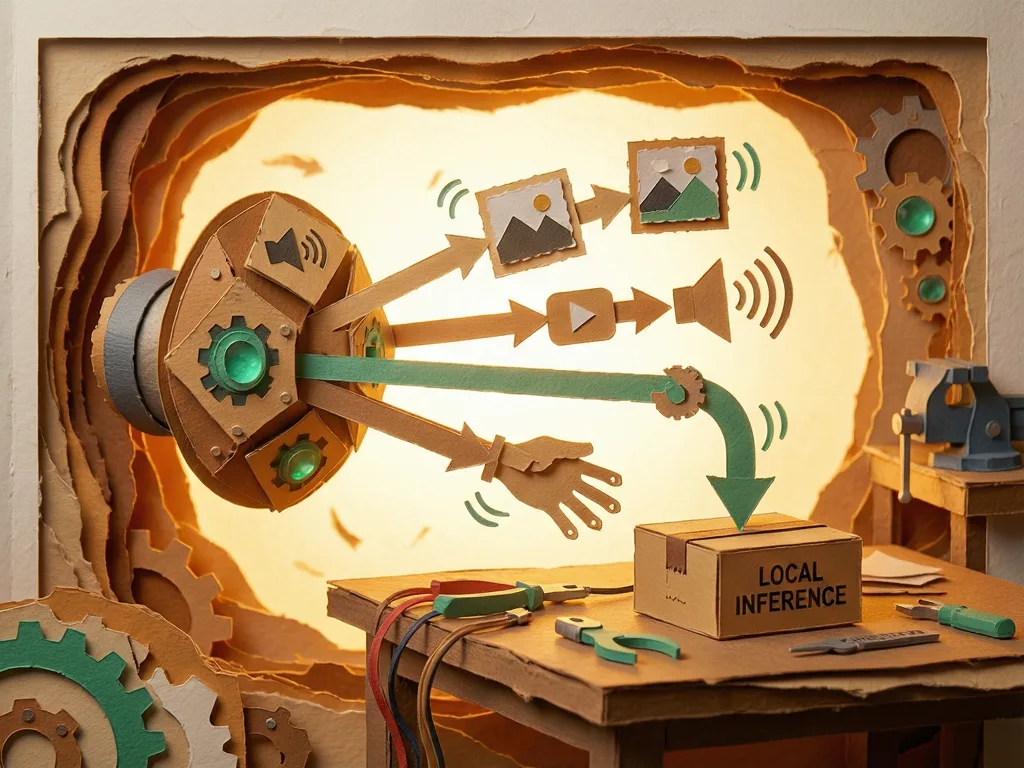
Featured image: an abstract, friendly illustration of text, charts, documents, and video streams merging into an agent workflow, with no real people, logos, or text.
NVIDIA Nemotron 3.5 Super VL is for developers and enterprise teams building always-on agents that need to read documents, check information across sources, follow company policy, and call several tools. NVIDIA describes it as an open, customizable multimodal model that combines reasoning, instruction following, and tool use with text, image, document, and video understanding. The model uses a 120B-parameter mixture-of-experts architecture that activates 12B parameters per token, aiming to balance capacity and inference efficiency.
Why a single multimodal model matters for agents
Many enterprise workflows no longer fit a single text prompt. A customer-service agent may need to follow return policies. A research agent may connect evidence across pages. A document agent may need to interpret tables, charts, and page layouts. If text and visual capabilities are split across separate models, teams must move context between systems. Nemotron 3.5 Super VL is positioned to handle those tasks in one workflow.
NVIDIA lists coding, web research, document intelligence, cybersecurity, and video understanding as target agent workflows. In coding, the model can test and validate code, analyze errors, and recommend fixes. In web research, it can search across websites, connect information, and verify answers. In document intelligence, it can extract information from tables, charts, and page layouts to produce summaries and reports. In cybersecurity, it can identify security vulnerabilities and triage threats to prioritize remediation. In video understanding, it can extract information for search, content review, and incident analysis.
Within a system of models, NVIDIA positions Nemotron 3.5 Super VL for specialized, multistep work that needs reasoning, tool use, and text and visual understanding together. Smaller models, such as NVIDIA Nemotron 3.5 Lightning, handle high-volume text tasks, while frontier models such as NVIDIA Nemotron 3 Ultra tackle complex planning and orchestration.
Customization and reported production results
Organizations in industries including cybersecurity, finance, and healthcare are post-training Nemotron 3.5 Super VL to outperform frontier models in accuracy and efficiency across their production workflows, according to NVIDIA. Domain terminology, tool interfaces, operating procedures, and policy requirements shape how agents complete tasks successfully.
NVIDIA reports several production-oriented examples. Scale AI, an AI data and technology provider, post-trained the model for automated vendor credit processing at Skydance Corporation, a media and entertainment company. NVIDIA says inference cost for that workload will decrease by 40 times and latency by 5 times. Ramp, a financial operations platform provider, is converting receipt images into structured JavaScript Object Notation data containing merchant information, dates, and payment data. NVIDIA says Ramp expects up to 50% higher throughput and 10 times lower latency. AI21 and Alice post-trained the model for threat intelligence and vulnerability analysis, improving accuracy by 41%.
Teams can use NVIDIA NeMo open libraries to post-train models for these requirements. Developers can use NVIDIA NeMo AutoModel for supervised fine-tuning and low-rank adaptation to teach domain-specific behavior. Reinforcement learning improves performance in agent environments that reflect organizational workflows. Alongside the model, NVIDIA is releasing open datasets on Hugging Face, including agent tool-use and conversational data, finance reasoning and tool-calling datasets, instruction-following and chat data, long-context transduction and translation data, fairness data, and 40 vision-language datasets. These can supplement proprietary data for supervised fine-tuning and reinforcement learning.
For multimodal data, NVIDIA points to NeMo Data Designer resources for chart question answering and long-document understanding, and to NVIDIA NeMo RL and NVIDIA NeMo Gym for reinforcement learning and environment-based evaluation. Organizations can adapt and deploy the model's open weights in supported local, data center, or cloud environments. For customization resources, NVIDIA points to the Nemotron 3.5 Super VL usage cookbook on GitHub.
Benchmark scores for visual and agent tasks
The model's visual training covers charts, tables, optical character recognition, multipage documents, and video understanding. A two-stage supervised fine-tuning pipeline trains the language and vision components while combining visual evidence with reasoning, chat, safety, long-context data, and agent trajectories. For document intelligence, the same model can interpret a chart, connect it with a table elsewhere in a document, and summarize both. NVIDIA says developers can tailor the workflow to their own documents and evaluation criteria.
Diverse training data generated with NeMo Data Designer helped the model understand complex charts, according to NVIDIA. On CharXiv, a chart-reasoning benchmark, the model scored 80.8%, compared with 63% for Nemotron 3 Nano Omni. With Python code interpretation, it reached 84%. NVIDIA also says the model is one of the top open models on the OCRBench v2 leaderboard. The source states that the model was built with support and expertise from Nemotron Coalition organizations, including high-quality datasets from Perplexity that improved and streamlined mid-training, and environments from Prime Intellect that helped build better teacher models.
For agent tasks, NVIDIA says evaluations span Hermes, LangChain, OpenClaw, OpenCode, Pi, Codex, and Claude. In addition to coding tasks, agent harness providers use their own evaluations to test a wide range of agent tasks. On Hermes Bench and LangChain behavioral evaluations, Nemotron 3.5 Super VL scores higher than Nemotron 3 Ultra.
| Model | Hermes Bench | LangChain evaluations |
|---|---|---|
| Nemotron 3 Ultra | 56.33% | 84.3% |
| Nemotron 3.5 Super VL | 63.44% | 87.05% |
For always-on agents, efficiency determines how much work a deployment can complete. Throughput, token usage, tool calls, and the steps needed to reach a correct result affect task completion time. NVIDIA reports up to 5 times higher throughput for agentic tasks compared with other open models in its size category on a single GPU. In one example, the model delivers over 600 tokens per second on Artificial Analysis Intelligence Index agentic tasks on the Baseten endpoint. NVIDIA also says the model uses higher throughput and token efficiency to deliver 4 times faster task completion. The model was optimized to run locally on NVIDIA DGX Spark, and an independent evaluation by EXO Labs placed it on the Pareto frontier, a term for an efficient trade-off between accuracy and task completion time.
Inference techniques behind throughput and efficiency
NVIDIA says Nemotron 3.5 Super VL was distilled from Nemotron 3 Ultra. Ultra's coding capabilities, combined with the SkewReverse loss used during distillation, helped improve coding accuracy. During post-training, multi-teacher on-policy distillation combines guidance from specialized teachers across text and vision: the model generates responses, and the teachers score them for video reasoning and tracking, vision tool use, and alignment. Additional training on examples of agent actions, code repositories, and software engineering tasks improved the model's performance on agent tasks; NVIDIA says it outperforms Nemotron 3 Super on SWE-bench and Terminal-Bench across multiple evaluation setups.
Continued pretraining with high-quality natural and synthetic data improved Indic-language capabilities and contributed to higher overall scores after post-training. This stage added 10 billion Indic tokens, drawn from a 12-language subset of Nemotron-pretraining-Indic-v1 and natural Indic text. NVIDIA is releasing the full dataset, which contains about 2.8 trillion tokens across 22 Indian languages and was developed with IIT Madras and its AI4Bharat lab.
NVIDIA also introduced LiLiCorr, an open speculative decoding technique. It improves parallel speculative decoding by jointly evaluating token candidates across an entire draft, capturing dependencies that independent token predictions miss. A lightweight network computes compatibility scores in a single pass to produce more coherent drafts, leaving only a low-cost, sequential final selection step. On DGX Spark, LiLiCorr is the recommended drafter for low-latency inference with Nemotron 3.5 Super VL, and NVIDIA says it delivers up to 2.3 times faster token generation than decoding without speculation.
The model uses NVIDIA Model Optimizer for post-training quantization and quantization-aware distillation. The NVFP4 recipe uses 4-bit weights and activations on the NVIDIA Blackwell architecture. The same checkpoint runs on non-Blackwell platforms with 4-bit weights and 16-bit activations, with precision selected separately for sensitive components. NVIDIA says NVFP4 makes the model smaller, and quantization-aware distillation helps it retain accuracy at lower precision. During quantization-aware distillation, the quantized model learns to match the outputs of the original BF16 model, closing the accuracy gap that quantization introduces. It also supports storing the key-value cache in NVFP4 instead of FP8 while meeting accuracy targets. Because quantization-aware distillation happens during training, it adds no inference overhead.
Multi-token prediction gives the model an internal drafter that proposes several tokens for the main model to verify in one forward pass. Accepting multiple tokens at once reduces the number of compute-intensive verification steps needed to generate a response. A dedicated multi-token prediction boosting training phase further aligned the drafter with the final model. For repeated agent calls, prefix caching reuses computation from shared inputs such as system instructions, tool definitions, and conversation history. The model's serving optimizations preserve attention caches and Mamba recurrent states. Additional Mamba checkpoints reduce the replay needed to recover inputs for speculative decoding, while internal checkpointing avoids extra model passes during prompt processing.
NVIDIA NIM packages models with optimized inference engines, validated configurations, and standard APIs for cloud and data center deployment. NVIDIA says NIM receives ongoing security, feature, and performance updates. The source also names NVIDIA Dynamo in the production deployment section, but does not provide further technical details.
What teams should consider next
For teams evaluating agent infrastructure, the practical question is whether one model can handle text and visual inputs, follow policy, call tools, and still be customized with private data. NVIDIA presents Nemotron 3.5 Super VL as a single open, customizable foundation for that pattern, with reported gains in throughput, task completion time, and accuracy across selected benchmarks and production examples.
The next step is verification. Because the reported results depend on specific endpoints, hardware, post-trained versions, and evaluation setups, teams should test the model on their own data, tools, and policy requirements before assuming the gains will transfer. Developers interested in customization can start with NVIDIA NeMo, the open datasets on Hugging Face, and the Nemotron 3.5 Super VL usage cookbook on GitHub.





Comments (0)