
Worldwide Express Automated Freight Exceptions Using Amazon Bedrock
Worldwide Express used Amazon Bedrock agents on AWS to automate freight billing exceptions, cutting them by 75 percent and freeing $10 million.
Key Takeaways
- Worldwide Express used multi-agent AI on Amazon Bedrock inside its SpeedShip transportation management system to automate freight billing exceptions, reducing active exceptions by 75% and freeing $10 million in cash flow within six months.
- The company faced severe cash delays because its large less-than-truckload network had $15 million in free cash flow frozen monthly by manual, carrier-specific exception handling across more than 75 carriers and 130,000 customers.
- Traditional rule-based automation was not enough because billing disputes required contextual judgment, such as interpreting carrier tariffs, pricing variances, and unexpected accessorial charges like liftgate or residential delivery fees.
- Specialized AI agents for invoice matching, pricing validation, and accessorial checks use carrier-specific knowledge bases and SpeedShip APIs, enabling one workflow to handle many carriers while maintaining auditable plain-language explanations and human approval controls.
Worldwide Express Uses Amazon Bedrock to Automate Billing Exceptions

Meta description: Worldwide Express uses Amazon Bedrock agents on AWS to cut billing exceptions by 75 percent and free $10 million in cash flow within six months.
Tags: Agentic AI, Amazon Bedrock, AWS, less-than-truckload freight, Order-to-Cash
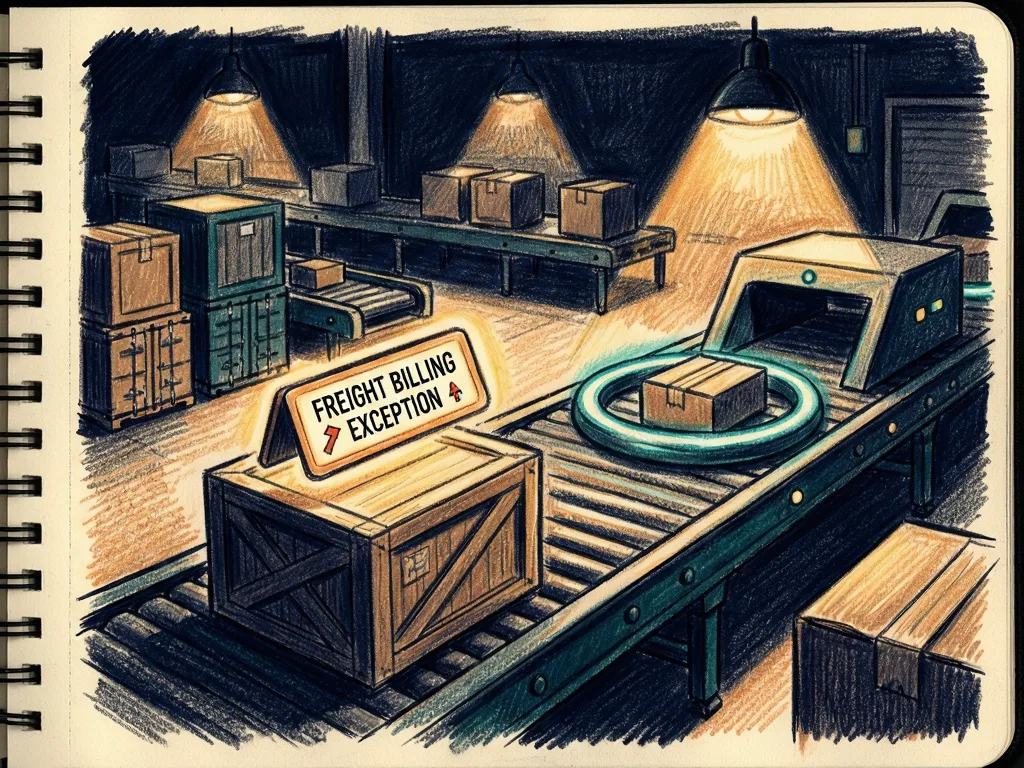
Featured image: abstract friendly illustration of freight invoices moving through a glowing digital workflow and turning into cash, no people, no logos, no text.
Worldwide Express, part of ShipStation Global, has used agentic AI billing exception automation to unlock cash that had been stuck in unresolved freight invoices. Working with AWS and LTM, the company built a multi-agent solution on Amazon Bedrock inside its transportation management system, SpeedShip. Six months after launch, Worldwide Express reported a 75 percent reduction in active exceptions, a 4-week improvement in time-to-cash, $1 million in annual savings, and a one-time $10 million free cash flow infusion.
Scale created a cash freeze
Worldwide Express had grown into a large network: approximately $5 billion in systemwide revenue, over 75 less-than-truckload carriers, and more than 130,000 customers. That size brought $15 million in free cash flow frozen each month in billing exceptions. Each exception required manual chasing, carrier by carrier, because each carrier had its own rules. An outsourced team handled cases one at a time, calling customers and carriers for each dispute. The longer exceptions remained open, the slower orders turned into cash.
Why routine automation was not enough
In less-than-truckload freight, roughly 14 percent of invoices fail the standard three-way match between the purchase order, the goods receipt, and the carrier invoice. When that match fails, the invoice moves into exception handling. Worldwide Express grouped exceptions into line-item mismatches, pricing variances, and unexpected accessorial charges such as liftgate fees, residential surcharges, or reweigh adjustments that were not on the original quote.
Each exception followed a five-step manual process: identify the exception type by cross-referencing the invoice against the purchase order, goods receipt, and pricing; research the root cause in vendor records; send email to the carrier or warehouse with dispute details; wait for a response; execute the resolution in the transportation management system. Because each carrier had a different tariff structure and dispute workflow, this consumed most of the financial operations team’s bandwidth.
Rule-based process automation can handle structured, predictable workflows, but the team needed contextual judgment. The AI had to interpret a carrier’s accessorial policy, compare charges with shipment data, and decide whether a dispute was valid based on carrier, exception type, and dollar amount. That variability made the problem a fit for an agentic AI framework.
From assessment to production in under six months

In June 2025, Worldwide Express engaged the AWS Business Transformation & Value Advisory team and identified 19 automation opportunities across the Order-to-Cash lifecycle. The company moved from assessment to production in less than 6 months, keeping financial controls visible while scaling automation.
How the agents work inside SpeedShip
The solution runs on AWS. Amazon Bedrock provides AI reasoning, and Amazon Elastic Compute Cloud is the compute engine. Building the orchestration logic directly on the compute service keeps agent roles, inputs, and decision boundaries explicit and auditable, and supports open source agent libraries. In a billing-dispute workflow, every automated decision needs to be explainable.
When an invoice exception is detected, the system routes it to one of three specialized AI agents. The Invoice Matching Agent finds the matching shipment record and flags what does not align. The Pricing Variance Agent compares the carrier’s charge with the contracted rate and determines whether the difference is valid. The Accessorial Validation Agent checks whether unexpected fees, such as residential delivery or liftgate charges, are supported by actual delivery events.
Each agent has an instruction prompt that defines its role, decision boundaries, and output format. It also has actions that integrate with SpeedShip and access to carrier-specific knowledge bases. Through Amazon Bedrock, each agent can use a suitable foundation model through a single API while inheriting existing AWS governance. For model availability by Region, the case points to the Supported models by AWS Region in Amazon Bedrock guidance.
After resolving an exception, the system generates a plain-language note explaining what was found and what action was taken. That note becomes part of the audit trail.
Carrier knowledge makes one workflow fit many carriers
Every carrier has different billing rules, fee definitions, and dispute procedures. Worldwide Express stores each carrier’s documentation, including tariff rules, surcharge definitions, dispute steps, and variance thresholds. Before making a decision, an agent retrieves that carrier’s policies and standard operating procedure documents. The same three agents can handle all carriers without carrier-specific code.
The agents connect to SpeedShip through the same APIs that analysts use. Because SpeedShip has APIs on AWS, the AI sees the same contract rates, shipment details, and delivery proof that a human reviewer would see, then writes its resolution into the same workflow.
Human approval became a quality gate, not a bottleneck
During the initial rollout, a human reviewer used the existing SpeedShip interface to approve recommendations before they were finalized. Once accuracy exceeded 99 percent, bulk approval became the default. This design gave financial operations a path to adopt automation while keeping control over customer-facing billing decisions.

Observability turned rejections into improvement
The team built dashboards tracking automation rate by carrier, error rate by exception type, resolution time, and human override frequency. When a reviewer rejects a recommendation, the system logs the feedback. Engineers then refine instruction prompts and knowledge bases based on rejection history, steadily increasing automation coverage.
The end-to-end flow begins where disputes begin
The source case includes Figure 1: Worldwide Express’s AI-powered exception handling architecture on AWS. Exceptions are detected from data sources including the SpeedShip transportation management system, a shipping system, an electronic data interchange server, and carrier and vendor portals. They are routed to one of three agents. Each agent runs on Amazon Elastic Compute Cloud with Auto Scaling, uses an agent framework with its own prompt, tools, and carrier knowledge base, and calls Amazon Bedrock for model inference. The agents produce a resolution report. Cost finalization and an AI-written note then go to a human reviewer for approval in the SpeedShip analyst interface.
Six-month results: fewer exceptions and more cash
Six months in, Worldwide Express had deployed the solution across over 40 less-than-truckload carriers. The agents currently close 10,000 exceptions weekly, approximately 50 percent of the exception volume, with a less than 1 percent error rate. The backlog of active exceptions fell from $15 million in June 2025 to $4 million six months later, a 75 percent reduction. Worldwide Express unlocked $10 million in freed-up cash flow, over $1 million in annual cost savings, and 60x first-year return on investment. The company reports time-to-cash improving by four weeks.
Nathanael Pearson, Vice President of Financial Operations at Worldwide Express, said: “With AWS, we’ve automated more than 40 percent of weekly billing exceptions, significantly reducing costs and accelerating billing cycles from days to minutes. Today, we release approximately $10 million more in customer billings each week at a speed that simply wasn’t possible before.”
What logistics teams can take from this
Worldwide Express is already expanding this approach to other parts of the Order-to-Cash cycle. For logistics companies managing high carrier volumes, the practical path is to start small: automate the most repetitive exception type first, prove accuracy, then scale across the rest of the portfolio. The case shows that the value of agentic AI comes not from replacing a team, but from giving that team a system that can chase routine billing disputes while humans focus on complex, high-value exceptions.
For organizations weighing a similar effort, the case study points to a conversation with an account team, more information about Amazon Bedrock, and a Proof of Value sprint with LTM using the organization’s own data.
The AWS case study lists four authors: Saumya Shah, an AWS Customer Solutions Manager with four years of experience helping Transportation & Logistics enterprises move AI projects from proof of concept to production; Nikhil Bhagat, a Senior Solutions Architect with over a decade of experience in wide area networks, DNS, and data center networks, and a focus on cloud infrastructure, networking, generative AI, and agentic AI frameworks; Lynette Woolfolk, a Transportation & Logistics account executive with six years at AWS who helps enterprise customers unlock measurable business value through technical solutions and AI-driven innovation; and Arjun Srinivasan, Senior Vice President of AI and Data Science at ShipStation Global, with over 20 years of experience across distribution, logistics, energy, manufacturing, and retail, including large-scale work in generative AI, agentic AI, intelligent automation, predictive analytics, computer vision, and physics-based simulations.





Comments (0)