
This Production Guide Explains How to Detect Financial Fraud Patterns Using Knowledge Graphs
This guide uses Neo4j knowledge graphs to model payments, precompute edges, and run Cypher queries uncovering five procurement fraud patterns.
Key Takeaways
- The guide shows how to build a Neo4j knowledge graph for accounts payable data, modeling vendors, invoices, payments, employees, organizations, and bank accounts as connected entities.
- Isolated transaction checks miss relational fraud because many schemes only become visible through the topology of the payment network, such as multiple vendors routing funds to the same bank account.
- The pipeline uses a property graph, precomputed derived edges, and parameterized Cypher queries to detect five procurement fraud patterns: duplicate invoices, circular invoicing rings, money mule rings, vendor collusion, and payment anomalies.
- Graph databases are highlighted as a complement to rules engines and ML models because they make multi-hop relationship queries efficient and reveal coordinated fraud behavior hidden in relational data.
- A reproducible synthetic dataset with injected fraud patterns, ground-truth validation, Docker, and Neo4j provides a practical reference implementation for testing and demonstrating the detection workflow.
Meta description: Use a Neo4j fraud detection pipeline to model payment entities, materialize derived edges, and run Cypher queries that reveal five procurement fraud patterns.

Tags: Neo4j, fraud detection, Cypher, payment graphs, procurement fraud
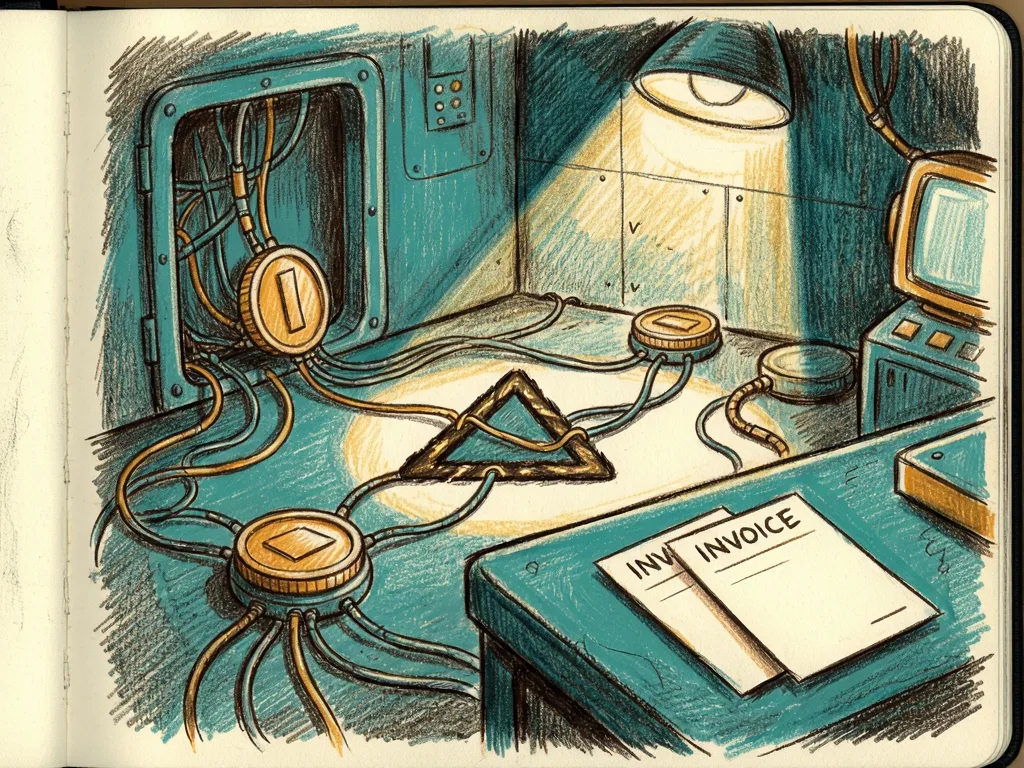
Featured image: Abstract friendly illustration of connected payment nodes and edges on a dark graph background, no real people, no logos, no text.
For finance technology teams and data engineers building accounts payable controls, this Neo4j fraud detection pipeline shows how to model vendors, invoices, payments, employees, organizations, and bank accounts as a property graph, precompute derived edges during ingestion, and use parameterized Cypher queries to uncover five procurement fraud schemes. The reference implementation is in the fraud-detection-knowledge-graphs repository.
Why isolated payment checks miss relational risk
Most anti-fraud architectures in enterprise payment workflows evaluate transactions separately. When an invoice arrives, an automated rules engine checks static thresholds: whether the dollar amount falls within normal limits, whether the vendor is on an approved vendor list, and whether the submitting IP address looks familiar. If the individual attributes look plausible, the payment clears.
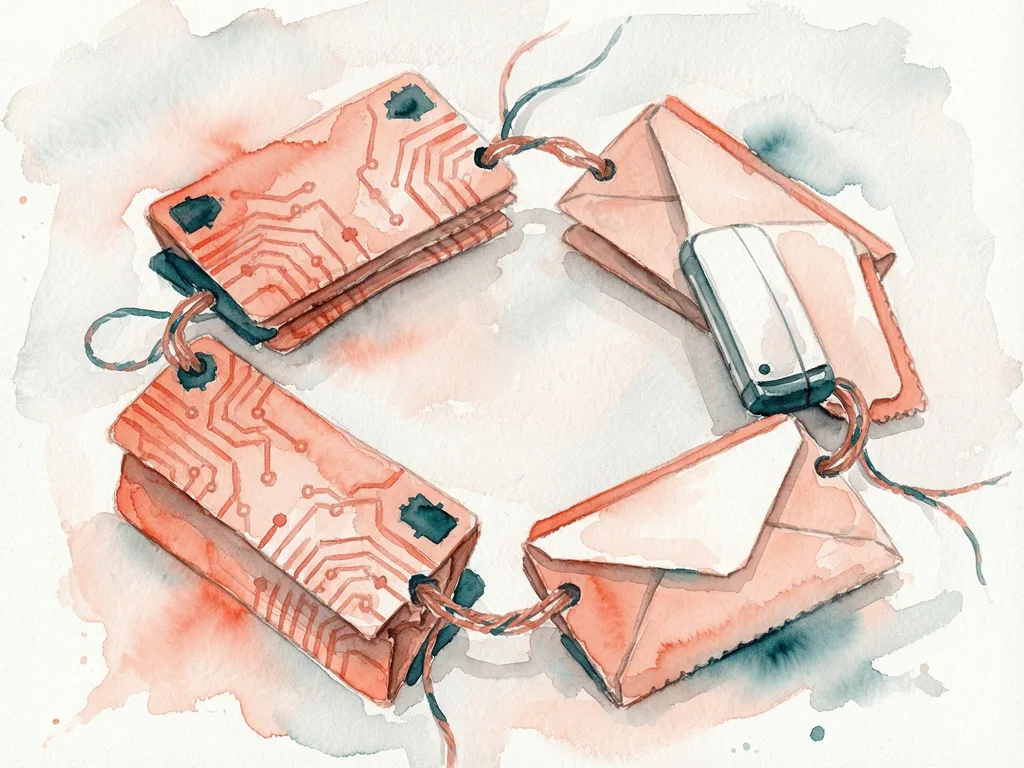
The weakness is structural. Sophisticated schemes such as money mule rings, circular invoicing loops, and vendor collision rarely trigger single-transaction thresholds. A shell company invoicing $4,800 to stay under a $5,000 dual sign-off threshold looks fine in isolation. But when 25 or more seemingly independent vendors route disbursements to the same bank account, the coordinated pattern becomes visible.
The warning is not in the attributes of an isolated transaction. It lives in the topology of the payment network. In the tutorial example, Alpha Corp sends $5,200.00 on 2025-08-01, Beta LLC sends $4,800.00 on 2025-08-02, and Gamma Inc sends $5,100.00 on 2025-08-03. All amounts fall within a normal $1,000-$15,000 range, all vendors are valid, and the dates are sequential. No single record breaks a rule.
The graph view changes the picture. Alpha Corp, Beta LLC, and Gamma Inc can map to ACC-MULE-001, while Delta Corp and Epsilon LLC map to ACC-0042 and Zeta GmbH maps to ACC-0099. ACC-MULE-001 receives from 25 or more vendors, which is a money mule ring. The convergence is the red flag. The underlying data has not changed, but evaluating transactions inside an entity graph reveals the coordinated funnel.
In a relational database, connecting these entities requires recursive joins across tables of vendors, invoices, payments, and bank accounts. As tables grow into millions of rows, deep path traversals degrade query performance. Graph databases store relationships as first-class, index-free adjacency pointers, turning multi-hop traversals into constant-time lookups. A knowledge graph does not replace rules engines or ML models. It fills the gap they cannot reach: relationships.
| Pattern | Injected scale | What isolated checks miss |
|---|---|---|
| Duplicate invoices | 12 pairs | Same vendor, near-identical amount, close dates, and slight variations |
| Circular rings | 1 ring of 3 vendors | Each invoice looks legitimate alone |
| Money mule rings | 25 vendors to 1 account | No single payment is anomalous |
| Vendor collusion | 4 vendors | Independent-looking vendors share underlying attributes |
| Payment anomalies | 3 cases | Role-based checks pass, but context checks do not exist |
Prerequisites and the financial graph schema
To follow the tutorial, install Python 3.10 or higher, Docker, and Docker Compose, and have basic familiarity with Python and database concepts. The reference dataset models six entity types commonly found in financial systems.

| Entity | Key properties | Role |
|---|---|---|
| Vendor | tax_id, name, country, city | Issues invoices |
| Invoice | invoice_id, amount, date, category | Records what was billed |
| Payment | payment_id, amount, date | Records what was paid |
| BankAccount | account_id, routing_number, bank_name | Records where money went |
| Employee | employee_id, name, department | Records who approved |
| Organization | org_id, name, departments | Records structural hierarchy |
The base relationships form a bipartite payment network. An Employee node connects through APPROVED to a Payment node. That Payment node connects through LINKED_TO to an Invoice node, and the Invoice node connects through ISSUED_BY to a Vendor node. The Payment node also connects through PAID_TO to a BankAccount node. Ingestion also connects Vendor nodes to Organization nodes through BELONGS_TO.
Build the Neo4j fraud pipeline step by step
- Generate reproducible synthetic data. Real-world financial datasets are difficult to access because of privacy and regulatory restrictions. Synthetic data allows known fraud patterns to be injected and detection queries to be verified systematically. The FraudDatasetGenerator class, imported from dataset.generate, creates approximately 500 entities with five known patterns: 12 duplicate invoice pairs, 1 circular invoice ring of 3 vendors, 1 money mule ring of 25 vendors for 1 account, 1 vendor collusion cluster of 4 vendors, and 3 payment anomalies. Configure it with num_vendors=100, num_employees=30, num_organizations=5, and seed=42, then save the output to dataset/output. The fixed seed=42 makes the dataset fully reproducible. The generated counts are 100 vendors, 220 invoices, which include 200 base invoices and 20 fraud invoices, 331 payments, which include 300 base payments and 31 fraud payments, 51 bank accounts, which include 50 normal accounts and 1 mule account, 30 employees, 5 organizations, and 5 fraud pattern types. The generator also writes ground_truth.json, a ground-truth manifest that logs every injected anomaly and serves as the automated validation oracle.
- Start Neo4j and connect. Run docker compose up -d to start a local Neo4j 5.20 container with APOC procedures enabled. Initialize the FraudGraph driver from the graph.connection module. The default connection settings are NEO4J_URI bolt://localhost:7687, NEO4J_USER neo4j, and NEO4J_PASSWORD password. The driver uses max_connection_pool_size=50 and connection_acquisition_timeout=30, and it checks the connection with a simple query.
- Create uniqueness constraints. Create constraints for Vendor.tax_id, Invoice.invoice_id, BankAccount.account_id, and Employee.employee_id. The constraint names used by the reference code are vendor_tax_id, invoice_id, account_id, and employee_id. These constraints are critical for query performance. In Neo4j, unique property constraints automatically build underlying B-tree indexes. Without them, every MERGE operation forces an unindexed full scan across all nodes in the database.
- Load entities into the graph. FraudGraphLoader uses Cypher UNWIND to batch-insert entities in parameterized transactions, and the loader can call load_all(data). The loading sequence respects foreign key dependencies: organizations are loaded first, followed by vendors, bank accounts, and employees, with invoices and payments loaded last. Each load method follows the same pattern. MERGE creates or matches a node using the constraint for O(1) lookup, SET attaches properties, and MERGE connects relationships. For a vendor, the loader can match an Organization node by org_id and connect the Vendor node through BELONGS_TO.
- Materialize derived edges for fast queries. A central architectural decision in graph databases is whether to compute relationships at query time or materialize them during ingestion. Discovering whether two vendors share a destination bank account requires traversing a four-hop path across Vendor, Invoice, Payment, BankAccount, and the reverse Payment, Invoice, Vendor path. Evaluating that path during every real-time fraud query causes computational overhead. Materializing derived edges when data enters the system adds slight write latency during batch ingestion, but it turns multi-hop traversals into direct, single-hop lookups during runtime detection queries.
Create SHARED_ACCOUNT_WITH between vendors that share a destination BankAccount. The query matches each vendor through Invoice and Payment to the same BankAccount, then uses WHERE id(v1) < id(v2) so the relationship is stored as one directed edge between the internal node IDs and duplicate reverse edges are avoided. Also materialize SHARED_LOCATION for vendors in the same city and country, and SHARED_ROUTING_PREFIX for vendors whose bank accounts have different account_id values but share the first 3 digits of routing_number. These derived edges help detect loose collusion networks.
After ingestion, inspect the graph topology with graph.get_info(). The output confirms raw entities and generated derived relationships: Invoice has 220 nodes, Payment has 331 nodes, Vendor has 100 nodes, BankAccount has 51 nodes, Employee has 30 nodes, Organization has 5 nodes, and SHARED_ACCOUNT_WITH has 412 relationships.
- Run parameterized Cypher detection queries. The detection layer uses the base and derived edges. For duplicate invoices, compare Invoice amount, date, and Vendor. For circular rings, follow ISSUED_BY and LINKED_TO edges through a closed loop of 3 vendors. For money mule rings, count vendors linked by SHARED_ACCOUNT_WITH to one BankAccount, such as ACC-MULE-001. For vendor collusion, inspect SHARED_LOCATION and SHARED_ROUTING_PREFIX clusters of 4 vendors. For payment anomalies, connect Employee department and Organization context to the approval path. Validate the results against ground_truth.json.
Production architecture and lessons
The pipeline scales by separating ingestion from detection. Constraints, batch UNWIND, and materialized edges reduce runtime work. Derived edges are a trade-off: a small write-time cost during batch ingestion buys faster detection queries later. This architecture is useful when fraud is relational, because many entities look normal individually but become suspicious when their edges are analyzed together. The graph layer does not replace static thresholds or ML models; it adds network context that isolated records cannot expose. The fraud-detection-knowledge-graphs repository provides the complete reference implementation.
Common mistakes
- Skipping uniqueness constraints, which causes unindexed full scans during MERGE.
- Leaving four-hop vendor-to-bank-account paths to query time instead of materializing SHARED_ACCOUNT_WITH.
- Creating both directions of a derived relationship, which duplicates edges and inflates relationship counts.
- Running FraudDatasetGenerator without seed=42, making the dataset and fraud patterns irreproducible.
- Treating graph checks as a replacement for rules engines or ML models instead of a relationship layer.
- Ignoring ground_truth.json, so detection results cannot be validated.
- Loading invoices and payments before organizations, vendors, bank accounts, or employees, which breaks relationship creation.




Comments (0)