
Sensorimotor Alignment Is a Platonic Proxy for Embodied Policy Success
Sensorimotor alignment links perception and action; higher scores predict robot task success across vision-language-action, world action models.

Key Takeaways
- Sensorimotor Alignment tests whether the Platonic Representation Hypothesis extends to robotics by linking model perception with physical action.
- Higher alignment between sensory representations and robot motion trajectories is associated with better task success in VLAs, WAMs, simulations, and real robots.
- Vision features show stronger alignment with successful motion than text features, helping explain why some robot models rely more on what they see than on language instructions.
- Sensorimotor Alignment can serve as a low-cost offline screening tool to identify promising models before expensive closed-loop robot evaluation.
Meta description: Sensorimotor Alignment tests whether the 2024 Platonic Representation Hypothesis extends to robot motion and task success across VLAs and WAMs.
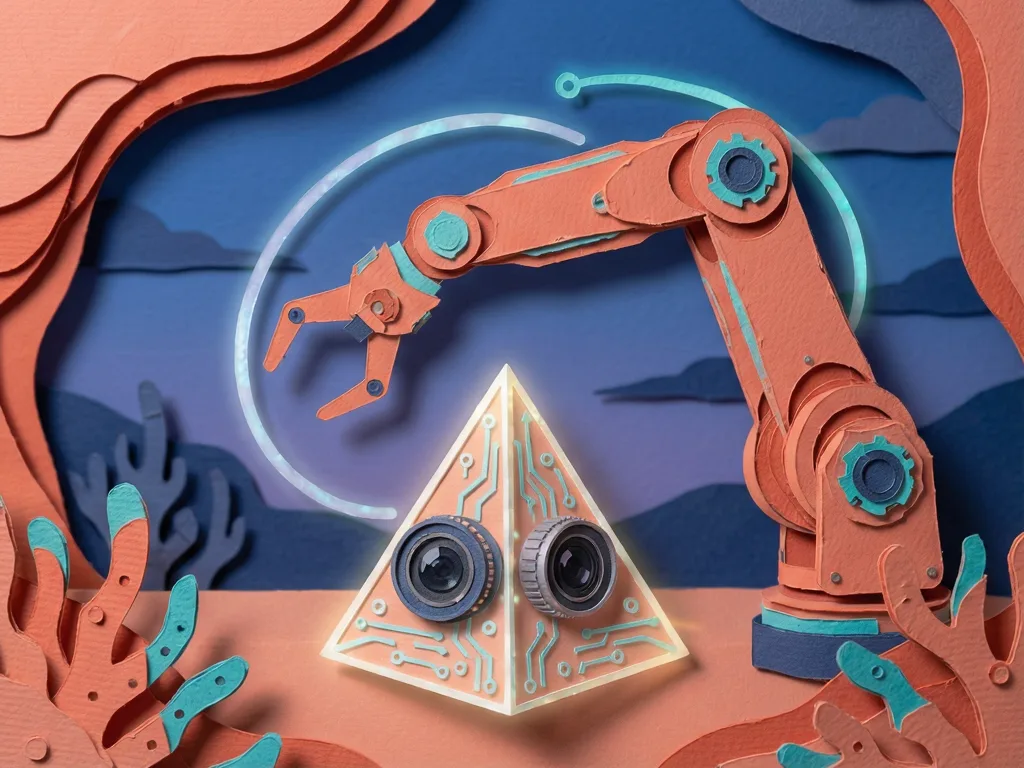
Featured image: Abstract friendly illustration of a robot arm, camera view, language prompt, and trajectory lines converging; no people, logos, or text.
Sensorimotor Alignment is the central idea in a robotics test of the 2024 Platonic Representation Hypothesis, associated with Huh et al. The hypothesis argues that as vision and language models scale, their representation spaces converge toward a shared statistical model of reality. The new work asks whether physical robot motion can also be viewed as another projection of that same world. Its evidence suggests the answer is yes: when a model’s sensory and motor representations are more aligned, robot task success tends to be higher.
From Shared Representations to Robot Motion
The original Platonic Representation Hypothesis starts from a simple observation: images and text are different projections of the same underlying world. As models recover that world more faithfully, they begin to agree on which inputs are similar. If a vision model places two images close together in its representation space, a language model tends to place their captions close together too.
The robotics version of that idea is more concrete. Instead of asking only whether images and captions align, the work asks whether robot motion itself can be treated as another projection of the same world. In other words, do more capable embodied models better align their vision and language representations with the structure of motion trajectories?
This reframing gives robotics researchers a way to test representation convergence beyond pictures and text. It also suggests that a robot’s internal “map” of what it sees may be connected to how it moves.
Measuring Sensory and Motor Neighborhoods
The method used to test this is called Sensorimotor Alignment, or S². It measures the overlap between neighborhoods of a model’s sensory representations and neighborhoods of end-effector trajectories. The end-effector is the robot’s working tool, such as a gripper or arm tip, so its trajectory captures the motion path used to complete a task.
A higher S² score means episodes that are nearby in sensory representation space are also nearby in motor representation space. In plain terms, the model’s internal grouping of what it sees matches its internal grouping of how it moves. That match is the key signal being tested.
The idea is not simply that a model must be accurate about language or vision alone. The question is whether its representations are structured in a way that connects perception with action.
Task Success Rises with Alignment
The first main finding is that S² is positively related to downstream robot task success. The work tests a range of Vision-Language-Action models, known as VLAs, and World Action Models, known as WAMs, in simulation. It also evaluates policies on real robots.
Across these settings, models with higher S² tend to achieve higher task success rates. That pattern gives empirical support for extending the Platonic Representation Hypothesis to robotics. It suggests that the same kind of representation-level convergence seen in vision and language may also appear when models learn to act in physical environments.
For readers outside robotics, the important point is practical: alignment is not just a technical curiosity. In these tests, it tracks something robot developers care about—whether the robot can complete tasks.
Vision Features Matter More Than Text Features
S² also explains, at the representation level, several phenomena that prior work observed only through closed-loop results. One example is a common failure mode in VLAs: they often ignore the language instruction and act mainly on what they see.
The work finds that VLA task success correlates with the S² of vision features, not text features. This gives a representation-level account of why a model may behave as if the instruction is weak or secondary. The visual part of the model’s internal space is doing more of the work in predicting whether the robot will succeed.

That does not mean language is useless in every robot system. It means that, for the models tested here, the alignment of visual representations with motor trajectories is the stronger signal. If a developer expects language to control robot behavior, this finding is a warning that vision may be carrying the task outcome.
A Low-Cost Offline Screen Before Robot Trials
The most practical implication is that S² can serve as a low-cost offline proxy. It can help identify which models are likely to achieve higher task success before closed-loop evaluation. Closed-loop testing often means running the robot through real or simulated tasks and measuring outcomes, which can be slow and expensive.
The work gives one concrete use case: S² can identify promising vision-language model backbones even before costly VLA fine-tuning. That matters because fine-tuning a VLA requires adapting a large pretrained model to action, which can be resource-intensive. If alignment can be measured earlier, developers may choose better starting points before committing to the expensive part of the pipeline.
In this sense, the finding is about screening, not proof. Higher alignment does not guarantee success in every task, but across the tested VLAs, WAMs, simulations, and real-robot policies, it tends to point toward higher success rates.
What Readers Should Watch Next
The result gives robotics and AI model developers a representation-level reason to check sensory-motor alignment before spending time on closed-loop robot evaluation. It also extends the Platonic Representation Hypothesis beyond images and text, offering a way to think about motion as part of the same shared world model.
The next development to watch is whether alignment can guide model choice and training more broadly. For now, the work shows that S² can act as a diagnostic proxy: a cheap, offline signal that connects what a robot-like model represents with how well it may perform in the world.
Tags: Sensorimotor Alignment, robotics, vision-language-action models, representation learning



Comments (0)