
LIBERO-Industry benchmarks robotic manipulation under industrial process constraints.
LIBERO-Industry tests embodied AI on factory tasks, showing how moving flows, product variation, timing, and tolerances degrade real-world performance
Key Points
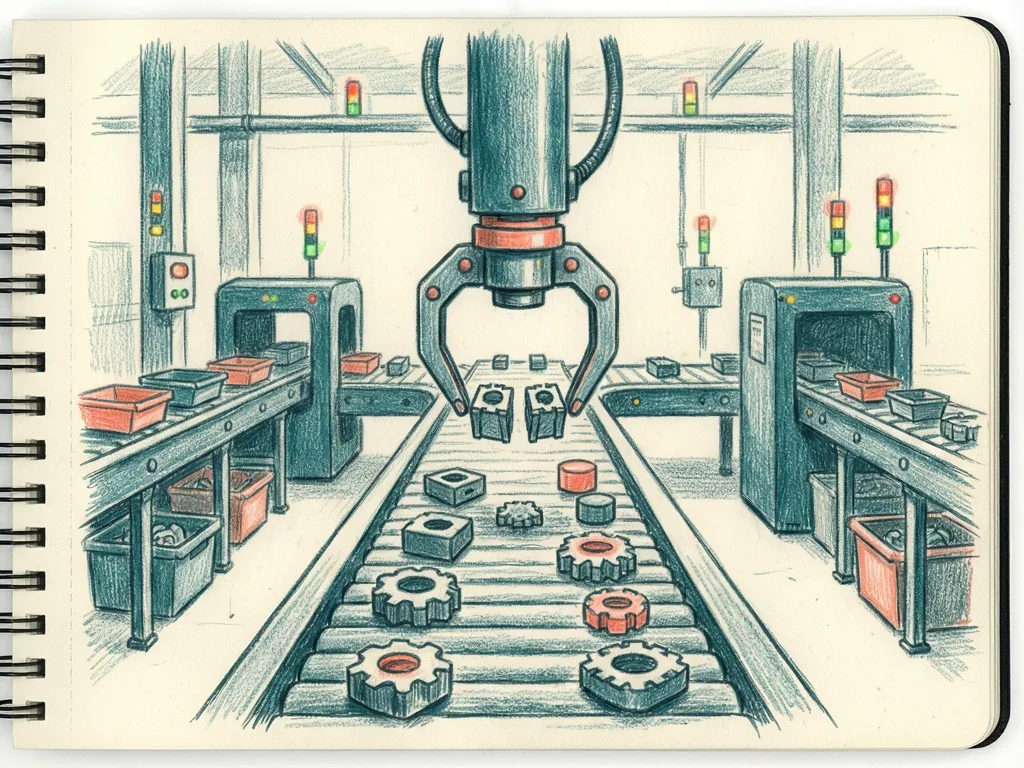
- LIBERO-Industry benchmarks embodied AI for industrial robotic manipulation under real production constraints, including moving material flows, product geometry variation, strict cycle times, and tight spatial tolerances.
- It evaluates loading, unloading, and material-transfer tasks in both simulation and a physical conveyor-belt workcell, allowing models to be tested under isolated and combined constraints.
- Results show policy performance generally degrades as industrial constraints accumulate, highlighting reliability gaps in general-purpose embodied AI models.
- Real-world experiments found that LIBERO-Industry co-training improved target-transfer completion over original-LIBERO, but this does not mean factory robots are ready for all production lines.
- The benchmark’s main takeaway is that industrial readiness should be measured through concrete production-line pressures rather than isolated demonstrations.
Meta description: LIBERO-Industry tests embodied AI models on factory tasks, measuring how constraints affect performance in simulation and real conveyor workcells.
Tags: LIBERO-Industry, embodied AI, manufacturing benchmark, robotics, flexible manufacturing
Featured image: An abstract friendly illustration of a robotic arm moving a part along a conveyor belt, with soft factory shapes and no text.
Why this benchmark matters now
LIBERO-Industry gives robotics researchers and factory-automation teams a measurable way to test whether embodied AI models can handle real production-line conditions. Embodied AI refers to systems that perceive the world and carry out physical actions, including robot manipulation tasks. Flexible manufacturing requires robots to adapt to changing products and production conditions. Yet today’s general-purpose embodied models still struggle when action failures and execution errors accumulate. LIBERO-Industry addresses that gap by turning four common production-line challenges into controllable test conditions: moving material flows, variation in product geometry, strict cycle times, and tight spatial tolerances.
How the tests are arranged
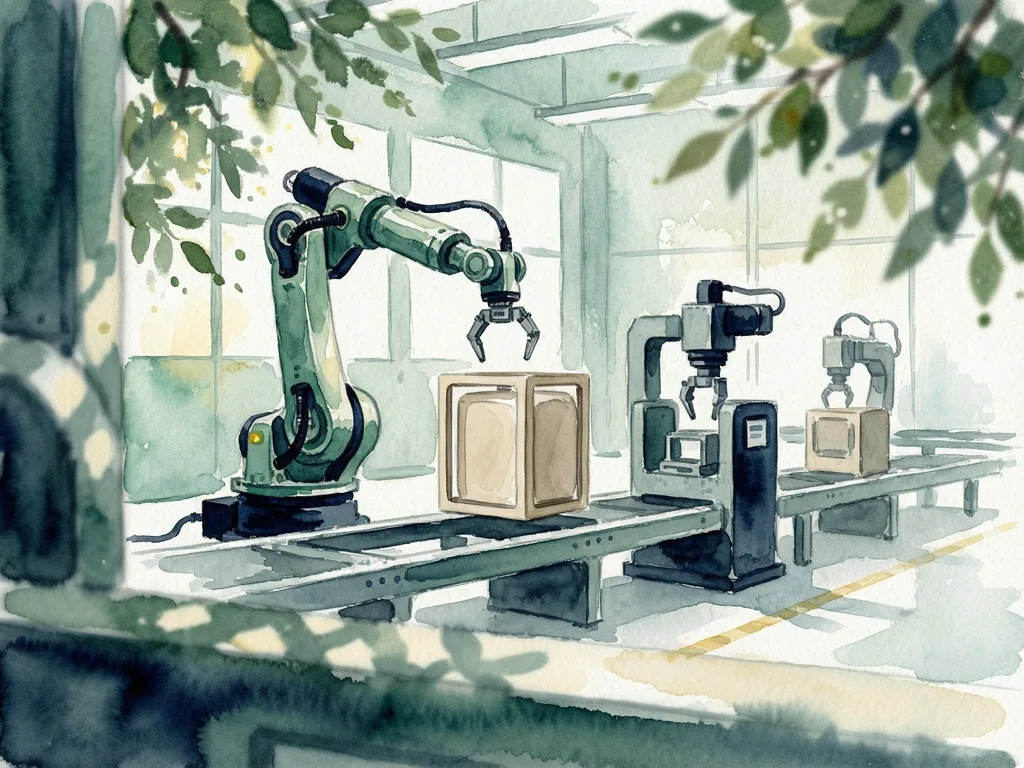
The benchmark evaluates models on industrial loading, unloading, and material-transfer tasks. It uses both simulation and a physical conveyor-belt workcell, so researchers can compare behavior in a controlled virtual environment with behavior on real hardware. The four challenges are not isolated demos; they are designed to be introduced separately and combined. That structure lets teams see whether a model degrades under one constraint, such as timing pressure, or whether performance falls further when several constraints appear together.
What the results show
In simulation, policy performance declined progressively as the constraints were introduced and combined. This pattern suggests that general-purpose embodied models may handle limited tasks well but lose reliability when industrial conditions stack up. In real-world experiments, the LIBERO-Industry co-training condition achieved higher observed target-transfer completion than the original-LIBERO condition. The result is a signal that a LIBERO-Industry co-training condition produced better performance on a physical transfer task, but it does not show that factory robots are ready for all production lines.
What readers should take away
For readers following robotics and manufacturing, LIBERO-Industry reframes industrial readiness as something that can be measured, not just demonstrated through isolated successes. The benchmark’s value is that it names the pressures that matter on a line: moving material flows, changing product geometry, strict cycle times, and tight spatial tolerances. Ultimately, LIBERO-Industry aims to make industrial readiness a measurable research target for embodied AI.




Comments (0)