
Game2Real-Bench asks whether toy games uncover and transfer visual reasoning skills to real-world settings.
Game2Real-Bench evaluates whether vision-language models that succeed in small, rule-based games can reason about real-world images. It tests 25 models using 1,000 generated game samples and 400 curated real-world samples, reporting 0.935 Pearson and Spearman correlations. The project also releases Game2Real-Dataset with nearly 24,000 game samples across 18 tasks and 65 question-answer families. Results suggest game-based scores can reflect real-world visual reasoning, while game-to-real transfer is mixed: it helps constraint reasoning but not fine-grained perception.
Key Points Summary
- Game2Real-Bench tests whether vision-language models that perform well on small, rule-based games can also transfer their visual reasoning skills to real-world image tasks.
- It evaluates 25 vision-language models using 1,000 generated game samples and 400 curated real-world samples, showing a strong 0.935 correlation between game and real-world performance.
- The benchmark links game and real-world examples through shared reasoning demands, including visual evidence interpretation, spatial reasoning, constraint handling, and state tracking.
- Game-to-real one-shot transfer results are mixed: game demonstrations help some models with constraint reasoning but can hurt fine-grained perception in real-world tasks.
- The project also releases Game2Real-Dataset, with nearly 24,000 programmatically verified game samples across 18 tasks and 65 question-answer families, to support training and evaluation.
A new benchmark called Game2Real-Bench asks whether vision-language models that perform well on small, rule-based games can also reason about images from real life. It evaluates 25 representative vision-language models on 1,000 generated game samples and 400 real-world samples, and reports a Pearson correlation of 0.935 and a Spearman correlation of 0.935 between game and real-world performance. The project also introduces Game2Real-Dataset, with nearly 24,000 game samples across 18 tasks and 65 question-answer families. The benchmark, dataset, and code are available at https://github.com/QingAnLiu/Game2Real-Bench.

Why the benchmark exists
Vision-language models are systems that process images and text together. Visual reasoning is a difficult part of that task: a model may recognize objects, but it also needs to understand visual evidence, spatial structure, constraints, and state changes. Most current evaluations rely on one of two sources. Real-world data preserve the complexity of natural scenes, while procedurally generated games provide controlled generation and verifiable answers.
The open question is whether success in simple games reflects abilities that transfer to real-world visual reasoning, or whether the games only measure narrow patterns. Game2Real-Bench was created to study that question across four capability groups: fine-grained perception, spatial reasoning, constraint reasoning, and sequential planning.
How the two sides are linked
Instead of matching tasks by how they look, the benchmark links game examples and real-world examples through the reasoning they demand. Those demands include reading visual evidence, performing spatial operations, respecting constraints, and tracking state transitions.
On the game side, 1,000 independently generated samples were built from executable task specifications, and their answers were verified programmatically. On the real-world side, 400 samples were curated from diverse real-world sources. This structure lets researchers ask a more focused question: when a game and a real-world image require the same type of reasoning, do models behave similarly?
What the model scores show
The evaluation covered 25 representative vision-language models. Performance across the game and real-world settings showed consistent trends. The Pearson correlation was 0.935, and the Spearman correlation was also 0.935. In simple terms, Pearson correlation points to a strong relationship between score levels, while Spearman correlation points to a strong relationship between model rankings.

That result is important because it gives a clearer interpretation of game-based tests. If a model performs well on procedurally generated games, it is also likely to perform well on the real-world visual reasoning samples in this benchmark. The benchmark does not prove that games capture every real-world challenge, but it suggests that toy games can reflect some reasoning patterns observed in real-world tasks.
Game-to-real transfer is mixed
The benchmark also examined whether game examples can help models solve real-world tasks. The project tested game-to-real transfer through one-shot in-context learning on four models. In this setup, a model receives a one-shot demonstration before being asked to answer a new task.
The effect varied across capabilities and models. Constraint reasoning showed positive gains for several models when game demonstrations were provided. However, fine-grained perception consistently declined with game demonstrations in the tested cases. That finding matters because fine-grained perception depends on noticing small visual details, and a game demonstration may not help a model attend to the right details in a natural image.
The mixed transfer result points to a practical caution. Game-based examples can provide useful demonstrations in selected settings, especially when the task involves rules, limits, or relationships that must be respected. But they are not a universal source of helpful prompts for every visual reasoning ability.
What the dataset adds
To support model training, Game2Real-Dataset includes nearly 24,000 game samples across 18 tasks and 65 question-answer families. Like the benchmark samples, these game samples are generated from executable task specifications and verified programmatically. For model builders, the dataset offers a controlled training resource with checkable answers. For evaluators, it complements the 1,000 game samples and 400 real-world samples used to measure cross-setting behavior.

What readers should watch next
For readers working with vision-language models, the main takeaway is that game benchmarks can be useful diagnostic tools, but they should be read alongside real-world evaluation. The strong 0.935 correlation suggests that game and real-world tasks can track similar model strengths. The one-shot transfer results suggest that game demonstrations are not automatically helpful. The most reliable use of Game2Real-Bench is to compare models, study reasoning patterns, and identify where game-based training or prompting might work.
The benchmark, dataset, and code are available at https://github.com/QingAnLiu/Game2Real-Bench.
SEO details
Meta description: Game2Real-Bench evaluates 25 vision-language models with 1,000 game and 400 real-world samples to test whether toy puzzles mirror real visual reasoning.
Tags: vision-language models, visual reasoning, Game2Real-Bench, game-to-real transfer, in-context learning
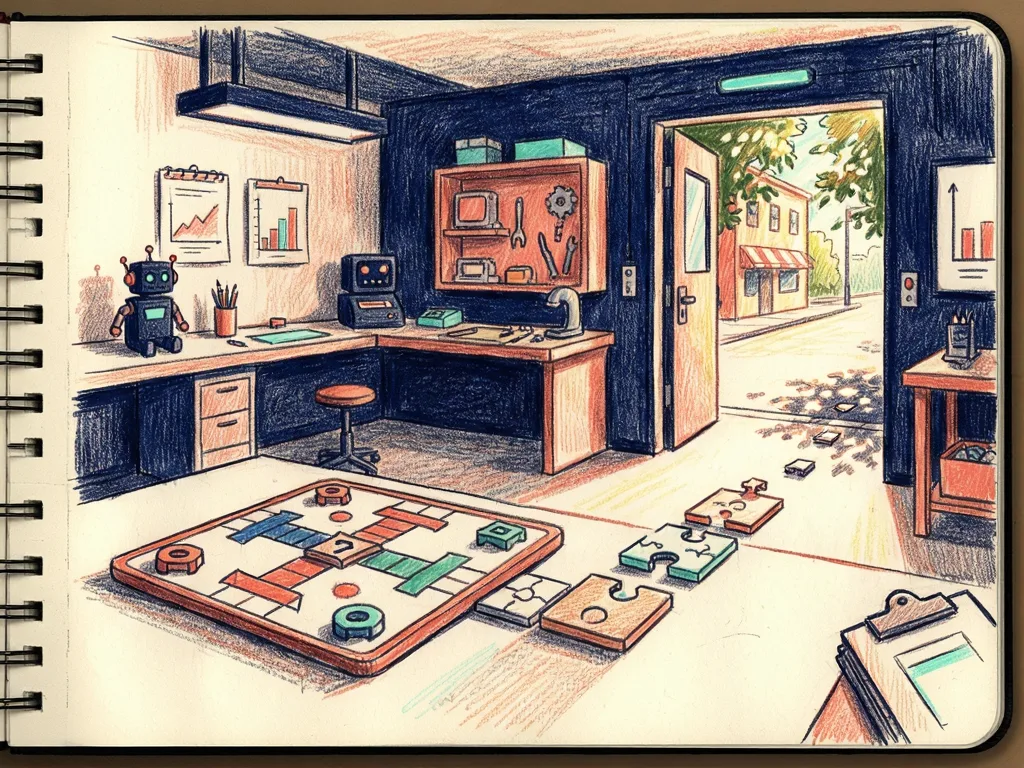
Featured image: Abstract, friendly illustration showing puzzle tiles linking to real-world objects, with no people, logos, or text.



Comments (0)