
AI gains a crystal-clear view of the materials world
MIT's multimodal AI pairs 3D crystal structures with text, beating text-only models and surfacing promising solid-state battery materials.

Key Takeaways
- MIT researchers built a multimodal AI model that links 3D crystal structures with natural language descriptions, helping address a major data bottleneck in AI-driven materials discovery.
- Text-only materials AI models struggle because crystal structures are not naturally represented in language and research literature is biased toward a limited set of common materials.
- The new model uses contrastive learning to align visual geometric structures with rich textual descriptions, including composition, properties, processing, and potential applications.
- In tests, the structure-aware model generated better material candidates than a text-only version, including promising materials for solid-state lithium-ion battery electrolytes.
- The approach could act as a step change for materials science by creating a general bridge between atomic structure and material behavior, similar in ambition to AlphaFold in biology.
Materials scientists at MIT have built a multimodal AI model that pairs 3D atomic structures with natural language descriptions, and in tests it surfaced better material designs than models trained on text alone. The work, published in Nature Communications, points to a practical way around a stubborn bottleneck in AI-driven materials discovery: the data problem.
The team was led by Ju Li, the Carl Richard Soderberg Professor in Power Engineering in the Department of Materials Science and Engineering (DMSE). Yang Jeong Park, a former MIT postdoc, is first author. The co-authors are Mayank Kumaran, a recent University of Illinois Urbana-Champaign computer engineering graduate; Chia-Wei Hsu SM '26; and Elsa Olivetti, the Jerry McAfee (1940) Professor in Engineering in DMSE.
Why text-only models struggle with crystals
The appeal of using large language models for materials discovery is easy to state: describe the material you need, and the model hands you a candidate crystal. The reality is messier.
Most solid materials are crystalline—3D periodic arrangements of atoms—and those structures live in specialized formats, not the text streams that today's large language models are trained on. The experimental literature adds a second bias: it concentrates heavily on a few popular classes of crystals, so models trained on papers tend to skew their answers toward those same materials.
Li puts the underlying issue plainly: "Structure is really at the heart of the materials science field. If you understand the structure, you can infer quite a lot about the properties and performance of materials. We wanted to build the connection between a material's atomic structure and its properties and processing for the model."
Building a model that can "see" atomic arrangements
Crystalline structures—highly ordered atomic arrangements that make up more than 90 percent of solid materials on Earth—are typically treated as 3D graphs by existing materials models. Large language models brought a new tool to the field, but their reliance on published papers and books limits their grasp of the physical world, since many potential crystal structures sit in computational databases rather than in print. Text-based models also lack any understanding of visual geometry.
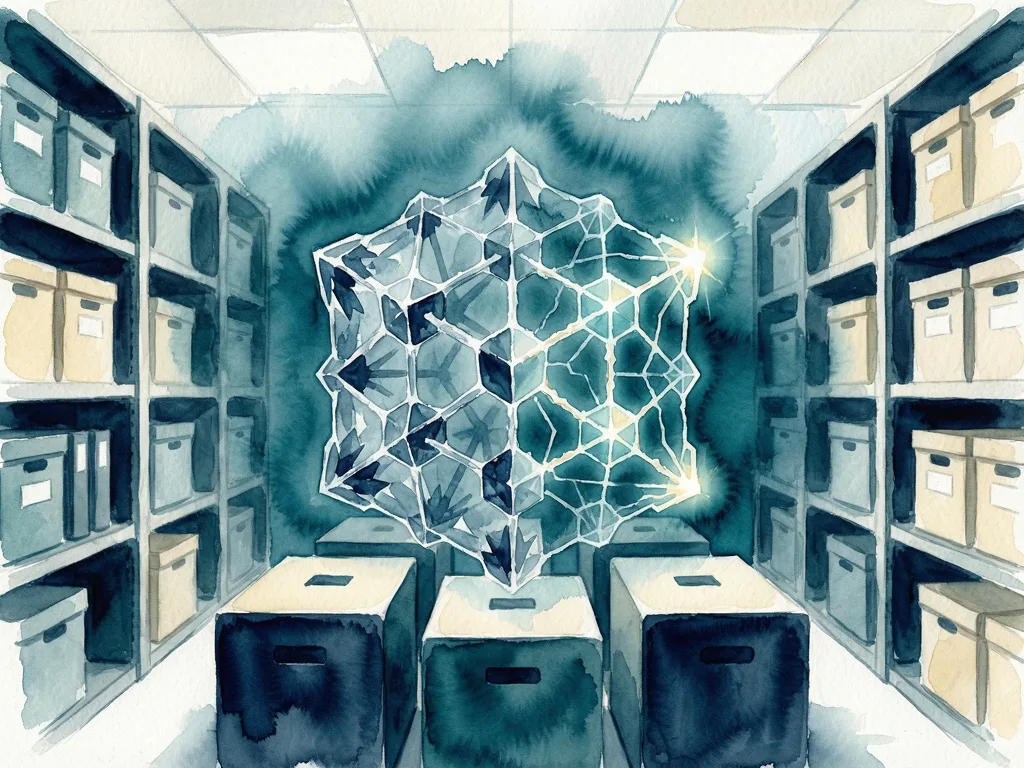
The MIT researchers responded by building a vision-language model for crystalline materials. They trained a language model to generate textual descriptions of crystal structures using contrastive learning, an approach in which the model compares similar and dissimilar examples of structures and descriptions to reach a unified understanding. The team likens the process to aligning the visual and language regions of the brain.
The descriptions themselves are unusually rich. By combining 3D atomic structures with natural language, the model produces linguistic accounts drawn from experimental research papers and first-principles computational databases. These narratives cover not just chemical composition and structure but also properties, processing considerations, and potential applications—giving the model a broader view of what makes a material useful.
What the tests showed
The researchers compared two versions of the model: one trained on a dataset containing the AI-generated descriptions, and one trained on a dataset containing text from papers only. The version trained on generated descriptions successfully learned to align geometric structures with text, while the paper-only version did not. The team also showed their model learned geometric representations of material structures in ways text-only models could not.
The headline result came from a practical query. Asked to identify materials suited for solid-state lithium-ion battery electrolytes, the model's top results included materials that had been independently identified as promising candidates.
"We wanted to create an AI model that works broadly across materials," Li says. "That's why we decided to synthesize narratives rather than rely solely on existing papers. We found when we used that narrative dataset, the models are better at predicting the function."
A possible step change for the field
Olivetti frames the result in terms of how materials science absorbs new tools. "There are sometimes these step changes within materials science around algorithmic integration toward useful tools, which the community uses to further advance the field," she says. "This approach helps us see more deeply into three-dimensional structures and link structures to property and processing. I hope this can be one of those step changes."
Li reaches for a biological comparison: AlphaFold, the AI model that links protein structures with function and has helped advance biological research and drug development. The parallel matters because it describes the ambition—not a single clever prediction, but a general bridge between structure and behavior that other researchers can build on.
The researchers believe the approach can work across many crystalline materials, and they hope other materials scientists will adopt it to accelerate their own work. "Being able to see a three-dimensional crystal and how its atoms are connected is super foundational," Li says. "I think this will be useful to anyone who practices materials science."
What to watch
The immediate significance is methodological. Instead of waiting for the experimental literature to broaden—a slow process shaped by which materials attract funding and attention—the team generated descriptions from computational databases and papers alike, then let contrastive learning tie those descriptions to geometry. That is a template other groups can reuse.
The open questions are the ones the paper does not answer: how far the approach scales beyond the crystal classes tested, and whether the model's top candidates hold up in synthesis and device testing rather than only in ranking exercises. The solid-state electrolyte result is encouraging precisely because independent work had already flagged those materials, but independent identification is not the same as a working battery component.
The work was supported, in part, by the U.S. Defense Threat Reduction Agency through the University Research Alliance; the U.S. Defense Advanced Research Projects Agency; and the National Research Foundation of Korea.




Comments (0)