
The Chunking Paradox: Why RAG Breaks Down Before Retrieval Begins
RAG failures often start at ingestion: bad chunk sizes split facts and hide context. Balanced chunks are key to accurate retrieval.

Key Takeaways
- In production RAG, answer accuracy is often determined during ingestion, because chunking defines the searchable units that retrieval can later surface.
- Bad chunking can cause critical errors even with strong LLMs: retrieval may return fragments that omit essential context or exceptions.
- Too-small chunks can create half-truths by separating rules from conditions, while too-large chunks dilute meaning in a single embedding and reduce focused retrieval.
- There is no universal “magic” chunk size; aim for the smallest self-contained unit that preserves the meaning needed for retrieval.
- Configure splitters carefully because chunk_size may count characters, not tokens, causing mismatches with embedding models and prompt budgets.
Meta description: Learn why Production RAG chunking fails when chunks are too small or too large, and how the Goldilocks problem shapes retrieval accuracy in RAG systems.

Tags: Production RAG, Chunking, Retrieval-Augmented Generation, Vector Databases, Ingestion Pipeline
Featured image: Abstract friendly illustration of documents being cut into balanced chunks, no people, logos, or text.
This Production RAG chunking guide is for engineers building production-grade Retrieval-Augmented Generation (RAG) systems that answer questions from company documents. Part 4 of the ongoing Production RAG Series, Demystifying the Ingestion Pipeline, The Goldilocks Problem of Chunk Size, and Baseline Splitting Strategies, says accuracy is often decided before a large language model (LLM) sees a question: during ingestion, when a 500-page employee handbook is split into chunks. Part 3 argued that an infinite context window is not a practical answer. Feeding hundreds of pages of company documentation into an LLM raises API costs, increases query latency, dilutes attention, and exposes the Lost in the Middle phenomenon, where buried facts are missed. The better rule is to retrieve only the specific information needed.

The Pipeline Begins Before a User Asks
A production system has two paths. The full flow is Documents to Chunking, Embeddings, Vector or Document DB, Retrieval, then LLM Prompt. Offline ingestion starts with raw sources: PDFs, Wikis, Codebases, Confluence, DBs, Tickets. It parses and cleans text, tables, code, and headers; chunks documents; enriches metadata with Breadcrumbs, page, source, and parent_id; creates embeddings, converting text into vector coordinates; then stores records in a Vector Database and Document Store. The online path embeds a user question, runs vector or keyword retrieval, returns top-K matching chunks, reranks and filters metadata, adds context to an LLM prompt, and produces an answer. The online path touches users, but the offline path sets what can be found. Chunking defines the physical units of memory the search engine later evaluates. Where to cut is the chunking dilemma. Dedicated deep dives on embeddings and vector databases are also coming.
A Quick Prototype Can Hide a Bad Split
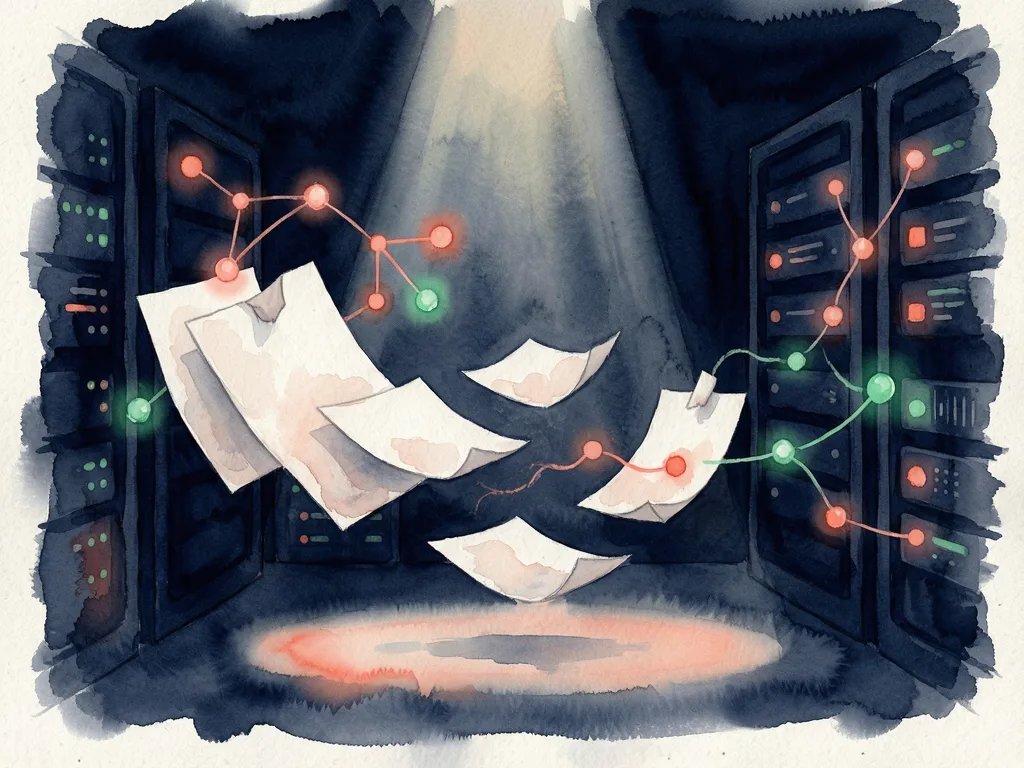
The series tells the story of a three-line quickstart. A team loads sample PDFs, uses RecursiveCharacterTextSplitter with chunk_size=1000 and chunk_overlap=200, then calls split_documents(docs). Five sample questions get five good answers. Two days later, after connecting the bot to 50,000 files—employee policies, SEC financial filings, API documentation, and architecture wikis—Slack reports errors. The bot says Q3 revenue dropped by 24%, while the official earnings release says global revenue grew by 24%. It tells an employee they are not eligible for parental leave and gives an API endpoint that does not exist. The team first suspects the LLM, upgrading from GPT-4o-mini to Claude 3.5 Sonnet, setting temperature to 0.0, and spending four hours rewriting the system prompt. Nothing works. Checking the database shows a retrieved chunk that started mid-sentence. The chunk contained decreased by 24% due to unexpected supply chain disruptions in the European sector, but the missing earlier text said global revenue grew by 24%, while regional European shipping volume decreased by 24%. Retrieval returned a fragment, not a complete thought, and the LLM had to answer from it. Search can only surface the units built during ingestion. No multi-billion-parameter LLM or reranker can reconstruct truth from a bad chunk.
Small Chunks Can Turn True Statements Into Half-Truths
There is no universal magic number. A chunk size of 100 tokens, 500 tokens, 1,000 tokens, or 2,000 tokens can be wrong for the content. Tiny chunks, such as 50 tokens or 1 to 2 sentences, may match keywords but sever context. A handbook says employees are entitled to 20 days of paid vacation per year, while contractors and interns are not eligible. If split into two pieces, a query for eligible paid vacation may retrieve only the vacation sentence, which can look like a 99% match. The bot can then tell an intern they qualify. That is a half-truth: the text was real, but chunking separated a rule from its exception. The same risk applies to conditions, definitions, and pronouns. The goal is not a rigid 400-token unit; each chunk should stand alone as a complete idea.
Large Chunks Can Blur a Focused Question
Oversized chunks create the opposite problem. Even though modern embedding models can process thousands of tokens, a 2,000-token chunk is not automatically better. A 2,000-token chunk might cover tokens 1-500 on office parking garage permits, 501-1000 on healthcare and dental coverage, 1001-1500 on Kubernetes cluster access for engineers, and 1501-2000 on client dinner expense policies and alcohol limits. An embedding model compresses the chunk into one vector, for example 768 or 1,536 numbers. Many transformer embedding models use Mean Pooling, averaging token vectors. The vector then represents four topics roughly 25% each and wastes prompt token budget. A 12-token question about maximum Food expense for a client dinner is focused. The giant chunk may get a low illustrative Cosine Similarity, such as 0.48, because 75% of the vector pulls toward parking and server clusters, while a focused 120-token chunk may score 0.89. The article notes these numbers are illustrative, not universal laws. The content is still present, but its searchable representation becomes diluted. That is semantic blur.
The Goldilocks Question and the Token-Character Trap
The practical target is the smallest text unit that preserves enough self-contained meaning for the retrieval task. Before setting chunk_size=500, ask what the splitter is counting. Characters are not tokens. A RecursiveCharacterTextSplitter can operate on character counts, while embedding models and prompt budgets use tokens, so a 500 setting may not mean 500 tokens. Part 5 will cover advanced chunking architectures: Bounded Semantic Chunking, Parent-Document Retrieval, Breadcrumbs, and Anthropic's Contextual Retrieval. For readers, the takeaway is concrete: audit chunks before tuning models. A bad cut can make a wrong answer look plausible, even when the LLM is not hallucinating.



Comments (0)