
Speculative forcing enables efficient autoregressive video generation.
Speculative Forcing accelerates autoregressive video generation by freezing tokens that already look settled, avoiding unnecessary final denoising steps. Accepted tokens remain cached as context, so the model spends computation on tokens that still need refinement. Two verifiers identify early acceptance: a training-free stability check and a learned gap estimator. Experiments report matching four-step quality with about 1.7 denoising steps per token on LongLive, running over 1.5x faster, and maintaining quality under changing camera motion with about 2.5 steps and 1.35x speedup.
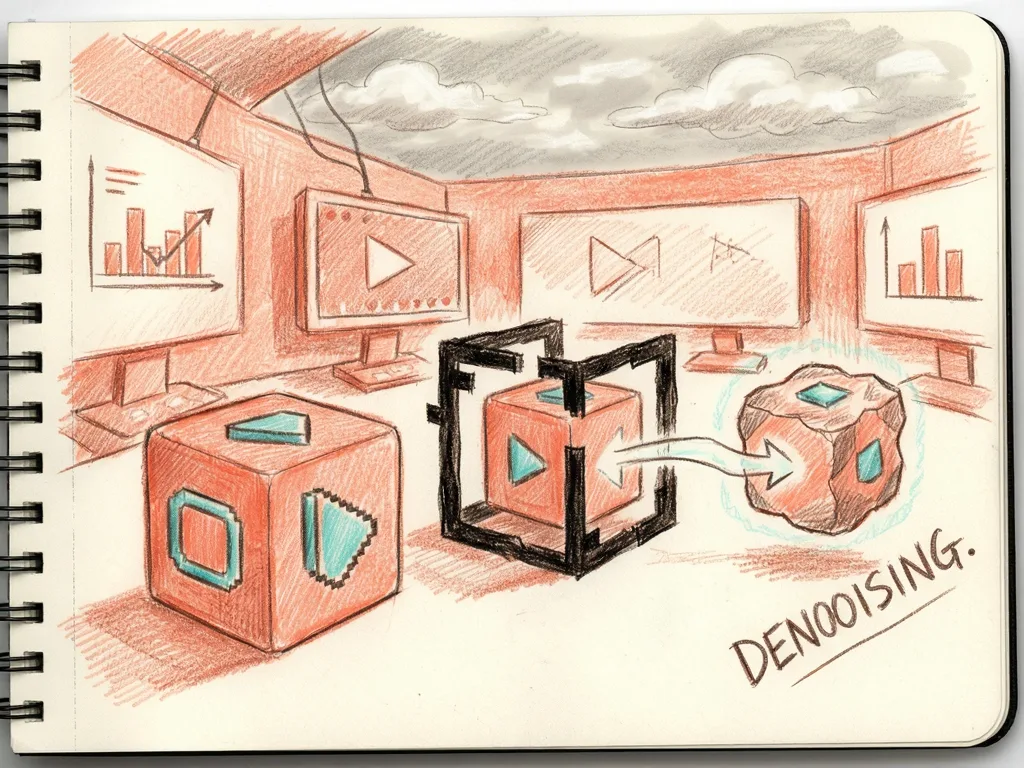
Key Takeaways
- Speculative Forcing speeds up autoregressive video generation by accepting and freezing already stable tokens early, avoiding wasted final denoising for all tokens.
- It preserves frozen tokens’ cached keys and values as context, allowing later generation to use earlier accepted content while focusing computation on tokens that still need refinement.
- The framework uses two verifier designs: a training-free method based on stability and closeness to clean output, and a learned method that uses generator features to estimate each token’s remaining refinement gap.
- Reported results show near four-step quality with about 1.7 denoising steps per token on LongLive and over 1.5x faster generation, while maintaining quality with about 2.5 steps and 1.35x speedup on dynamic Lingbot-World 2.0 scenes.
- Speed gains are workload-dependent, so builders should test verifier choice, frame rate, and quality on their own video settings before assuming similar improvements.
Speculative Forcing Speeds Video Generation With 1.7 Denoising Steps

Meta description:
Speculative Forcing speeds autoregressive video generation by freezing ready tokens early, matching four-step quality with about 1.7 denoising steps per token.
Tags:
Speculative Forcing, Video Generation, Autoregressive Models, Denoising Steps
Featured image:
abstract friendly illustration of video tokens freezing early, no real people, no logos, no text
For builders of streaming video tools, the new framework Speculative Forcing speeds up few-step autoregressive video generators by freezing tokens early. Instead of sending every token through the same final denoising step, it accepts some tokens once they look settled, freezes them as final output, and keeps their cached keys and values as context for the remaining tokens. The results show that it can match a four-step generator while using about 1.7 denoising steps per token on LongLive, and run over 1.5 times faster at 41.7 and 37.8 frames per second.
Why uniform denoising costs too much
Few-step autoregressive video generators create video one piece at a time, which is what enables streaming generation. Each piece is a token, a small unit of the sequence. In a denoising step, the model refines a noisy estimate into a cleaner estimate. The issue is that the final step is applied uniformly, even when some tokens are already close to the result that a full-step process would produce.

The analysis finds that many tokens already closely match their eventual full-step outputs in the initial steps, while others require refinement until the end. Running every token through the same final computation therefore wastes work. That waste is especially relevant for streaming use, where the model must keep producing content quickly and steadily.
How early freezing works
Speculative Forcing treats intermediate clean estimates as drafts. A draft is a candidate output that can be checked before it is accepted. The framework predicts when an individual token can be safely accepted early. Once accepted, the token is frozen as its final output and undergoes no further denoising.
The method preserves the token's role in the sequence. Its cached keys and values remain available as context for the remaining tokens. This lets the generator continue to use earlier accepted content to guide later generation, while avoiding repeated refinement of content that has already stabilized. In effect, the computation budget shifts toward the tokens that still need work.
Two ways to verify a token
The framework explores two verifier designs. The first is training-free. It judges whether a token can be accepted by comparing its draft to clean content and checking how stable the token remains across steps. If a token looks close to a clean result and changes little over time, the verifier can accept it earlier.

The second verifier is learned. It reads the frozen generator's intermediate features to estimate each token's remaining gap to its full-step output. This design uses the generator's own internal signals to predict which tokens still need refinement and which can stop being updated. Both approaches aim to preserve the quality of full-step sampling while reducing unnecessary computation.
What results show
Across short-video, long-video, and world generation, Speculative Forcing is reported to preserve the quality of full-step sampling while substantially reducing computation. On LongLive, it matches the four-step generator with about 1.7 denoising steps per token and runs over 1.5 times faster at 41.7 and 37.8 frames per second.
The result on Lingbot-World 2.0 is more demanding because camera motion continually changes the visible content. In that setting, Speculative Forcing maintains quality with about 2.5 denoising steps per token and runs 1.35 times faster at 24.5 frames per second. This shows that early acceptance can still work when the scene is changing, not only when content is stable.
What this means for readers
For builders of streaming video tools, the practical value is fewer wasted refinement steps. If many tokens settle early, the generator can stop spending time on them and move to the next part of the sequence. The reported speedups come with the claim that quality is preserved, so the method is positioned as a way to make few-step autoregressive video generation faster without changing the expected output target.
For readers evaluating real deployments, the key detail is that the savings are workload dependent. The LongLive and Lingbot-World 2.0 numbers show different step counts and speedups, so teams should test the verifier choice, frame rate, and quality on their own video settings before assuming the same gain.



Comments (0)