
Cross-Teacher Guarding Enhances Multi-Teacher On-Policy Distillation Beyond Domain-Routed Supervision.
RoadMOPD reduces teacher conflicts in multi-teacher distillation, improving student accuracy by up to 8.78 points in medical tests with Qwen3-4B.

Key Takeaways
- RoadMOPD is a multi-teacher on-policy distillation method developed by JD.com and Nanjing University to help student models learn more effectively from expert teachers with conflicting response styles.
- It reduces harmful teacher conflicts by strengthening token-level corrections supported by multiple teachers while attenuating signals where teachers disagree.
- RoadMOPD uses preventive gradient projection to suppress conflicting update directions while preserving useful learning signals for the target domain.
- In Qwen3-4B experiments, RoadMOPD improved medical accuracy by up to 8.78 percentage points over Vanilla MOPD in high-conflict Math-Medical and Code-Medical settings.
- The method is expected to be open-sourced within 1-2 months, pending internal company approval.
Meta description: RoadMOPD from JD.com and Nanjing University helps a student model learn from conflicting teachers and lifts medical accuracy by up to 8.78 percentage points.

Tags: RoadMOPD, multi-teacher training, Qwen3-4B, model distillation, AI research
Featured image: Abstract friendly illustration of teacher paths merging into one student path, no real people, no logos, no text
RoadMOPD, developed jointly by JD.com's OxygenVLM team and Nanjing University, is a training method for student models that learn from several expert teachers at once. It is aimed at readers who want to know why adding more teachers can sometimes make a model worse in one domain, and how this approach tries to keep the useful parts while reducing harmful conflicts. The reported result is a medical accuracy gain of up to 8.78 percentage points over Vanilla MOPD in high-conflict settings using Qwen3-4B.

Why multiple teachers can create noise
The core issue is not the number of teachers by itself, but the way different teachers answer. A teacher strong in one area may use a style, explanation pattern, or correction focus that clashes with another teacher strong elsewhere. When a student model receives all of these signals at the same time, useful expertise can be mixed with contradictory guidance. RoadMOPD is designed to mitigate learning conflicts among teachers with substantially different response styles and domain expertise. The goal is to help a student integrate multiple experts' capabilities while reducing degradation in individual domains.
Agreement strengthens corrections, conflict is reduced
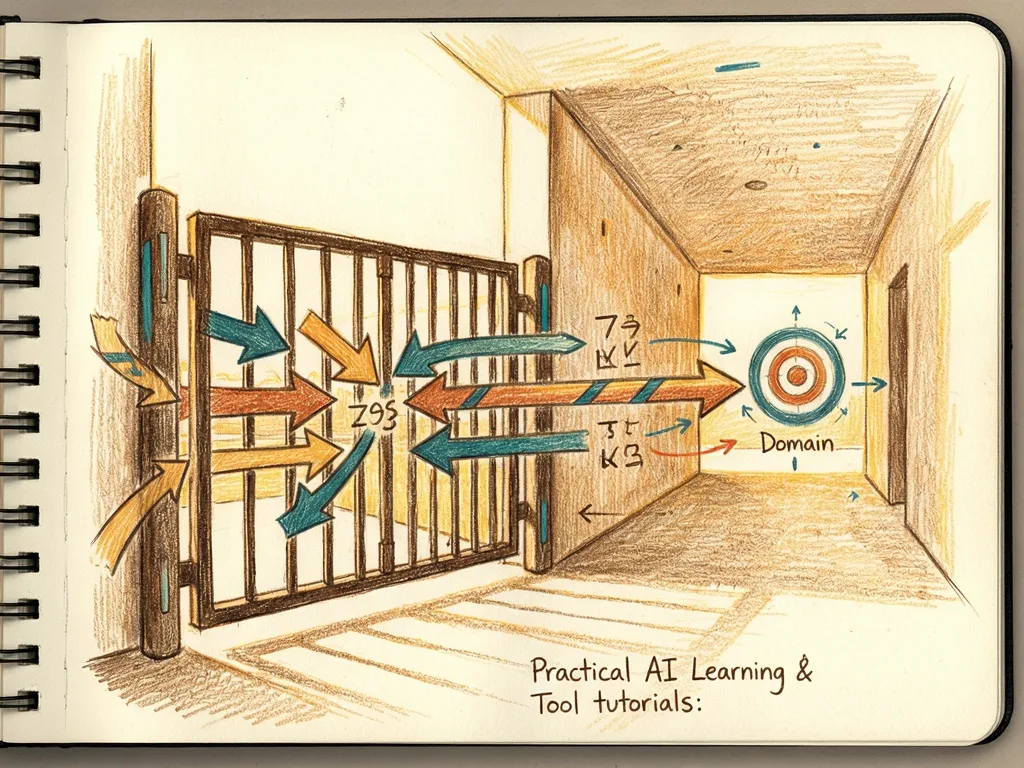
RoadMOPD brings routed and auxiliary teachers together to evaluate the same student-generated response. That shared evaluation gives the method a way to compare what the teachers support. If several teachers jointly support the same token-level correction, the correction is strengthened. A token-level correction can be understood as guidance tied to a small piece of the response, rather than only a broad judgment on the whole answer. If the teachers disagree, the conflicting signal is attenuated instead of being passed on with the same force.
The next step is Preventive gradient projection. A gradient represents the direction in which the model is being updated during training. RoadMOPD uses this projection to suppress update components that reflect teacher conflict, while adaptively preserving the learning signal for the target domain. In practical terms, this means the method does not simply mute every disagreement. It tries to keep the parts of the update that help the domain being trained on, and reduce the parts that push the student in opposing directions.
Qwen3-4B results in high-conflict domains
The reported results use Qwen3-4B. In the high-conflict Math-Medical and Code-Medical settings, RoadMOPD improves both domains over Vanilla MOPD. The largest reported figure is an increase in average medical accuracy by up to 8.78 percentage points. The method also shows benefits in the more compatible Math-Code combination. Under joint Math-Code-Medical training, improvements are reported across all three domains: math, code, and medical.
These settings are useful because they test different levels of teacher compatibility. Math and medical, or code and medical, are described as high-conflict, while math and code are described as more compatible. The reported gains suggest that reducing teacher conflict is most visible when the teachers pull the student in different directions, but it can still help when the domains are closer.
What readers can expect next
The code is currently undergoing internal company approval for open-source release. The expected release window is within the next 1-2 months. For readers, that means the implementation may become available for inspection soon, although no fixed date is given. The main takeaway is that RoadMOPD addresses a concrete training failure mode: a student model losing domain-specific performance because multiple expert teachers disagree. By strengthening agreement, attenuating conflict, and projecting gradients, it aims to make multi-teacher learning more stable, with a reported medical accuracy gain of up to 8.78 percentage points.


Comments (0)