
Evolving scientific agent swarms enable recursive self-improvement.
SwarmRSI turns failed AI science runs into reusable state, sharing hypotheses, code, evidence, and needs; scores improved across 118 tasks.
Key Takeaways
- SwarmRSI improves AI science agents by storing and reusing failed or partial experiment results instead of discarding them.
- It uses a shared graph to record hypotheses, programs, evidence, and unresolved needs, allowing later agents to build on earlier work.
- The method combines feedback-guided mutation, complementary recombination, and recursive evolution to repair programs and mix useful components.
- Across 118 tasks, SwarmRSI reports strong benchmark results, including 76.2 on OpenProblems and SOTA matching on 44.4% of NatureBench tasks.
- The main insight is that progress may come more from better reuse of agent discoveries than from simply adding more agents or scaling models.
SwarmRSI Turns Failed AI Science Runs Into Useful Clues Across 118 Tasks
For researchers and developers who run multiple AI science agents in parallel, a new paper introduces SwarmRSI, a method that turns discarded experiment results into reusable research state. Instead of treating each agent run as a separate pass or fail score, the method records hypotheses, programs, evidence, and open needs in a shared graph, then reuses parts across later agents. The paper reports results across 118 scientific coding and ML engineering tasks. The paper is available at https://arxiv.org/abs/2610.20431.
The problem: parallel agents can waste useful information
Running more agents at the same time does not automatically make a research system smarter. The paper describes two failure modes. First, when an experiment fails, the record may not show whether the scientific hypothesis was wrong or the code was faulty. Second, a program that produces no overall gain may still contain one component another agent could use. Without a way to separate these cases, promising ideas can be abandoned and useful pieces can be buried.
SwarmRSI changes what agents inherit
SwarmRSI, Recursive Self-Improvement through Evolving Scientific Agent Swarm, evolves the information passed between agents rather than only selecting the highest-scoring result. Its shared graph holds each research state: the hypothesis, the program that tested it, experimental evidence, and open needs.
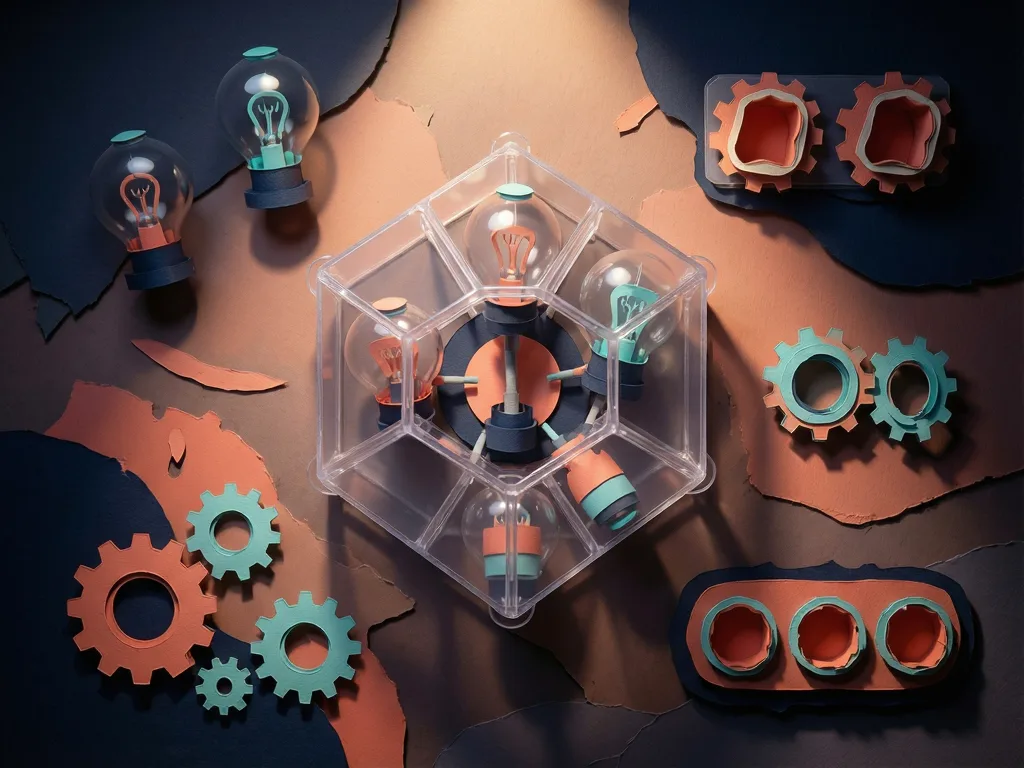
Three mechanisms guide the evolution. Feedback-Guided Swarm Mutation uses signals from other agents to decide whether to revise a hypothesis or repair a program. Complementary Swarm Recombination has two moves: rebase, which tests kept hypotheses on programs from other agents, and crossover, which merges complementary program components. Recursive Swarm Evolution sends every outcome back into the graph, whether it succeeded, failed, or made no gain, so the next agent can start from a more complete picture.
Benchmark results point to reuse, not just scale
On 118 tasks, the paper reports a 76.2 average score on OpenProblems (single-cell), compared with 57.2 for human experts and 67.1 for TusoAI. On NatureBench, it reports matching published state-of-the-art results on 44.4% of the benchmark’s 90 tasks, the highest among the compared methods; the best Claude Code setup reaches 35.6%. On MLE-Bench Lite competitions, the paper reports medals on 81.8%, above Arbor and MLEvolve.
The paper also gives a reuse signal: about 77% of the final best NatureBench programs come from a rebase, a crossover, or a feedback-triggered update. That suggests the gains are not only from producing more programs, but from recombining and repairing existing ones. As a practical note, biologists reproduced two of its programs and used them in follow-up studies of intestinal and splenic immunity.
What readers should watch
The paper’s larger claim is modest: the next advance in AI science may come less from adding agents or scaling models and more from making sure what one agent learns changes where the next one begins. For anyone building scientific agent swarms, the open question is how far a shared graph can reduce wasted work without adding excessive overhead or leaking one context into another.
Featured image: Abstract friendly illustration of connected experiment cards, arrows, and mutation markers, with no real people, logos, or text.
Meta description: SwarmRSI turns failed AI science runs into reusable clues with a shared graph, reporting 76.2 on OpenProblems and 44.4% NatureBench state-of-the-art matches.
Tags: AI science agents, SwarmRSI, benchmark results, agent swarms


Comments (0)