
Selecting the Best Agentic AI Framework for 2026 Using a Decision Tree
Choose 2026 agentic AI frameworks for production with a seven-step decision tree covering state, tools, guardrails, evaluation, cost, and deployment.

Key Takeaways
- Use a seven-step decision tree to choose an agentic AI framework for production, focusing on state, tools, guardrails, observability, evaluation, cost, and deployment rather than framework names.
- Match the framework to the system’s operational profile: simple chatbots may need only thin orchestration, while multi-agent workflows require explicit state management, approvals, tracing, and rollback.
- Define the task and required autonomy level carefully, reserving high autonomy for low-risk tasks with strong monitoring and deterministic guardrails.
- Prioritize production controls over demo features, including typed tool inputs, retries, timeouts, rate limits, sandboxing, structured error handling, and kill switches.
- Build evaluation and observability early, with realistic tasks, failure scenarios, and full run tracing so teams can debug and reproduce agent behavior reliably.
Meta description: Use a seven-step decision tree to choose an agentic AI framework for production, covering state, tools, guardrails, evaluations, cost and deployment.

Tags: agentic AI, production systems, AI frameworks, decision tree, LLM agents
Featured image: abstract illustration of a friendly branching decision tree connecting small robot-like nodes, with soft gradients and no text
For engineering teams moving from prototype to production, a structured seven-step decision tree can help choose the right agentic AI framework for a production system. The approach replaces vague feature comparisons with checks on state, tool calling, guardrails, evaluation, cost and deployment. Agentic AI here means software that can plan, call tools, keep context and take actions toward a goal with limited step-by-step human prompting. This is for platform owners, application builders and technical leads who need agents to run reliably, not just demo well.
Why the Framework Choice Becomes a Production Risk
In a prototype, the model can often do most of the work. It receives a prompt, returns an answer, and the developer manually fixes the next step. In production, that pattern breaks down. An agent may call APIs, read databases, trigger workflows, ask users for confirmation, retry failed actions and keep state across long conversations or tasks. The framework starts to determine how visible those steps are, how recoverable failures are, and how safely the system can act without a human watching every call.
Teams often compare options such as LangGraph, AutoGen, CrewAI, Semantic Kernel and LlamaIndex agents, but the framework name should not decide the answer. The question is whether the framework matches the operational profile of the system. A simple chatbot with tools may need a thin orchestration layer. A multi-agent workflow that writes to internal systems may need explicit state management, approval gates, tracing and rollback. The wrong choice can create hidden loops, unclear ownership of errors, security gaps and surprise model costs.
A Seven-Step Decision Tree for Production Teams
1. Define the task and the level of autonomy
Start with the job the agent must perform. Is it answering questions, drafting content, routing tickets, updating records, running code, calling external services or coordinating several models? Then decide how much independence it should have. A production system rarely needs fully autonomous action on every task. Low autonomy may mean the agent suggests an action and a human approves it. Medium autonomy may allow safe actions automatically and block risky ones. High autonomy should be reserved for tasks with limited blast radius and strong monitoring.
If the task is mostly retrieval and one model call, a full agentic framework may be unnecessary. If the task requires planning, tool use, retries and stateful workflow control, a framework becomes useful.

2. Map required state and memory
State is often where production agents become complicated. Some systems only need conversation history. Others need workflow state: what step is active, which tool already ran, what data was fetched, what failed, and whether a human should be notified.
Ask whether the framework supports explicit state objects, checkpoints, resumable runs, timeouts and human-in-the-loop pauses. If the agent may stop and restart because of a user delay, an API timeout or a deployment update, the system needs a way to resume without repeating side effects. If the application is stateless and short-lived, a lighter stack may be enough.
3. Check tool calling and execution controls
Agents become useful when they can interact with the outside world, but that is also where risk enters. Review the tools the agent will use: search APIs, internal services, databases, email, file access, code execution, payments or admin actions. The framework should support clear tool definitions, typed inputs where possible, retries, timeouts, rate limits and structured error handling.
For production, execution controls matter more than demo-friendly tool lists. If a tool can change data, the system should know who authorized the call, what the expected outcome was and how to stop repeated calls after a failure. If code execution is involved, sandboxing and permission boundaries are not optional features.
4. Evaluate observability and debugging
A production agent can fail in ways that are hard to reproduce. The model may choose the wrong tool, skip a step, repeat a call or misinterpret context. Without observability, teams end up guessing. Look for traces that show each model call, tool input, tool output, latency, token usage and error path. A useful framework should make it possible to reconstruct a run after the fact.
If the framework does not provide strong tracing, check whether it can be wrapped with standard logging or observability tools. The key question is simple: when a user reports a bad output, can the team find the exact step that caused it?
5. Set guardrails before granting autonomy
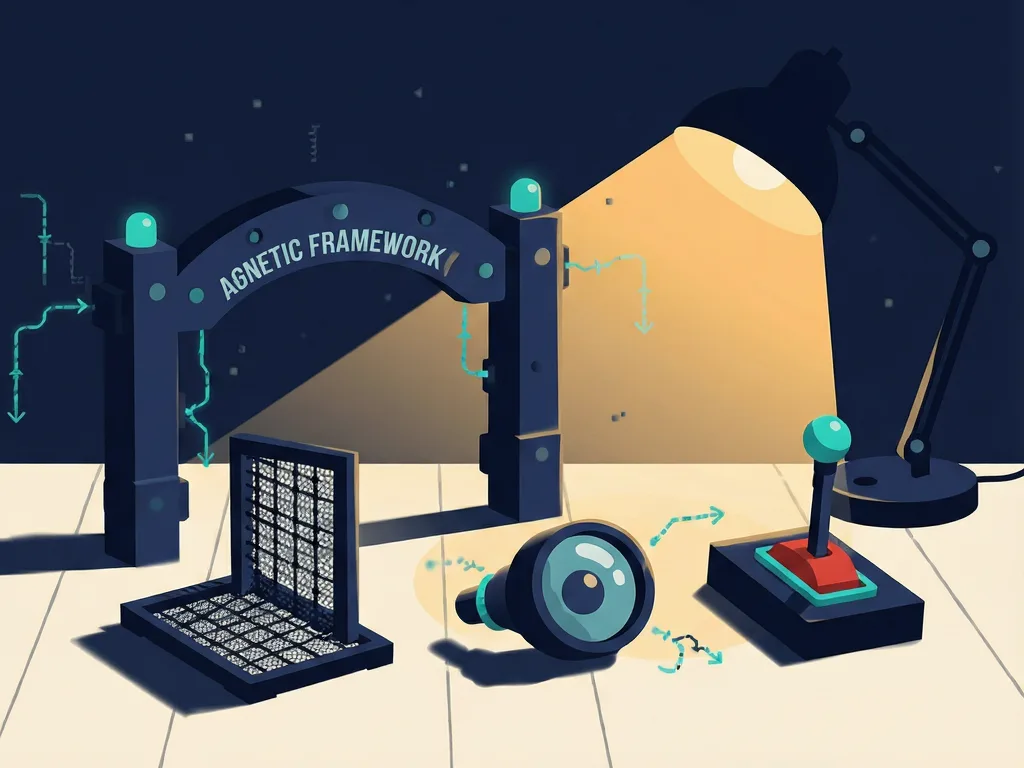
Guardrails are the controls that keep an agent inside acceptable behavior. They can include input filtering, output validation, policy rules, allowlists, blocklists, confirmation prompts, usage limits and kill switches. A good production setup treats guardrails as deterministic checks, not only as model instructions.
Ask where guardrails live: in the framework, in middleware, in the tool layer or in the application. If guardrails are scattered across prompts and one-off code, maintenance becomes fragile. The framework should make it easy to apply consistent rules across agents and workflows.
6. Build evaluation before deployment
Evaluation is not a final step. It should be part of the selection process. Teams need a small set of realistic tasks, expected tool calls, failure scenarios and acceptable outputs. These tests should cover normal use, edge cases, refusals, retries, long conversations and high-risk actions.
If a framework makes it hard to run repeatable evaluations, that is a warning sign. Production agents need measurable regressions. Without evaluation, a model upgrade, prompt change or tool update can quietly break behavior.
7. Decide the operational model and deployment path
The last step is operations. Will the system run inside the company’s infrastructure, through a managed service, or as part of a larger platform? How will it scale, rotate secrets, handle concurrency, monitor cost and respond to incidents? Teams also need to decide how model providers will be swapped if one service changes limits, pricing or reliability.
If the team lacks platform or incident-response experience, a simpler managed setup may reduce risk. If the team needs deep control over data, tools and workflow state, a framework that supports self-hosting and explicit orchestration may be better.
Common mistakes
- Choosing a framework because it is popular instead of because it matches the task.
- Treating chat memory as if it were reliable application state.
- Giving an agent write access before defining approval rules and rollback.
- Skipping traceability and expecting model logs to explain production failures.
- Testing only happy paths and ignoring timeouts, repeated tool calls and partial failures.
- Ignoring cost per task, especially when agents call large models repeatedly.
- Making the framework decision permanent instead of revisiting it after deployment data arrives.
The practical follow-up is to start with a narrow production pilot, measure tool success rates, human correction rates, latency and cost, then expand autonomy only when the system behaves predictably. The right agentic AI framework is the one that makes failures visible, recoverable and auditable, not the one that produces the most impressive demo.



Comments (0)