
How Can AI Agents Safely Process Untrusted Sources?
AI agents reading untrusted sources need architectural guardrails to prevent prompt injection from turning malicious text into privileged actions.

Key Takeaways
- AI agents that browse, read files, or process external content face prompt injection risks when untrusted input can influence privileged actions.
- Safety should come from architectural guardrails, not just polite prompts, by separating reading from acting and treating untrusted content as data.
- Provenance tracking, least-privilege permissions, and validation before irreversible actions reduce the chance of harmful execution.
- Practical workflows should include filtering, policy checks, and audit-friendly boundaries so teams can trace failures and control risk.
- The core lesson for builders is that reading a source must not automatically mean obeying it.
Meta description: Learn how AI agents can read untrusted sources safely by adding architectural guardrails, validation, and workflow controls to reduce prompt injection risks.
Tags: AI agents, untrusted sources, prompt injection, agent security, workflow guardrails
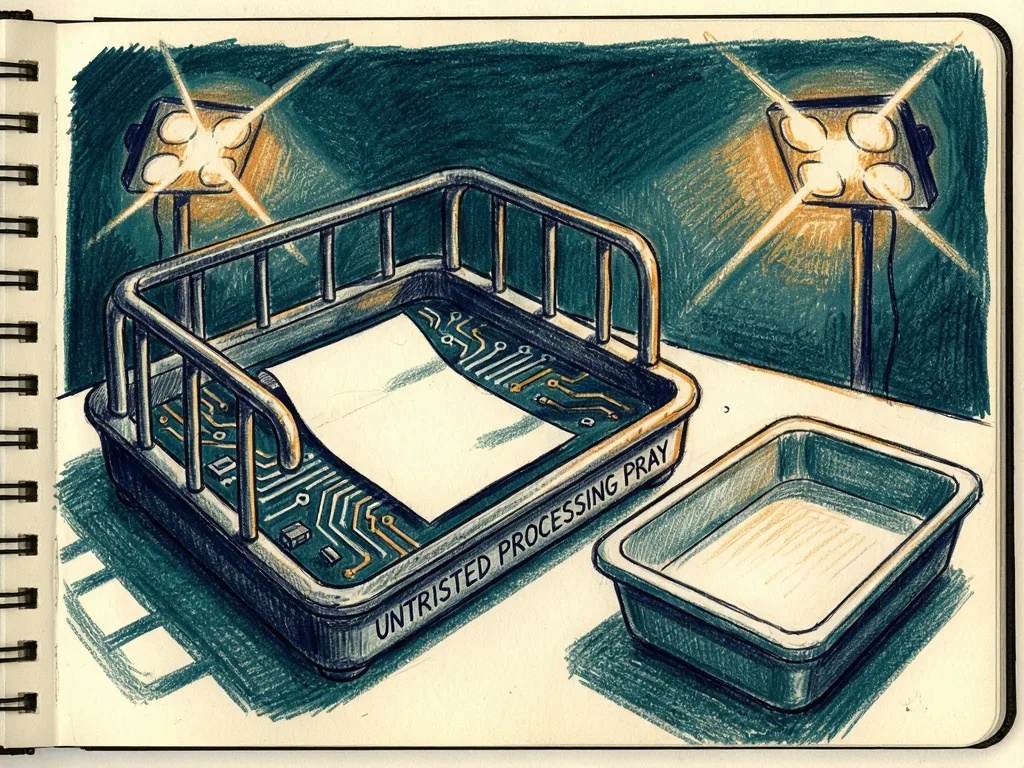
Featured image: Abstract, friendly illustration of an AI agent reading floating documents behind a shield-like filter, with no real people, logos, or text.
A post titled “How Can AI Agents Read Untrusted Sources Safely?” appeared first on Towards Data Science. It argues that AI agents that browse the web, open email, or ingest files should not treat every external source as equally trustworthy. The advice is to add architectural guardrails around how agents read untrusted sources and how those sources are allowed to influence the workflow. For teams building or operating agent systems, the point is practical: safety depends less on hoping the model behaves politely and more on designing the system so untrusted input cannot easily become privileged action.
Why untrusted content becomes a control problem
An AI agent differs from a simple chatbot when it can retrieve information, choose tools, write files, send messages, or trigger downstream systems. That capability creates value, but it also expands the attack surface. A webpage, PDF, spreadsheet, email, or ticket comment may contain normal content, hidden instructions, or misleading text. If the agent reads it and then acts, the content has moved from observation into operation.
This is where prompt injection becomes relevant. Prompt injection is a technique where text supplied to a model tries to override the developer’s instructions with its own commands. A malicious document might tell the agent to ignore earlier rules, reveal private data, call an API, or change its behavior in a later step. The risk is not only that the model produces a bad answer, but that the system takes a bad action.

The Towards Data Science post frames the problem in a way that is useful for engineers and product teams: the important question is not only whether an agent can understand a source, but whether the architecture lets that source affect sensitive steps in the workflow.
What architectural guardrails mean in practice
Architectural guardrails are system-level controls placed around agent behavior, rather than a single prompt that says “be safe.” They define what the agent may read, how it should interpret that reading, and what it may do next.
A useful starting point is to separate reading from acting. An agent can fetch a document, summarize it, and classify its trust level without giving that document permission to issue commands. Once the content is inside a controlled channel, the system can ask whether it should be treated as data, as instructions, or as both. In many cases, the safest answer is that untrusted content should be treated as data.
Another guardrail is provenance. The system should know where each piece of context came from: a public website, a private repository, a user upload, an internal ticket, or a third-party API. Provenance lets the workflow apply different rules to different sources. A source that is public and unverified may be allowed to inform a draft but not to trigger a refund, send a message, or edit a database.
Least privilege is also central. If an agent needs to read a source to answer a question, it should not automatically receive credentials to modify that source or access unrelated systems. Narrow permissions reduce the damage caused by a bad interpretation, a misleading document, or a compromised external page.
Validation before action is the final common control. Before an agent performs an irreversible or sensitive step, the system can require checks: a human approval, a deterministic policy check, a sandboxed dry run, or a second review from a model given only the original task and the proposed action. The goal is to stop a risky path before it becomes an event in the real world.

How to apply the advice to agent workflows
For teams already using retrieval, browsing, or tool-calling agents, the post suggests a design review rather than a model swap. Ask what sources are untrusted, what actions those sources can influence, and what happens if a document contains hidden instructions. Then map each step of the workflow and add controls at the boundaries.
A simple pattern is to run untrusted content through a filter stage. The filter can remove or mark suspicious instructions, strip formatting that hides text, summarize the content into a controlled data format, or route it to a low-authority context window. The next stage can then decide whether the summary is sufficient for the task. If the task requires action, a policy layer should evaluate the proposed action against the user’s original intent and the system’s allowed operations.
This approach also helps with debugging and auditing. When an agent behaves badly, a team can trace whether the problem came from retrieval, interpretation, tool selection, or execution. Without guardrails, those layers are mixed together, and failures become hard to reproduce.
What the shift means for builders
The broader lesson is that agent security is becoming a workflow design problem. As AI agents move from answering questions to completing tasks, the most important safety layer is not a warning in the prompt. It is the boundary between untrusted information and privileged action.
For readers building agents, the practical takeaway is to start by assuming that external content may be misleading, incomplete, or adversarial. Then design the architecture so that reading a source does not automatically mean obeying it. That distinction is the core of making AI agents read untrusted sources safely.





Comments (0)