
An agentic feedback loop, not a chatbot interface, is what truly makes an AI an agent.
AI agents self-correct by perceiving, reasoning, acting, and observing. This guide explains the agentic loop, ReAct, Python examples and failure modes.

Key Takeaways
- An AI agent is defined by an agentic feedback loop—perceive, reason, act, observe—not by a one-shot chatbot interface.
- The loop’s core value is self-correction: agents use real results from tools, code, tests, or the environment to adjust and finish tasks.
- Named patterns such as ReAct, evaluator-optimizer loops, human-in-the-loop, and inner/outer loops all rely on this same feedback mechanism.
- Coding agents like Claude Code, Cursor, and Copilot agent mode demonstrate the loop by reading errors, making changes, running checks, and repeating until success.
- A minimal Python example shows that an agent needs action plus observation, not just model replies, to behave as a true agent.
The Agentic Loop Explained: How AI Agents Correct Themselves Step by Step
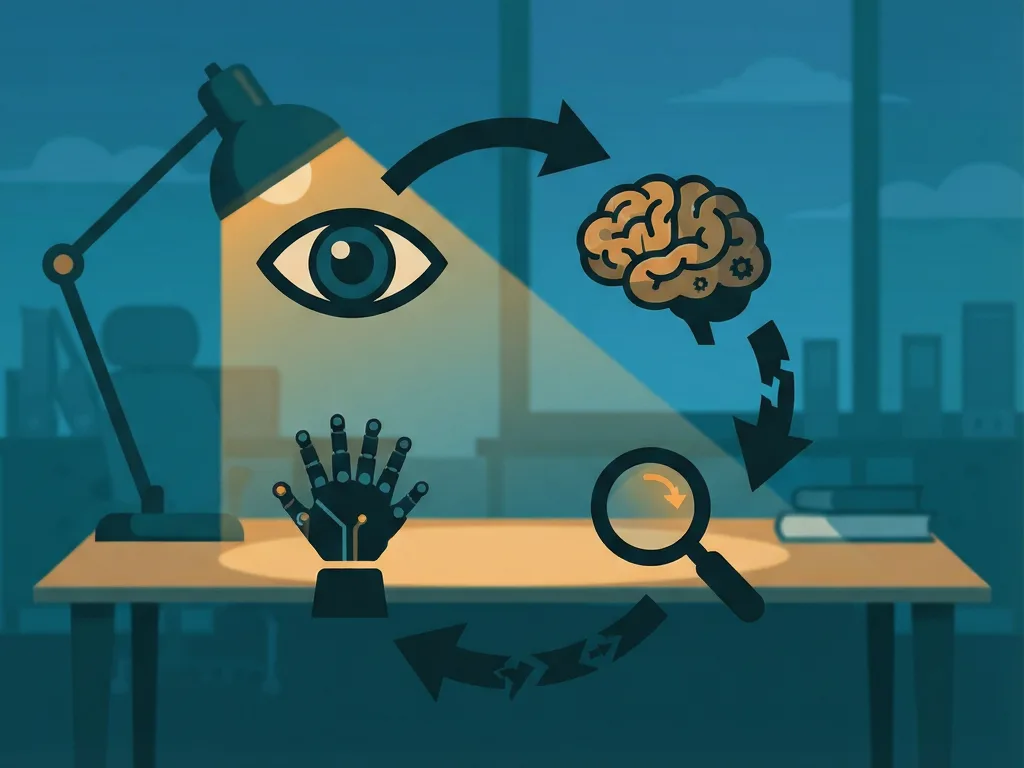
Meta Description: Learn how the agentic loop lets AI agents perceive, reason, act, observe, correct mistakes, and finish tasks with simple practical Python examples.
Tags: agentic loop, AI agents, feedback loop, Python, ReAct
Featured Image: Abstract friendly illustration of a circular loop with four connected steps, no real people, no logos, no text.
If you are trying to understand why some AI assistants only answer questions while others complete tasks, the agentic loop is the key. It is the repeated cycle of seeing the situation, deciding the next move, taking an action, and learning from the result. This guide explains the loop in plain words, shows a small Python example, and covers the places where production agents fail.
What the Agentic Loop Is
Think about the last time you used Google Maps. You did not get one fixed route at the start and then drive without checking anything. If you missed a turn, the app noticed, recalculated, and kept guiding you until you arrived. That recalculation is the basic idea behind an agent.
A plain chatbot is more like a vending machine. You press a button, you get one thing back, and the interaction ends. An agent is closer to a personal assistant. If you say, "book me a trip to Goa under ₹20,000," the assistant checks flights, finds one option too expensive, tries other dates, compares hotels, and only comes back when the job is done.
Anthropic describes this difference in its guide on building effective agents. An agent is not just a model that replies once. It is a system that acts, checks what happened, and adjusts. The same pattern is often called the agentic loop, the agent loop, or the feedback loop.
The Four Steps and Why Feedback Matters
The loop can be described with four steps.
Step 1 is perceive. The agent reads the current situation. This may include the original task, the history of earlier steps, and any new input.
Step 2 is reason. The agent decides what to do next. It may ask a question, call a tool, open a file, run code, search for information, or prepare a final answer.
Step 3 is act. The agent performs the chosen action. This could be a tool call, an API request, a file edit, a database query, or a command execution.
Step 4 is observe. The agent reads the result of the action and folds it back into its state. The result becomes part of the next perception step.
The loop repeats until the task is complete.
The feedback part is what turns a chain of steps into a loop. Without observation, the agent is just answering, then answering again, then answering again. With observation, it can see that something failed, changed, or became incomplete, and then correct itself.
Anthropic says it is crucial for agents to gain ground truth from the environment at each step. That ground truth can be a tool call result, a code execution result, a test result, or any other evidence from the outside world.
ReAct research combined reasoning with acting. Oracle’s summary says models perform significantly better when they can reason, act, observe, and reason again, with a 34% absolute improvement in success rate on ALFWorld and 10% on WebShop. A recent agent cybernetics paper argues that the absence of robust closed-loop feedback is a fundamental architectural bottleneck.
There are several named variations of this same pattern.
The ReAct loop comes from a 2022 research paper. The model alternates between reasoning traces and actions, such as calling tools or querying databases.
The evaluator-optimizer loop uses one LLM call to generate a response while another provides evaluation and feedback in a loop. It is like a writer and an editor passing a draft back and forth.
The human-in-the-loop pattern lets agents pause for human feedback at checkpoints or when they hit blockers.
The agent cybernetics paper also describes inner and outer loops. The inner loop keeps the current goal on track. The outer loop restructures the goal itself when the current approach is clearly inadequate. A simple version is that the inner loop fixes a failing test, while the outer loop decides the whole approach is wrong.
A real coding agent uses this same pattern. Tools like Claude Code, Cursor, and Copilot’s agent mode perceive by reading files, error messages, and user requests. They reason by deciding what to investigate or change. They act by editing code, running commands, hitting APIs, running tools, and searching docs. They observe by checking test results and reading outputs.
One example is debugging. The agent reads the error message. It thinks about what may be wrong and decides to open a specific file. It examines the content. It observes that a function signature does not match the call. Then it edits the code, reruns the tests, and keeps going until the tests pass or it reaches a step limit.
Every loop needs an exit. More on that below.

Build a Small Loop in Python
A minimal agent can be built with the OpenAI Python SDK and tool calling. The weather data below is fake because the point is the loop, not the weather service.
The following example uses the same tool names from the source: get_weather and celsius_to_fahrenheit.
import json
fake_weather = {"Pune": "10C", "Oslo": "12C"}
def get_weather(city):
return fake_weather.get(city, "no data")
def celsius_to_fahrenheit(value):
return float(value.replace("C", "")) * 9 / 5 + 32
tools = {
"get_weather": get_weather,
"celsius_to_fahrenheit": celsius_to_fahrenheit,
}
messages = [
{"role": "user", "content": "Compare the weather in Pune and Oslo in Fahrenheit."}
]
while True:
Replace this with a real model call that can request tools.
model_step = ask_llm(messages, tools)
if model_step["type"] == "final":
print(model_step["content"])
break
for call in model_step.get("tool_calls", []):
result = tools[call["name"]](**call["arguments"])
messages.append({
"role": "tool",
"name": call["name"],
"content": str(result),
})
What happens in the source example is useful. The model calls get_weather("Pune") and get_weather("Oslo"). Those results are appended to messages. That is the observe step. On the next pass, the model sees the temperatures and calls celsius_to_fahrenheit. After that result is fed back, it writes the final answer and the loop exits.
You do not need to write, "first get weather, then convert." The model chooses that path from the feedback. That is the point.
Frameworks hide the loop, but the same structure is underneath. In the OpenAI Agents SDK, the runner loop works like this. It calls the LLM for the current agent with the current input. If the output is classified as a final output, the loop ends and the result is returned. If the LLM requests a handoff, the current agent and input are updated, and the loop re-runs. If the LLM produces tool calls, those run, the results are appended, and the loop re-runs.
Two details matter. By default, the first LLM response without any tool calls or handoffs counts as the final output when no output type is set. The max_turns parameter limits the number of loop executions. If the agent cannot finish in time, it signals that the task was not completed within the specified number of agent-loop turns.
There is also a self-correcting loop that uses test results as feedback. Anthropic notes that coding agents can iterate on solutions using test results as feedback.
A simple skeleton looks like this.
def run_test():
Replace this with your test runner.
return "failure output"
prompt = "Write the code."
while True:
code = ask_llm(prompt)
test_output = run_test()
if test_output == "pass":
break
prompt = "Fix this code. Failure output: " + test_output
The important line is where failure output becomes the next input. That is the feedback loop in one sentence.
Stop Conditions, Guardrails, and Real-World Failures

A loop with no exit is very expensive. The first examples need stop conditions.
Max steps or turns is the simplest guardrail. A loop should not run forever. Natural completion is another exit: the agent returns a final answer instead of asking for another action.
Blank Result is also important. A blank result is 100% valid output. It may occur because of an empty return statement or because some condition returns nothing. Instead of treating it automatically as an error, handle it wisely inside the loop.
Limits on tokens, cost, and wall-clock time are also needed. Risky actions need gates. Payments, deletions, emails, and anything irreversible should require stronger review.
Repeat detection is another useful guardrail. If the agent calls the same tool with the same arguments three times in a row, stop and escalate.
A small repeat detector can be added to a loop.
from collections import deque
recent_calls = deque(maxlen=3)
def is_stuck(tool_name, arguments):
signature = (tool_name, json.dumps(arguments, sort_keys=True))
recent_calls.append(signature)
return len(recent_calls) == 3 and len(set(recent_calls)) == 1
Before each tool runs, check whether the agent is stuck. If it returns true, break out of the loop.
Guardrails should also sit at the edges, wherever the loop touches the outside world. Validate tool inputs and tool outputs.
Loops can break in real production.
One problem is errors compounding. Anthropic’s evaluation team notes that agents modify state in the environment and adapt as they go. That means small mistakes can propagate and become bigger. Verify after risky steps, keep actions small, and make them reversible when possible.
Another problem is bad perception or observation. One analysis argues that most production failures start at the perceive or observe step, not the reasoning step. Think of a driver with a dirty windshield. The driver is not necessarily bad; they just cannot see clearly.
The fix is to return clean, short, structured tool outputs. Do not dump 5,000 lines of logs into the next prompt.
A third problem is goal drift. Over long runs, the original task can become diluted. The agent cybernetics paper says the original task specification becomes semantically diluted over extended contexts, so the effective objective diverges from the intended one.
The fix is to restate the goal periodically. Keep the original task visible, shorten the context when needed, and make the agent check whether it is still solving the problem that was requested.
Common Mistakes
The first mistake is treating an agent like a chatbot. If the system answers once and stops, it is not really an agent loop.
The second mistake is forgetting the exit. Without max turns, natural completion, blank-result handling, or a final output condition, the loop can run for too long.
The third mistake is giving the model noisy observation. If tool output is messy, long, or unstructured, the next reasoning step starts with a bad view of the world.
The fourth mistake is ignoring repeated failures. If the same tool call with the same arguments happens three times, the agent is probably stuck. Stop and escalate.
The fifth mistake is letting irreversible actions run without gates. Payments, deletions, emails, and other one-way actions need stronger controls.
The sixth mistake is allowing goal drift. The agent may begin solving a smaller local problem and forget the original task. Restate the goal during long runs.
The agentic loop is not magic. It is an architecture choice. The system perceives, reasons, acts, observes, and repeats. The feedback is what makes the loop useful.





Comments (0)