
While 74% of shoppers trust AI agents to guide their purchases, the checkout process remains a different matter.
Salesforce survey shows shoppers trust AI shopping agents for advice, but reject agent checkout. AI referrals lift traffic, purchases, and loyalty.
Key Takeaways
- Most holiday shoppers trust AI shopping agents for product advice: 74% trust their recommendations, 20% use them as a first stop, and AI-driven traffic to e-commerce sites has grown 104% year over year.
- AI agents can significantly benefit retailers: shoppers referred by agents are twice as likely to buy, spend 8% more, order 23% more items, and brands using agents see seven times faster sales growth.
- Checkout remains largely human-controlled: only 19% of personal agent users let agents complete purchases, 73% are uncomfortable sharing payment details, and 49% do not want agents buying on their behalf.
- Trust is fragile: shoppers may abandon an AI agent after 2-3 mistakes, and a bad recommendation can erase the loyalty gained from a good one.
- The near future points toward more autonomous shopping, but today AI agents mainly serve as research, comparison, and brand-discovery tools rather than fully independent buyers.
Meta description: Salesforce survey finds 74% of holiday shoppers trust AI shopping agents, while only 19% of personal agent users let them check out for now.
Tags: AI shopping agents, Salesforce, holiday shopping, Cyber Week, e-commerce
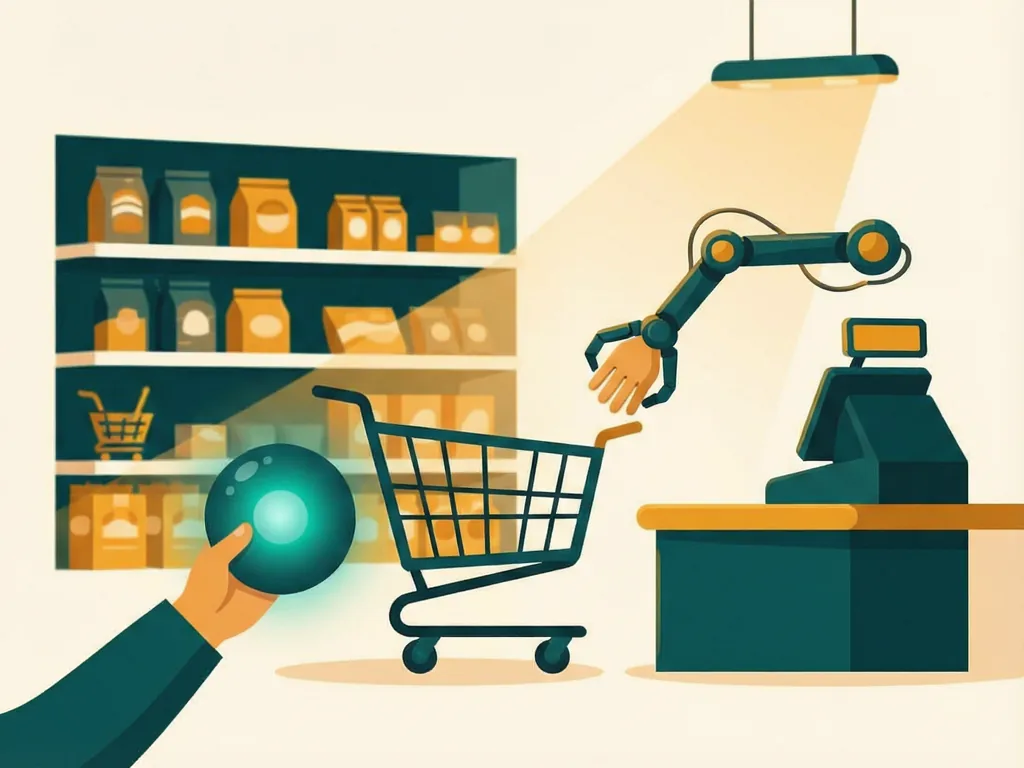
Featured image: abstract friendly illustration of a shopping cart connected to chat bubbles and search icons, no people, logos, or text.
Salesforce research reported by ZDNET shows that AI shopping agents have become a common first stop for holiday buyers: 20% of holiday shoppers worldwide use them for buying advice, 74% trust their recommendations, and e-commerce sites are seeing 104% more traffic from AI tools year-over-year. The same data shows that shoppers are not yet ready to let agents complete purchases.
The survey covered more than 2,500 shoppers in the US, UK, Canada, and Australia and is part of Salesforce's 2026 holiday shopping research. Salesforce forecasts that AI-driven shopping recommendations will drive $75.8 billion in Cyber Week spending, up 13% from 2025.
What the holiday shopping data shows
ZDNET's key takeaways describe the shift as research-first rather than checkout-first. Twenty percent of holiday shoppers are using AI agents as their first stop for research and advice, but that does not translate into full buying authority. The trust level is high: 74%, or 3 out of 4 shoppers, trust recommendations from AI shopping agents.
Brand discovery is becoming a measurable effect. Thirty percent of shoppers say they were first introduced to a new brand through an AI agent. The power of that introduction cuts both ways: 1 in 10, or 11%, shoppers would avoid a brand if an AI agent told them to.
The traffic trend reinforces the point. The research reports that traffic from AI tools to e-commerce sites has increased by 104% year-over-year, suggesting that shoppers are already using agents to find products, compare options, and narrow choices before they land on a retailer's page.
How AI agents are already helping retailers
For retailers, the value is not only in attracting clicks. The survey found that shoppers who use AI agent referrals are twice as likely to make a purchase. Among consumers, 39% have used AI agents on an e-commerce site, and 80% of those shoppers had a positive experience. Seventy-five percent said they felt more loyal to the brand after that AI agent experience.
The spending effect is also visible. Shoppers who use AI agents spend 8% more than the average buyer and purchase 23% more items per order. For brands, the growth gap is even larger: brands that use AI agents are seeing seven times faster sales growth than brands without them.
That means the current opportunity is less about replacing human choice and more about shaping it. When an AI agent can surface the right product, explain tradeoffs, and reduce search time, retailers can gain better conversion and stronger loyalty without forcing a fully automated checkout.
Why checkout still belongs to humans
The research shows that agent adoption is spreading, but purchasing authority remains narrow. One in three consumers has used an AI agent, including Meta Muse, which the report describes as widely adopted and now used by 12% of all consumers. Grok Bot is also in high demand.
Daily use is often task-based. Twenty-eight percent of consumers give their agents multiple tasks per day. The most common uses are price comparisons, product reviews, and brainstorming for gift items. Brand discovery is another major benefit.
Still, agents are mostly advisors, not buyers. Only 19% of personal agent users are using logic to check out. Only 9% of consumers allow their personal AI agents to have unrestricted access to their financial details, while 36% have set up a separate credit card for their AI agents.
The comfort gap is clear. Seventy-three percent of consumers are not comfortable giving personal AI agents their payment information, and 49% are not interested in agents making purchases on their behalf. Consumers do not want to share purchase history or personal data that could potentially lead to unwanted charges.
Patience is also limited. Shoppers will abandon an AI agent after 2-3 mistakes. If an AI agent makes a bad recommendation, 1 in 3 consumers will blame the AI. For retailers, that means a flawed recommendation can erase the loyalty gain from a good one.
What retailers must do as agents grow
The report's forward-looking point is blunt: retailers must adopt AI shopping agents in order to compete. They must be able to service and respond to shopper agents, not just human visitors.
This requires machine-scale listening. The ability to detect intent, buying signals, sources of dissatisfaction, and other consumer-related buying patterns at machine scale will require retailers to invest in AI agentic engagement capabilities. Machine scale is significantly faster and higher volume than human scale.
Today, AI agents advise consumers on their holiday shopping journeys. But the research says that in the very near future, they will autonomously make purchasing decisions with little to no involvement from their human counterparts. The future of shopping is described as more autonomous, highly personalized, and nearly frictionless.
For readers, the practical takeaway is that AI agents are already changing how products are found, compared, and trusted. Shoppers can use them as research tools now, while retailers need to prepare for a model in which brands that invest in agentic AI will garner the most loyalty and future business.
What else ZDNET is tracking around this story
The holiday shopping report sits alongside a wider set of related coverage. ZDNET links to guides on what to know about early Black Friday sales, ChatGPT Wallet, and OpenAI's liability disclaimer. It also points to ZDNET's favorite tech devices for 2026 and a story about 50 AI agents trying to build a thriving Minecraft civilization, which did not end well.
More from Vala includes a piece titled "74% of shoppers trust AI agents for buying advice - but checkout is another story," Gartner's 2027 tech trends, described as going beyond AI, and 5 reasons a company may need a chief AI officer in 2026.
Other links mentioned in the page include top 3 minimalist Android launchers and why they may be better than a default launcher, a Verizon Black Friday sale that lists free iPhone 18 Pro, Apple Watch, and AirPods as offers to qualify for, 6 early Black Friday MacBook deals recommended for shopping now, and early Black Friday Apple deals covering MacBooks, AirPods, and more. The page also includes a cookie notice for comments powered by Disqus.



Comments (0)