
NVIDIA DGX Spark Developer Kit Transforms Any Desk Into a Supercomputing Lab
A four-node NVIDIA DGX Spark desk cluster supports AI, scientific workloads, 512GB memory, 20TB NVMe storage, and 700-billion-parameter models.
Key Takeaways
- NVIDIA DGX Spark HPC Developer Kit is a four-node desktop cluster built on the GB10 Grace Blackwell Superchip, designed for researchers to test multi-node AI, scientific workloads, and HPC SDK tools without waiting for shared GPU cluster time.
- The kit scales from one to four nodes, uses NVIDIA ConnectX-7 ring networking without a switch, and provides up to 512GB combined memory and 20TB NVMe storage, enabling local deployment of models up to 700B parameters with NVFP4.
- It supports scientific applications and workflows such as LAMMPS with Kokkos, NAMD, GROMACS, OpenFOAM, WRF, and NVIDIA NIM microservices, with an upcoming HPC SDK installation playbook for GPU-accelerated development.
- Early use cases show its value in quantum chemistry, satellite-image decoding, protein/drug discovery, genomics, and large-model fine-tuning, helping teams debug locally, save shared-cluster hours, and keep proprietary data on premises.
- The developer kit is available through NVIDIA Marketplace and OEM partners, best suited for research teams, academic groups, and developers needing local multi-node prototyping rather than general enterprise deployment.
NVIDIA DGX Spark HPC Developer Kit Puts Four-Node Clusters on Researchers' Desks
Meta description: NVIDIA DGX Spark HPC Developer Kit gives researchers a four-node desk cluster for multi-node AI, scientific workloads, and HPC SDK testing at SC26.
Tags: NVIDIA DGX Spark, HPC, scientific computing, supercomputing, deep learning
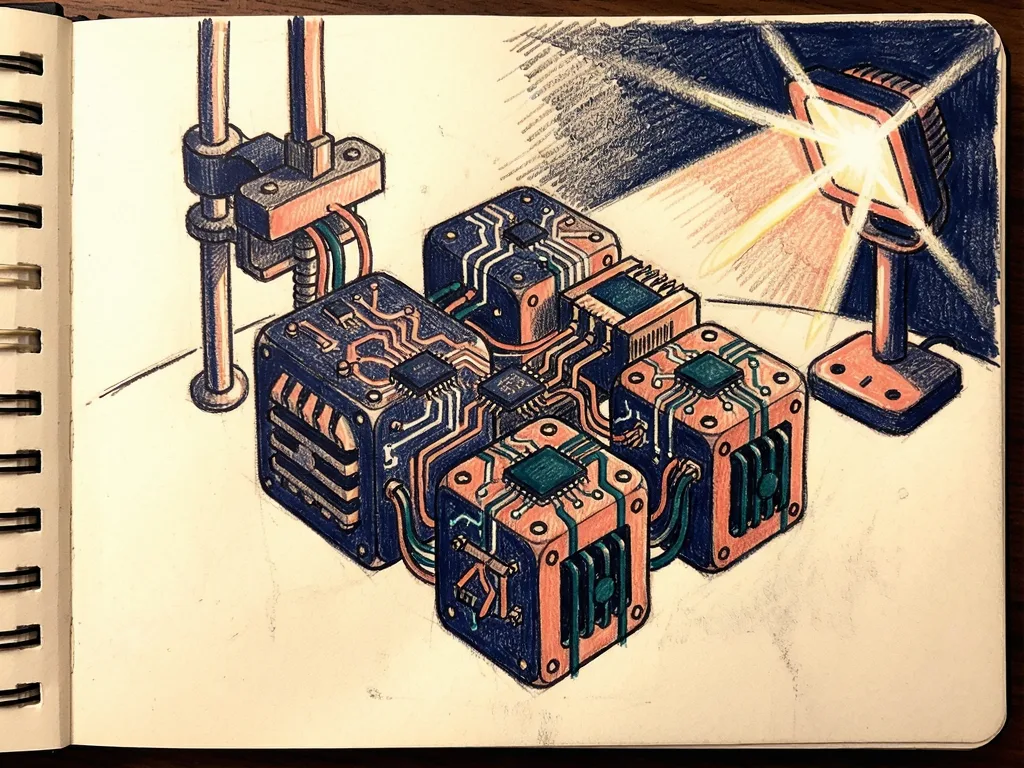
Featured image: Abstract, friendly illustration of four small computer nodes linked in a ring on a desk, no real people, no logos, no text.
NVIDIA DGX Spark HPC Developer Kit is a four-node cluster of NVIDIA DGX Spark systems introduced at SC26, an annual supercomputing conference taking place this week in Chicago. It is aimed at researchers, academics, and developers who need to test multi-node scientific workloads, AI models, and agents without waiting for time on a shared GPU cluster. Each node is connected directly to its two neighbors in a ring, creating a desktop-sized lab built around the GB10 Grace Blackwell Superchip.
A Four-Node Cluster for Desktop Work
The kit can scale from one node to four. The nodes are linked over NVIDIA ConnectX-7 networking, so teams do not need to buy or set up a network switch. At four nodes, the cluster provides 512GB of combined memory and 20TB of NVMe storage, giving researchers more room to distribute models and scientific workloads across the systems.
With NVFP4, researchers can deploy models with up to 700B parameters locally across the four NVIDIA DGX Spark systems, including DeepSeek V4.1. That capacity is intended for work that previously required queue-based access to larger infrastructure. For teams with fixed compute and server allocations, the local cluster means development and debugging can happen at the desk, saving shared server hours for production runs. It also keeps unpublished results and proprietary datasets on premises.
HPC SDK Playbook and Scientific Apps
NVIDIA says an installation playbook for the NVIDIA HPC SDK is coming soon. The playbook is for the NVIDIA HPC SDK, a software development kit for scientific computing. It is expected to bring GPU-accelerated C, C++, and Fortran compilers, libraries, and message passing interface tools to the DGX Spark cluster. These are the same development tools used on NVIDIA-powered supercomputers, so teams can build and test scientific applications across four nodes, check how computation and data are distributed, and debug communication issues before moving to larger systems.
The kit is positioned for scientific simulation and AI models and agents on the desktop. Demonstrated four-system workloads include LAMMPS with Kokkos for materials simulation and NAMD for molecular dynamics. The broader DGX Spark community has validated GROMACS for molecular dynamics, OpenFOAM for fluid dynamics, WRF for weather modeling, and NVIDIA NIM microservices such as OpenFold3 and Boltz-2 for predicting biomolecular structures.
New open dataset and post-training recipes for Nemotron 3.5 Super VL are also part of the picture. They help researchers adapt the model for life sciences and chemistry while enabling secure scientific workflows on infrastructure organizations control.
Research Use Cases Already Shown
The kit supports several patterns that can shorten the path from idea to experiment. Researchers can use agent-assisted workflows to prepare simulation inputs, launch runs, and summarize results, while scientists validate the setup and conclusions. They can also train AI models that approximate slow simulations, then use those models to refine wing designs toward minimum drag. Before committing supercomputer time, a team can narrow a 10-million-cell simulation to the 50-500 dimensions that matter.
Kvantify is using NVIDIA cuQuantum and reports running tensor-network simulations of quantum-chemistry circuits with up to 70 qubits and 975 gates on a single DGX Spark. The work benchmarks circuits generated for penicillin ground-state energy calculations. CYRAN AI, an IIT Delhi spin-out, uses DGX Spark and its PixelFlux library to accelerate JPEG 2000 decoding for large satellite images, supporting local geospatial analysis. OpenFold shows how researchers can fine-tune OpenFold3 on DGX Spark to improve protein-ligand structure predictions for drug discovery.
At the University of California, Berkeley, the Rubin Lab at IGI is using a DGX Spark and NVIDIA Evo 2 to predict bacterial traits directly from genome sequences. The approach compares embeddings from genomic and protein language models against classical baselines. The lab reports that, with no 11-hour cluster queue times, results arrived 15x sooner on DGX Spark.
The Hartwig Group at the University of California, Berkeley is using a DGX Spark to perform LoRA fine-tuning on the Nemotron 3 Super 120B-A12B model for chemistry machine learning, training a prediction head on experimental values. By running locally on the Spark with NVFP4 quantization, the lab fit a 120B-class model on a single device and bypassed multi-day cluster queue times. That allowed continuous eight- to 24-hour training fits back-to-back.
Availability and Who Should Use It
The developer kit is on display at SC26 and available for sale. DGX Spark products and cables can be purchased from top original equipment manufacturer partners and through NVIDIA Marketplace. The partners listed are Acer, ASUS, Dell Technologies, GIGABYTE, H3C, HP, Lenovo, MSI, and xFusion.
Once the NVIDIA HPC SDK playbook is available, it will give scientists and researchers a local platform to develop multi-node GPU applications, explore FP32 and mixed-precision algorithms, and run molecular dynamics and materials simulations using LAMMPS with Kokkos before scaling to data center systems.
Who should use it: research teams, academic groups, and developers who need to debug multi-node scientific workloads, run local large-model prototypes, or test HPC applications without waiting for shared cluster time.
Who should skip it: organizations whose primary need is single-node inference, users who do not need four-node ring networking, or teams that already have fast access to a large cluster and do not require a desk-scale test environment.






Comments (0)