
SpatialScout: Can Vision-Language Model Agents Actively Explore and Map Three-Dimensional Scenes?
SpatialScout evaluates vision-language agents on active spatial mapping in 80 indoor scenes, showing precise object localization remains challenging.

Key Takeaways
- SpatialScout is a benchmark for testing whether vision-language model agents can actively explore indoor environments and build accurate object-level 3D maps from limited visual observations, camera poses, and calibration data.
- It evaluates three core capabilities: active exploration, multi-view spatial mapping, and accuracy with completeness, penalizing missing objects and inefficient viewpoint selection.
- Results show that precise metric localization remains difficult: the best evaluated model reaches only 41.71% mean IoU, and just 3.25% of targets exceed IoU 0.9.
- The benchmark highlights a gap between coarse spatial understanding and usable spatial memory, which matters for real-world agent tasks such as navigation, object manipulation, and spatial reasoning.
- Public code and standardized scoring make SpatialScout useful for researchers and engineers working on active perception, camera control, and 3D object mapping.
Meta description: SpatialScout tests vision-language model agents on active object mapping in 80 indoor scenes and shows precise metric localization remains hard.

Tags: SpatialScout, vision-language model agents, spatial mapping, active perception, benchmark
Featured image: Abstract, friendly illustration of camera viewpoints, object centers and a simple indoor map, no real people, no logos, no text.
SpatialScout is a benchmark designed to test whether vision-language model agents can actively explore indoor environments and build accurate object-level three-dimensional maps. It evaluates 80 diverse indoor scenes and asks each agent to work from an object inventory, red-green-blue visual observations, camera calibration information and camera poses. The agent must control a camera, collect useful visual evidence and estimate the centers of objects in one shared three-dimensional coordinate frame.
For researchers and engineers building agents that combine vision, language and action, SpatialScout turns spatial intelligence into a concrete test. It asks whether a model can decide where to look next, connect views over time and produce a map that is both complete and precise.
What the benchmark measures
SpatialScout focuses on three linked capabilities.
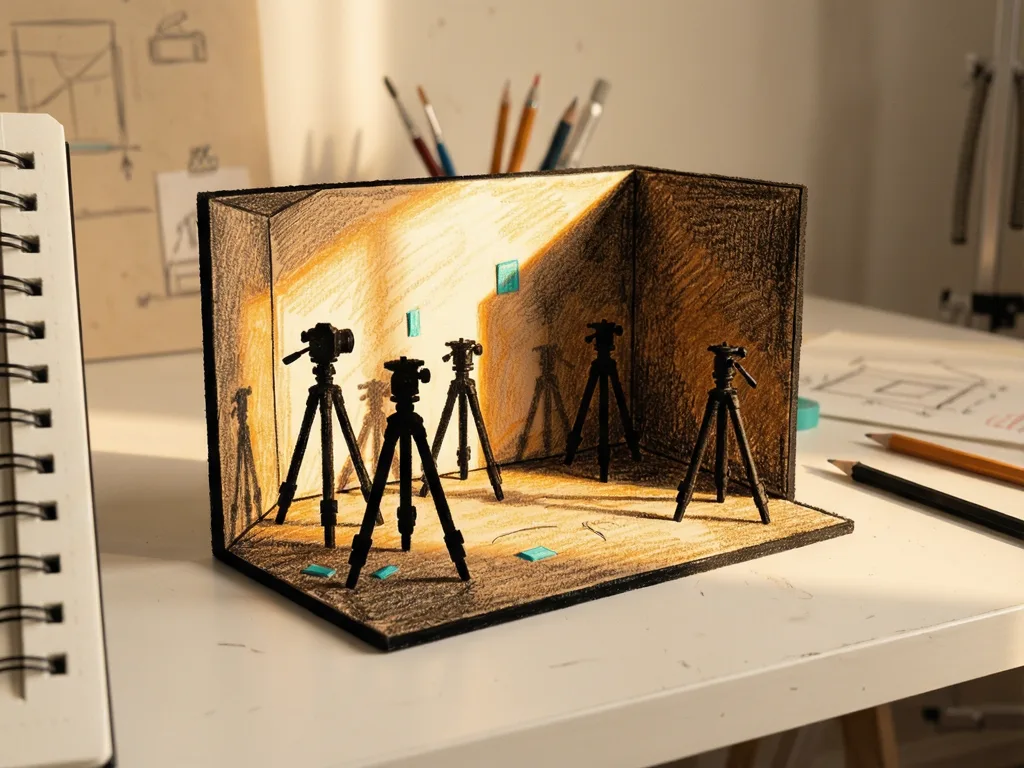
First, active exploration. An agent must choose informative viewpoints while its number of interactions is limited. This matters because a system cannot simply sweep a room with an unlimited camera; it has to decide where to look next.
Second, spatial mapping. The agent must associate objects across views and progressively refine their three-dimensional positions. This means the same object seen from two angles should not become two separate objects in the map. Instead, the agent should update the object’s estimated location as more evidence arrives.
Third, accuracy and completeness. The benchmark scores localization while penalizing missing objects. A system that finds a few easy items but ignores the rest should not receive the same credit as one that covers the full inventory.
Why precise object mapping is difficult
The results show that precise mapping remains a hard problem. The strongest evaluated model achieves 41.71% mean IoU, the best score reported among evaluated models. Mean IoU, or intersection over union, is a common score for comparing predicted spatial targets with true targets; higher values indicate better alignment. Only 3.25% of targets exceed IoU 0.9.
The 41.71% and 3.25% figures make the difficulty easy to track: progress should raise both the average alignment score and the number of highly accurate targets.
The pattern suggests a gap between rough understanding and exact placement. A model may recover the coarse layout of a room well enough to identify where objects are generally located, yet still fail to build a complete, precise metric map. For agents that need to navigate, manipulate objects or answer spatial questions, that gap is significant.

This gap matters because many practical agent tasks depend on exact spatial relationships. A map that is merely approximate may fail when the agent must reach an object, avoid a collision or answer questions about distances. The benchmark therefore highlights the difference between spatial recognition and usable spatial memory.
What this means for readers
For researchers and engineers building vision-language model agents, SpatialScout provides a focused test of active perception rather than passive recognition. It turns spatial intelligence into a task with clear inputs: an object list, visual observations, calibration data and poses. It also gives a clear output requirement: object centers in a shared three-dimensional frame.
The benchmark is useful because it combines several failure modes into one setting. An agent can do poorly because it explores inefficiently, misaligns objects across views, forgets earlier evidence, or estimates positions inaccurately. The missing-object penalty also discourages simple shortcuts, such as reporting only the easiest targets.
Code, feedback and next steps
The benchmark code is available at https://github.com/JesseZZZZZ/SpatialScout. The open code also lets other teams compare their agents under the same 80 scenes and scoring rules. The project invites feedback and discussion on active perception and spatial intelligence. The current scores suggest that future work may need to improve camera-control strategies, multi-view object association and uncertainty-aware refinement, if the goal is complete, accurate metric maps rather than approximate room layouts.
Who should use it and who may skip it
SpatialScout is most useful for researchers and engineers evaluating active perception, camera control and object-level spatial memory. Teams that only need image captioning, object recognition or static scene descriptions may skip it, because its core value is the combination of limited interaction, multi-view association and metric localization.



Comments (0)