
Granite Switch 4.1 supports chat, decisions, and speech from a single endpoint.
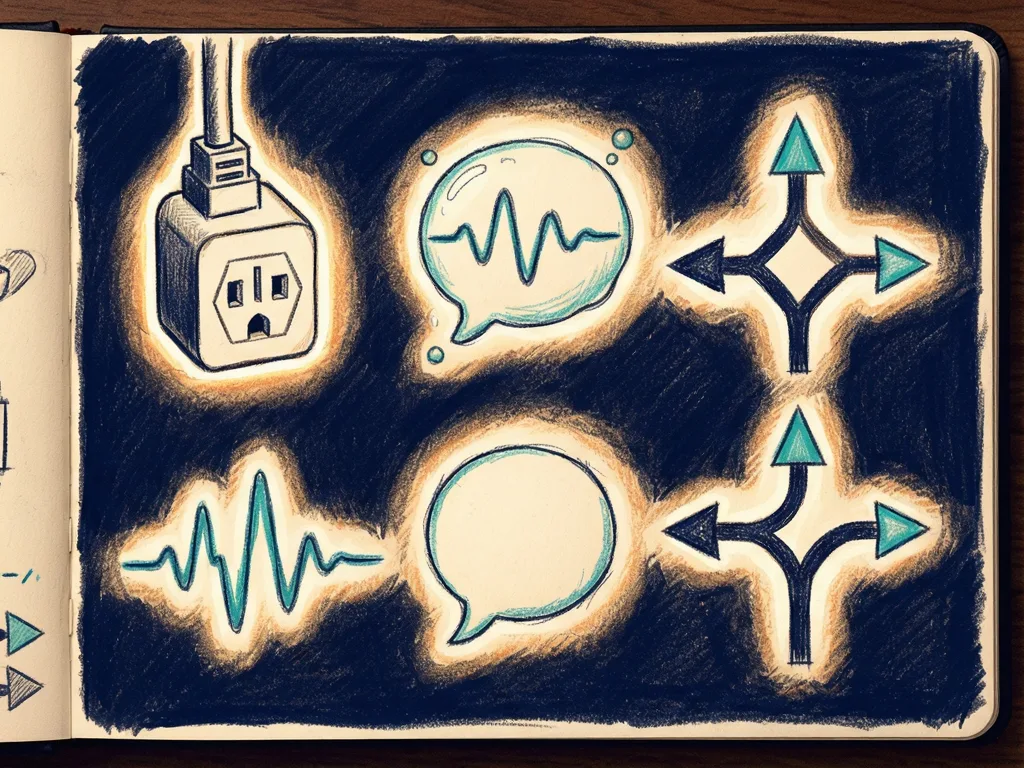
Granite Switch 4.1 combines chat, speech, and decisions in one model, reusing cache and adapters to cut GPU needs while adding specialists.

Key Points
- Granite Switch 4.1 combines chat, speech recognition, and decision-making in one model via bundled adapters, including Decision aLoRA, Guardian aLoRA, and Granite-Speech-5.0-Turbo-CTC.
- It uses a shared KV cache and cache-efficient Activated LoRAs to switch quickly between tasks while keeping GPU memory requirements similar to a base model.
- The model supports both general-purpose decisions and specialized adapters, allowing teams to add higher accuracy for specific tasks at low cost.
- Prebuilt Granite-Switch-4.1-8B and -30B models are available, and users can compose custom models using adapters from Granite Libraries.
- Future support includes an Adapter SDK in Mellea, enabling community-created adapters for custom decision, language, or task-specific workflows.
Meta description: Granite Switch 4.1 lets developers combine speech, chat, and decision workflows in one model while reusing the base KV cache to reduce GPU needs.
Tags: Granite Switch 4.1, decision models, speech recognition, vLLM, Mellea

Granite Switch 4.1 is aimed at developers and teams building AI applications that need a single endpoint to handle ordinary chat, automatic speech recognition (ASR), and decision-making tasks. The new Granite-Switch-4.1-8B and Granite-Switch-4.1-30B models bundle a general decision adapter, a safety-focused decision adapter, and a speech transcription model into one package. The result is a model that can do more than a plain base model while using about the same VRAM on a GPU.
One base model, three specialized jobs
The Granite-Switch-4.1-8B and -30B versions include three technologies on top of the underlying base model. First is a new Decision aLoRA, an adapter for general-purpose decision-making, such as v1/systemone. Second is a specialized Guardian aLoRA for safety-related decision tasks. The source says that, on average, this Guardian aLoRA outperforms Jev 1.13, Microsoft-Decision-1, GPT-Luna-Decisions, and Clef-Flash on those tasks.
Third is Granite-Speech-5.0-Turbo-CTC, an ASR model described as the fastest ASR model on the OpenASR Leaderboard. It is embedded for use in transcription tasks. All three technologies are composed into one model, so a deployment that needs speech, chat, and decision outputs can stay compact. That means more capabilities with fewer GPUs.

Faster switching through shared caches
The performance claim rests on how the adapters are built. The Switch adapters are cache-efficient Activated LoRAs, and the KV cache created from a base model generation can be reused for any subsequent adapter-based decisions. In practical terms, the model does not have to start from scratch when it moves from answering a question to running a decision step or processing spoken input.
The team also points to its recent vLLM contributions to speed up low rank adapter inferencing, plus a co-located ASR encoder. Together, these allow Granite Switch 4.1 models to switch between a chat request, a decision request, and a spoken request at high speed. The source describes this switching as blazing fast.
A practical demonstration is the Speech-to-Decisions HF space. In that environment, granite-switch-4.1-8b transcribes audio, generates summaries, screens for harmful content, and tests 15 other user-defined flags. The source says all of these tasks run on a single endpoint in real time.
Specialists can add accuracy without much cost
Decision models are not new. The earlier Granite Libraries release included a repository of specialized decision model adapters and other specialized task adapters that can be composed into custom Granite Switch models. While Jev and other closed decision models focus on generality, the source says many specialized granitelib adapters can outperform generalists on specialized classification tasks. When granitelib adapters are compared with generalist decision models on specialized classification tasks, the specialists can be stronger on the narrow jobs that matter.
Because adapters share the base model's KV cache, adding specialists alongside a generalist decision adapter costs almost nothing. A user gets broad coverage from the generalist and higher accuracy from specialists on selected tasks. The source frames this as a way to combine wide decision ability with focused classification strength.
That approach was tested in a Race between Granite-Switch-4.1-30B and Jev-27B. The Granite-Switch-4.1-30B configuration used a frozen base Granite model plus 4 specialized aLoRAs. Jev-27B used a frozen base Qwen model plus 1 generic decision LoRA. In a real world, 5-step RAG workflow, Granite-Switch-4.1-30B completed the task much faster than Jev-27B.

Teams can compose their own Granite Switch model
The released Granite-Switch-4.1-8B and -30B models come with batteries included. They are precompiled Granite Switch models with a predefined set of helpful adapters. However, the source says anyone can compose their own Granite Switch model by mixing and matching adapters from Granite Libraries to meet specific needs.
The team sees a large opportunity for the community to compose and extend Granite Switch models with custom and third party adapters. It plans to release an Adapter SDK for training adapters in Mellea, alongside other tutorials and Granite Switch support. Those adapters could be specialized classification adapters to augment decision-based workflows, or adapters for specialized language tasks.
The source gives a playful example: custom adapters could teach a 3B parameter version of Granite to play the classic game Doom. Like Jev, the custom 3B parameter Granite Switch model made split second decisions to navigate Doom. The source says it did so at 60 - 100 decisions per second, compared with Jev's reported 10 decisions per second. Unlike Jev, this Granite Switch model can also narrate and respond to questions while it is playing.
What the release points to
Granite Switch 4.1 matters because it packages several capabilities into one deployment shape. For teams that run speech, chat, and decision workflows, the shared KV cache and adapter composition can reduce the number of GPUs needed for a multi-task endpoint. For builders who want control, the Granite Libraries adapters and planned Mellea SDK suggest a path toward custom model assemblies rather than a single fixed product.
The source links to Granite Switch 4.1 Model Cards, the Speech-to-Decisions Demo, the Granite Switch GitHub Repo, the Original Granite Switch and Granite Libraries Release Blog, and a Colab where users can create their own aLoRA v LoRA race. The Jev decision-rate figure cited in the source is linked to the Typesafe blog post at https://typesafe.ai/blog/introducing-system-one-models-and-jev.



Comments (0)