
Quine is an artificial intelligence research system designed to address the complexity of biology.
Quine is an experimental AI system for biological discovery, linking models, tools, literature, researchers, and wet-lab validation for research use.
Key Takeaways
- Microsoft Research introduced Quine, an experimental AI system for scientific discovery in biology, not clinical or medical use.
- Quine combines a multimodal biological world model with an interactive harness linking models, tools, literature, researchers, and wet labs.
- Its goal is to accelerate biology research by connecting knowledge across scales, predicting intervention effects, and prioritizing experiments.
- Initial work with Broad Institute used Quine to rank compounds predicted to shift tumor states, with several top candidates validated in lab assays.
- Outputs may be incomplete or inaccurate and require review and experimental validation; broader access is expected as the technology matures.
Microsoft Research today introduced Quine, a research effort designed to work across the boundaries that separate biological knowledge, reflecting its long-term vision for a discovery system that evolves through scientific use. It combines a multimodal world model of biology with an interactive harness connecting models, scientific tools, literature, researchers, and the wet lab. The system is for scientific discovery, not clinical or medical use. In work with researchers at the Broad Institute of Harvard and MIT, Microsoft Research used Quine to prioritize compounds predicted to drive therapeutic tumor-state shifts and validated several top-ranked candidates across multiple wet-lab assays. A Quine Fellows program will give a cohort of scientists direct access to the system, a chance to accelerate their own research, and a route to provide scientific feedback. Quine is experimental research technology, and its outputs may be incomplete or inaccurate; qualified researchers must review them and confirm findings through appropriate scientific and experimental validation. As the technology matures, Microsoft Research expects broader access through products such as Microsoft Discovery.

Why biology needs more than isolated models
For more than two decades, Microsoft Research has worked where computation meets biology. Its projects have spanned immunology, virology, genomics, biomedical imaging, cell biology, and protein engineering. That work has produced foundational methods, new science, and technologies that reached the clinic, from rare and infectious disease diagnosis to cancer biomarker detection. The lesson the team draws is that biology does not obey the clean borders used by many models and tools. Genes affect proteins, proteins interact inside cells, cells organize into tissues, and experiments continually reshape what scientists know and what they ask next. The hardest biological questions therefore need systems that connect knowledge across scales and data types, reason about experiments and evidence, and participate in the iterative cycle through which science advances.
The obstacle is practical. Experimental methods have improved and wet-lab throughput has increased, but biology still runs slowly and is deeply complex. Nature cannot be hurried, and its answers cannot be forced from first principles alone. Experiments take time, iteration cycles are long, and many important questions involve interactions, combinatorial design spaces, and downstream effects too large to explore only in the lab. At the same time, large-scale machine learning—especially general-purpose foundation models and reasoning models that can work through problems step by step—suggests a different path. These systems are starting to do more than recognize patterns: they can integrate information across domains, reason about abstractions, and support iterative problem solving. Techniques built for human language have also adapted well to parts of biology, letting models learn representations of biological systems across many data types and scales.
This raises a provocative question: what would it take to build a world model for biology? Microsoft Research defines that idea as a system that can represent the state of a biological system, predict how that state changes after an intervention, and reason about consequences several steps into the future. Such a system would not replace experiments. It would let computation explore, propose, rank, and prioritize possible paths before scarce lab resources are committed. The stated north star is a continuously accelerating loop among scientists, models, and experiments.
How Quine links a world model to real experiments
Quine is Microsoft Research’s first step toward that loop. It has two frontier components: a world model of biology and an interactive harness. The harness connects the model to orchestration and reasoning models, scientific tools, literature, the wet lab, and teams of scientists. In the workflow described by the team, a question becomes a set of proposals; proposals become designs worth testing; experiments return measurements; and those measurements sharpen both the scientist’s next question and the model itself.
The world model learns shared representations across biological modalities and scales, including sequence, structure, function, cellular state, and imaging data. By training these modalities together, Quine can use evidence from one to inform predictions in another, capturing relationships that might remain siloed or lost if separate single-domain specialist models were only orchestrated. This multimodal design reflects the reality of biology: understanding any one level requires context from the others. The team reports that learning across connected representations strengthens performance rather than diluting it, enabling broader generalization and more biological reasoning tasks.
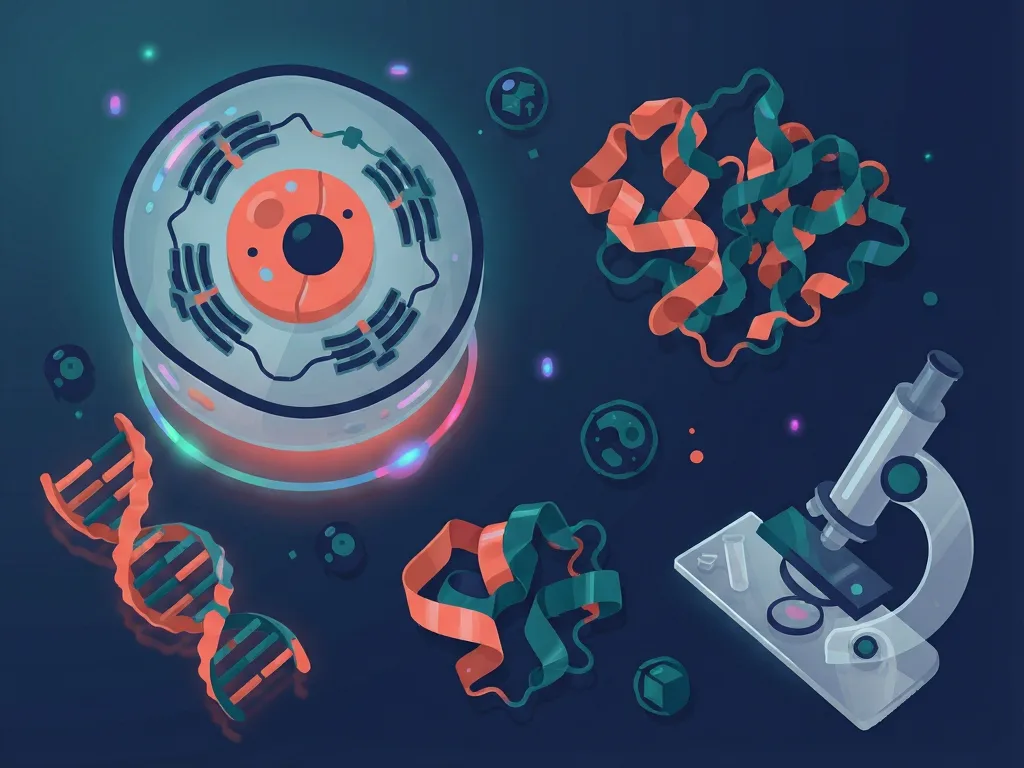
Biology is also multiscale. Evidence stacks from molecules to cells to tissues to patients, with scientific language running underneath all of it. The modalities Project Quine trains on include genomics, proteins, chemistry, RNA and cell state, and bioimaging. Each observes a different span of that range, and the spans overlap. Reading down the stack follows the causal path from genotype to phenotype; reading across follows physical scale. Because the model learns these representations jointly rather than orchestrating separate specialists, evidence at one level can inform predictions at another.
By placing the model inside a unified system that supports computational experimentation and learns from iteration, researchers can generate predictions across modalities and reason about consequences of biological interventions before lab testing. The team stresses that the world model does not need to be perfect. It says the model will never perfectly capture biology; it only needs to usefully inform experimental design.
A cancer test in pancreatic tumors
A concrete example comes from pancreatic ductal adenocarcinoma, or PDAC, the most common form of pancreatic cancer and one of the hardest to treat. Working with researchers at the Broad Institute of MIT and Harvard, Microsoft Research has spent years developing and applying patient-derived ex vivo models to investigate a longstanding hypothesis: tumor behavior and drug response may depend not only on genetics, but also on transcriptional cell state. In PDAC, tumor cells can occupy different cellular states associated with treatment response.
With Quine, the team turned that hypothesis into a practical test, exploring whether non-genetic features of cancer, especially cellular state, can serve as actionable therapeutic targets. Quine predicted and prioritized thousands of compounds based on their potential to shift tumor cells between therapeutically relevant states. In wet-lab studies using PDAC cell lines focused on the transition from classical to basal cell states, Quine’s highest-ranked compounds produced the largest intended transcriptional shifts across experimental assays. The entire process—rapidly narrowing the compound search space, prioritizing a handful of promising candidates, and validating them in the lab—took just one weekend, potentially saving months of experimental work and significant research costs. Some of the strongest effects came from compounds with unexpected mechanisms of action, offering early evidence that AI can uncover new opportunities for drug repurposing and discovery.
The reverse transition, from basal to classical cell states, proved more difficult. Quine predicted that available compounds would have this weaker effect. The experiments also revealed something not fully anticipated: Quine predicted that several compounds would consistently move cells toward a distinct third phenotype, and that observation was borne out in the lab. It suggests that the pancreatic cancer cell-state landscape is richer than a simple classical-basal axis. The experiments not only tested the model’s hypotheses but also generated new ones.
Continued work will use newly integrated RNA datasets and tasks to represent this richer landscape, strengthen state-transition predictions, and provide calibrated confidence estimates that help scientists prioritize the most promising hypotheses for wet-lab testing. Microsoft Research describes this as exactly the feedback loop Quine was built to support. Each round of experimentation improves understanding of biology, and each new insight can become training signal for the next generation of the system.

Early access, safeguards, and the next loop
Microsoft Research created Quine to improve how it does science itself. As the system evolved, the team embedded it in ongoing scientific programs. Every research question, experimental result, and unexpected finding became a chance to refine the models, improve workflows, and understand where AI could meaningfully accelerate research. Over time, Quine became central to discovery across multiple domains, including cancer biology, protein engineering, genomics, and bioimaging.
The team is now introducing Quine at an early stage. It grew out of Microsoft Research’s own work, but the company says development should not continue in isolation. Many questions that will determine where Quine goes next require the expertise, creativity, and perspectives of the broader scientific community. That is why the Quine Fellows program opens the system to scientists working at the frontier of biology and medicine.
Responsibility comes first, Microsoft Research says. Progress in AI and biology must move together with safety, security, and responsible stewardship. The team is taking a deliberate, phased approach to development and access. At first, availability is limited to the Quine Fellows program and selected research collaborations. Ongoing internal review and built-in safeguards are intended to maintain appropriate oversight as the system evolves. As the technology matures, the team expects to expand access through products such as Microsoft Discovery.
Benchmarks and leaderboards are tempting measures, and they matter. But the real test, in Microsoft Research’s framing, is what happens when Quine meets science as it is actually practiced. Can it be useful when evidence is incomplete? Can it help with questions genuinely never asked before? Can it make the path from question to discovery shorter? The ambition is for Quine to recede into the background while the science moves faster in the foreground. The central actors are not the model or the platform, but the scientists and the experiments.
Meta description: Microsoft Research introduces Quine, a biology world model and lab harness tested with the Broad Institute to prioritize compounds in pancreatic cancer.
Tags: Quine, Microsoft Research, AI biology, Broad Institute, pancreatic cancer
Featured image: abstract friendly illustration of connected biological scales, no real people, no logos, no text.

Comments (0)