
PaperFormalizer Enables Authors to Automatically Formalize Research Papers in Lean
PaperFormalizer converts LaTeX proof papers into Lean-verified versions, audits gaps, proposes repairs, and keeps authors in control.

Key Points
- PaperFormalizer is a Lean-based agentic pipeline that helps authors detect and close gaps in proof-heavy papers, producing Lean-verified versions.
- It converts LaTeX sources into a statement dependency graph, audits natural-language claims for faithfulness, ambiguity, and correctness, then formalizes and proves them with Lean, Mathlib, and the author’s toolkit.
- The system keeps meaning under author control: when statements or repairs are ambiguous, it proposes fixes in natural language and TeX for the author to accept, decline, or redirect.
- It outputs an annotated revised paper, a change report, and Lean code linked to formalized statements, while the author’s toolkit can grow and be shared as reusable proof foundations.
- It is best suited for LaTeX-based, proof-heavy researchers willing to review formalization proposals, and less useful for papers with little formal structure or authors who do not want to resolve ambiguity.
Lean paper verification is the task PaperFormalizer addresses: a Lean-based agentic pipeline that helps authors find and close gaps in their own papers and produce a Lean-verified version of each paper. It is aimed at researchers whose work rests on mathematical proofs, especially authors who start from LaTeX sources and want formal evidence that their statements match their intended claims.
From LaTeX source to a statement graph
PaperFormalizer begins by transcribing a paper’s LaTeX source into a dependency graph of statements. The graph shows how the paper’s results depend on definitions, assumptions, and earlier claims. From there, the pipeline audits each statement in natural language for faithfulness, ambiguity and correctness. It then formalizes and proves the statements in Lean against Mathlib, optional domain libraries and the author’s personal toolkit.
Lean is a proof assistant that checks formal arguments mechanically. Mathlib provides formal mathematical definitions and theorems that can be reused in such proofs. The author’s toolkit lets the pipeline reuse pieces the author has already formalized, so verification can build on prior work instead of starting from zero.
The author decides what the paper means
The pipeline is designed around a practical limit: formal tools cannot always know what a statement is intended to say. They also cannot always know how a formalization gap should be repaired. When a statement admits more than one reading, PaperFormalizer stops and asks the author. It presents every repair in natural language and TeX symbols as a proposal the author can accept, decline or redirect. Any decision that could change the paper’s claims remains with the author.
This keeps the verified output tied to the paper’s actual contribution. A formalization gap may be repairable in more than one way, and the best repair depends on the author’s intended meaning. If the pipeline silently picked one option, it might verify a theorem that no longer matches the original paper.

What authors receive as output
PaperFormalizer produces an annotated and revised version of the paper, a report of the changes, and Lean code where each declaration is linked to the statement it formalizes. The report helps authors see what was audited, what was changed, and why the formal version differs from the draft. The links between declarations and statements help later researchers trace a paper claim back to its formal proof.
The author’s personal toolkit grows as more papers are formalized. Authors can share their verified papers so researchers who build on that work can reuse the Lean code. This makes verification useful beyond a single manuscript: it can become a reusable foundation for future papers.
Why this matters for proof-based research
The pipeline’s stated aim is to make research that rests on mathematical proofs more robust. Even carefully proofread papers can leave small gaps in proofs or stated assumptions. A paper-level workflow helps authors find those gaps, propose repairs, and leave behind formal evidence that others can inspect and reuse.

Who should use it and who may skip it
Use PaperFormalizer if you are an author of LaTeX-based, proof-heavy research, want to turn papers into Lean-verified artifacts, and are willing to review formalization proposals. Skip or delay it if your paper has little formal structure, you are unwilling to resolve ambiguous statements, or you need the system to decide the paper’s meaning without your input.
Meta description: PaperFormalizer is a Lean-based agentic pipeline that helps authors find proof gaps, revise papers, and build Lean-verified research with an author toolkit.
Tags: PaperFormalizer, Lean verification, mathematical proofs, research robustness
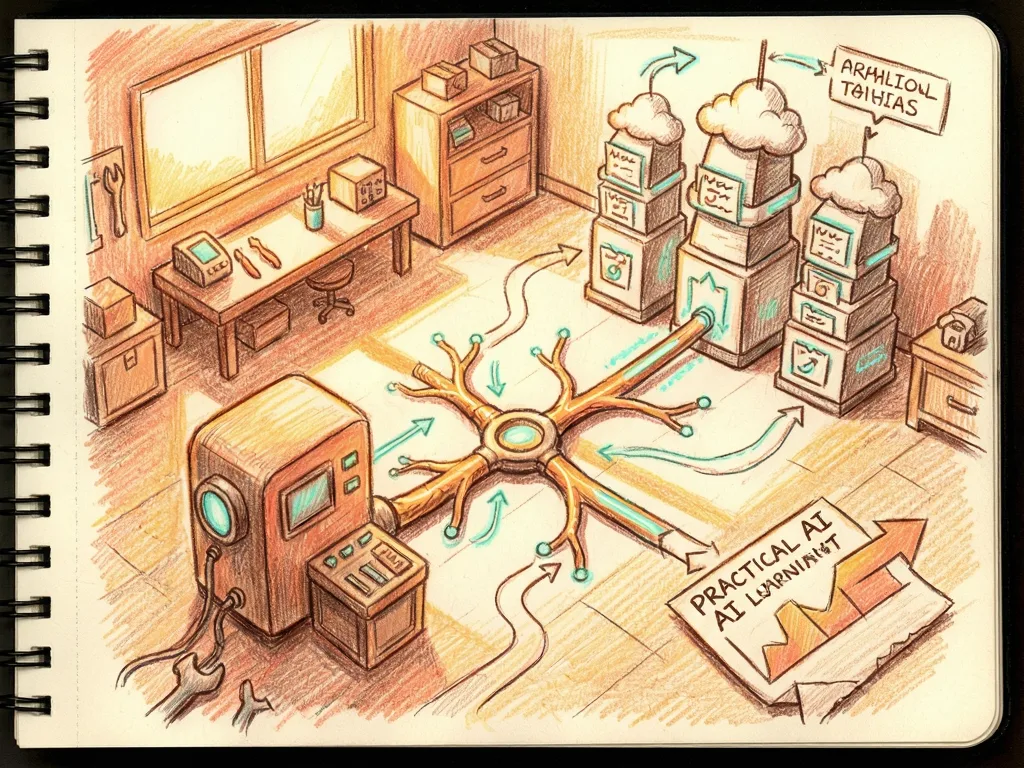
Featured image: Abstract friendly illustration of a paper becoming a linked graph of formal proofs, no people, no logos, no text.

Comments (0)