
A new AI assistant supports engineers in designing improved structures.
MIT built an AI copilot for topology optimization that lets designers give early feedback, improving manufacturability and buckling load by 39 percent
Key Points
- MIT researchers developed an AI copilot for topology optimization that lets engineers review and adjust selected regions while the algorithm is still generating a structure.
- The system addresses distrust of black-box algorithmic design by giving engineers early control, feedback, and confidence that the resulting structures are manufacturable and structurally sound.
- A machine learning model trained on synthetic human-feedback data quickly identifies likely design regions that engineers may want to change, avoiding the major slowdowns of earlier human-in-the-loop approaches.
- In demonstrations, the collaborative method improved manufacturability and linear buckling load by 39 percent while adding only about 15 seconds to total design time compared with all-algorithmic methods.
- The researchers see the tool as complementary to fully automated design, aiming to make topology optimization more practical, trustworthy, and accessible for engineers, researchers, and students.
MIT researchers have developed an AI copilot for topology optimization, a design method that uses algorithms to generate structures. The system asks human designers to review selected regions while the algorithm is still building the design. In an open-access Communications Engineering paper, the team reported easier-to-manufacture structures and higher buckling loads, with the human feedback path adding only 15 seconds to total design time versus all-algorithmic methods.
Why engineers still distrust algorithmic designs
Algorithmic design has already helped create parts optimized for ultralight aircraft, high-bandwidth antennas, and F1 racing cars. But the best algorithmic design techniques still require lots of computation and time. The final shape is usually visible only after the computation ends, so designers often have to restart the process to request changes. That makes it harder to trust whether the result is structurally sound.
Topology optimization is one of the most advanced techniques in this field. It uses formal optimization to iteratively fill a given design space so the structure maximally meets stated goals. For most applications, the process can produce designs that are impractical to build or that include other issues the engineer did not consider. Some generated structures might have eight or more beam connections at a single point, a detail that would be difficult to make in the real world.
Lead author Dat Ha, a recent MIT civil and environmental engineering doctoral student listed with a 2026 degree designation, is now a structural designer at LeMessurier. He said engineers are always very skeptical of computer programs, especially when the programs produce weird-looking or unexpected designs. He described topology optimization as powerful on paper, but said its black box nature has made it less widely adopted in industry.
The technique has gained traction in automotive and aerospace design. It has been used less for buildings or bridges, partly because design engineers need to know they can trust the output. Senior author Josephine Carstensen, an MIT associate professor of civil and environmental engineering, said a big limiting factor is that design engineers have very little influence over how the design evolves, so they cannot control undesirable features. That lack of control and ownership also inhibits its use.
How the copilot finds regions worth changing
To address those problems, the researchers made topology optimization more collaborative in an approach Carstensen compares to a design copilot. Instead of waiting for a finished structure, the algorithm presents regions to the human designer for feedback as it generates the design.
Prior attempts at adding human judgment slowed the process down dramatically. The researchers’ new system uses machine learning to quickly identify the most likely regions of an algorithmic design that a human would want to change. To train the machine learning model, the researchers created a synthetic dataset of probable human feedback on thousands of designs, with critiques of aesthetics, performance criteria, and manufacturability.
Ha said the team thought that if they could create a record of where humans have made changes to these design programs, there might be a pattern to those choices, which is not very different from other machine learning approaches. Carstensen sees the system as bringing together algorithmic and human design strengths. The paper’s coauthors also include Ferdous Alam, a former MIT postdoctoral researcher who is now an assistant professor at Georgia Tech; Markus Buehler, the MIT Jerry McAfee (1940) Professor of Engineering; and Faez Ahmed, an MIT associate professor of mechanical engineering.
Results point to manufacturability and trust gains
In demonstrations, the researchers showed their human-in-the-loop approach improved manufacturability and linear buckling load by 39 percent while only modestly increasing the total design time. Buckling load is a measure of structural stability, so a higher value indicates a design that can carry more load before losing stability.
The team also compared the collaborative approach with all-algorithmic methods. They found that adding human feedback increased total design time only modestly, by 15 seconds in their reported comparison. The result suggests the copilot can provide practical control without making the design loop unusably slow.
At present, the system only allows users to make structures thicker or thinner within identified regions. The researchers hope to add other options for modification in future versions. Carstensen said the approach could make algorithmic design more accessible and manufacturable for a broader class of design engineers. She said the hope is that addressing these hurdles opens topology optimization to a much wider audience, not only in industry but also to researchers and students in academia.
What this means for engineering workflows
The researchers see their approach as complementing AI-only methods. Carstensen argued there is room for both. If a discipline has a lot of computational resources, it can use the all-algorithmic approach; if a team really needs human input, it can use the collaborative approach.
For engineers, the practical value is control and trust. When designers can see and adjust risky regions early, they can apply domain knowledge as the design evolves instead of rejecting a finished model after long computation. Carstensen emphasized that in some settings humans need to make final decisions before advancing the final design. By involving humans, she said, teams can get higher-performing designs to the real world and create higher-performing structures. The point is not just designing good artifacts, but creating good artifacts that humans will actually accept and make.
The work was supported in part by the MathWorks Engineering Fellowship Fund, TATA Steel, and the MIT Generative AI Impact Consortium.
Meta description: MIT's AI copilot for topology optimization lets engineers guide regions, adding 15 seconds and improving manufacturability and buckling load by 39 percent.
Tags: topology optimization, AI copilot, engineering design, MIT research, manufacturability
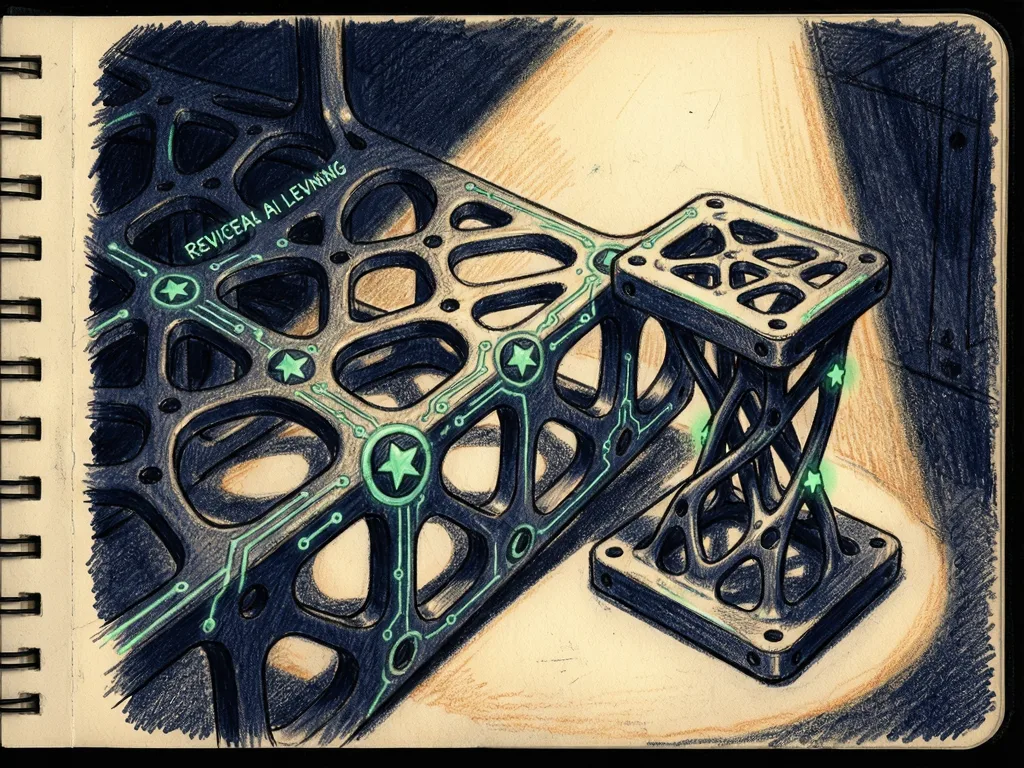
Featured image: Abstract friendly illustration of a structure being guided by a glowing copilot interface, with no real people, logos or text.




Comments (0)