
LiveFoley Dynamically Generates Real-Time Audio from Video for Immersive Interactive Worlds
LiveFoley decouples sound from video, generating synchronized audio in 156 milliseconds for games, virtual reality, and camera apps.
Key Takeaways
- LiveFoley is a plug-and-play sound engine that generates audio from live video streams in real time, targeting 156 milliseconds of end-to-end latency.
- It addresses the latency problem in interactive worlds by keeping audio synchronized with visual actions within a perceptual budget of under 250 milliseconds.
- Its Trailing Sliding Window method helps align generated sound with current video moments, aiming to match the quality of offline video-to-audio models.
- LiveFoley is source-agnostic, so it can attach audio to video from game engines, AR/VR systems, cameras, or other visual pipelines without depending on a specific video generator.
Meta description: LiveFoley is a plug-and-play sound engine that brings streaming video-to-audio generation to interactive worlds with 156 milliseconds end-to-end latency.
Tags: LiveFoley, video-to-audio, real-time audio, interactive worlds, sound generation
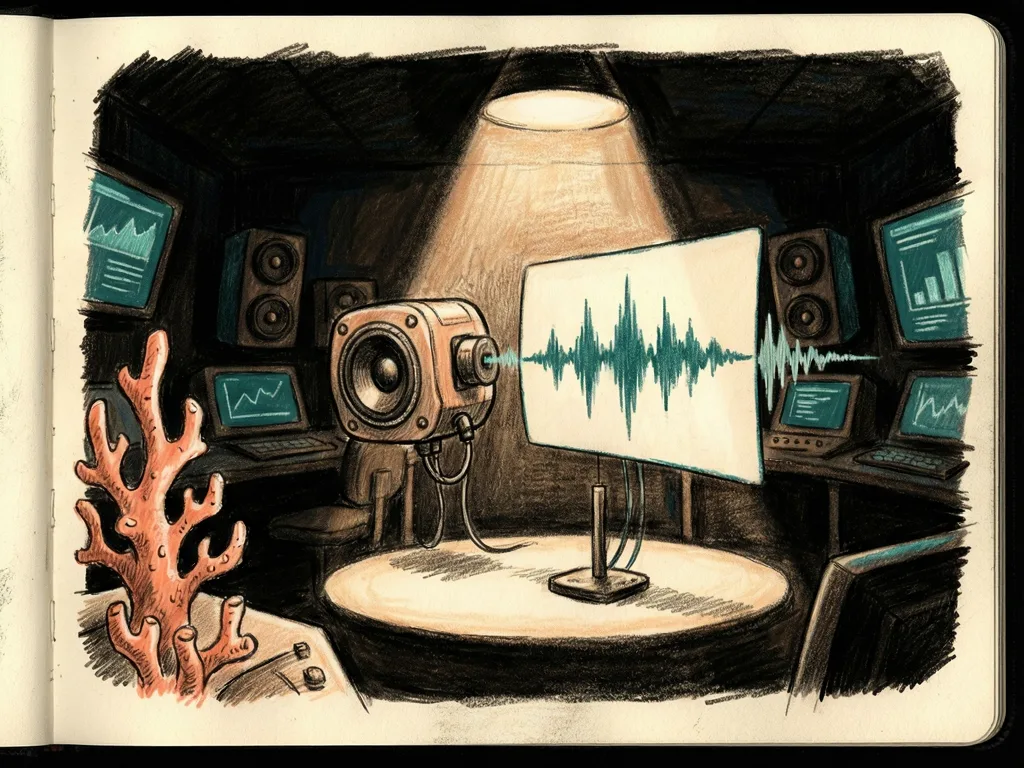
Featured image: A friendly abstract illustration of sound waves moving from a live video feed into a virtual table, with no people, logos, or text.
LiveFoley cuts video-to-audio latency to 156 milliseconds for interactive worlds
LiveFoley is a plug-and-play sound engine for real-time interactive worlds. It is designed to create synchronized audio from live video streams while aiming for an end-to-end latency of 156 milliseconds. The target audience includes developers building responsive games, augmented reality/virtual reality experiences, and camera-driven applications, where the sound must appear to follow the action without a noticeable delay.
Why streaming audio generation is difficult
Generating sound from moving images in real time is a different problem from generating sound after a video file has been fully processed. The description presents the task as streaming video-to-audio generation, and it highlights two major bottlenecks in current systems. The first is latency.

In a turn-based AI setting, such as the example of GPT-Realtime, a system can wait for a complete request and then return a response. Interactive worlds do not have that luxury. If a player knocks on a virtual table, the sound must arrive instantly enough for the action to feel connected. The stated perceptual budget is under 250 milliseconds, and both video encoding and audio synthesis must stay inside that limit. According to the description, earlier streaming models struggled to match the alignment quality of offline models such as MMAudio.
Trailing Sliding Window addresses the visual frontend
The LiveFoley approach is described as a solution to the visual frontend bottleneck. It uses a method called Trailing Sliding Window, which processes live video input in a way that keeps the audio generator close to the current visual moment. The result is an end-to-end latency of 156 milliseconds, which is below the 250-millisecond perceptual budget cited in the description.
For a non-expert, the difference is whether the sound arrives early enough to feel like part of the scene. If the audio is late, an impact can feel disconnected, like a dubbed effect. If it arrives within the stated window, the environment can feel more immediate, especially when actions repeat quickly. The description also says the method matches offline models in alignment, meaning the generated audio is intended to correspond closely to the visual events rather than drift behind them.
A sound engine that does not depend on the video source
The second bottleneck concerns architecture. The description notes a recent trend in joint video-audio world models, where sound generation is tightly coupled to a system’s own video generator. That design can work when the same model creates both the visual stream and the audio, but it becomes a problem when the video comes from somewhere else, such as a game engine, a camera feed, or another visual source.

LiveFoley is presented as a decoupled, source-agnostic sound engine. Instead of requiring a specific video generator, it takes a live pixel stream as input and synthesizes synchronized audio on the fly. This design makes it plug-and-play for 3D game engines, augmented reality/virtual reality systems, and live cameras. For builders, the value is not only speed, but also flexibility: audio can be added without rebuilding the visual pipeline around a particular world model.
What to watch next
The bigger idea is that interactive audio no longer has to be locked inside a single generation stack. If the stated latency and alignment goals hold up in deployment, LiveFoley could serve as a common sound layer for real-time visual systems, letting game developers, augmented reality/virtual reality builders, and camera-based applications attach responsive audio to streams that were not designed for it.
That said, the material presents the result as a step toward truly immersive interactive worlds rather than a completed product rollout. The next question is how easily the system can be integrated into existing engines, how stable the 156-millisecond end-to-end latency remains under different loads, and whether developers will prefer a separate sound engine over the tighter but less flexible joint models now appearing in the field.
Who should use it, and who should wait: teams that need synchronized audio from live video feeds without changing their visual generators are the clearest fit. Projects that are already built around a single video-audio world model may need to compare the convenience of an all-in-one system against the plug-and-play separation offered by LiveFoley.





Comments (0)