
RAG’s $80,000 Hallucination: Why It Fails Healthcare Eligibility Verification
RAG answered coverage from stale PDFs, missing live deductibles and prior auth, causing an $82,410 bill. Use real-time payer data instead.

Key Takeaways
- A healthcare AI agent using RAG incorrectly confirmed a $250 copay from an outdated benefits PDF, while the real patient liability reached $82,410.
- Insurance verification is a live, stateful process, not a static document search; deductibles, coverage status, and authorization requirements change in real time.
- RAG fails because semantic similarity is not authoritative: it can confuse a general benefit description with actual claim eligibility and pre-authorization approval.
- The correct architecture separates conversational intake from financial verification, limiting the LLM to structured data extraction and using deterministic EDI workflows.
- Real-time eligibility should be checked through ANSI ASC X12 270/271 transactions, with a rules engine enforcing coverage, deductible, and prior-authorization conditions before confirmation.
Meta description: A clinic's AI intake bot promised a patient $250 for surgery. The real bill was $82,410. Here's why RAG breaks on insurance verification and what to build instead.

Tags: healthcare AI, RAG, eligibility verification, X12 270/271, revenue cycle
If you are building or buying an AI agent that answers patient coverage questions, this article explains exactly how a state-of-the-art retrieval stack produced an $82,410 billing disaster, and what a correct architecture looks like. The short version: reading a PDF is not the same as checking a live insurance ledger, and the gap between those two activities is where health systems lose money.
What happened: a routine call, a catastrophic bill
A 42-year-old patient scheduled an outpatient cervical spine decompression at an ambulatory surgical center. Ten days before the procedure, the patient called the clinic to verify coverage.
The clinic was piloting an autonomous conversational agent for patient access, scheduling, and intake. The voice was smooth, latency was under 700 milliseconds, and the interaction felt efficient.
The caller explained they had Blue Cross Blue Shield through their employer, needed confirmation that the procedure on the 18th was covered, and wanted to know what they would owe at check-in.
The agent ran a retrieval-augmented generation (RAG) query against the clinic's document store. The vector database held a 78-page summary of benefits brochure that the employer group had uploaded six months earlier. The model retrieved a relevant chunk:
Section 4.2: Outpatient Surgical Procedures. In-network outpatient surgical services are covered at 90% after deductible. Copayment of $250 applies per surgical encounter.
The model matched the payer name, cross-referenced the term "outpatient surgery," and synthesized a spoken answer: the procedure with Dr. Vance was in-network and fully approved, and the patient would owe the standard $250 copay at check-in.
The patient arrived, paid $250, and had the surgery.

Six weeks later, the payer issued an explanation of benefits (EOB) denying the entire claim. The denial code was CO-197: Precertification/authorization/notification/pre-treatment absent. The patient's employer had also restructured its policy tier forty-eight hours before the call, moving to a high-deductible plan with an unmet $8,500 individual deductible and a specialized surgical carve-out.
The hospital's automated revenue cycle system generated a balance-due statement. Total patient responsibility: $82,410.00.
Why a modern RAG stack got this so wrong
The failure exposes a common misunderstanding about how healthcare revenue cycles actually work. Health insurance is not a static text document. It is a live, stateful, distributed ledger. Using an LLM with vector retrieval to answer coverage questions introduces three failure modes.
Accumulators decay in real time. Deductibles, out-of-pocket maximums, and co-insurance accumulators move continuously as claims, pharmacy benefits, and clinic encounters clear across the national clearinghouse network. A static PDF brochure or cached benefit summary contains zero real-time accumulator data.
Coverage is not authorization. A procedure can be a covered benefit under a plan while simultaneously requiring mandatory pre-authorization backed by strict clinical documentation. A generative model reading broad policy summaries cannot evaluate complex CPT/HCPCS code combinations against changing payer rules.
Semantic similarity is not authority. When a patient asks "Am I covered?", an ungoverned agent optimizes to resolve the question with a helpful answer. Without a hard transactional gate, the model confuses "benefit description" with "claim approval" and commits the health system to unverified promises.
The fix: deterministic EDI gateways
Patient access automation cannot rely on document search. In enterprise healthcare operations, verification must occur through standardized Electronic Data Interchange (EDI) rails under the Health Insurance Portability and Accountability Act (HIPAA).
The correct pattern decouples conversational intake from financial verification using a deterministic clearinghouse gateway. The language model is strictly limited to extracting structured entities: group number, patient date of birth, and the scheduled clinical procedure mapped to CPT/HCPCS codes. The model is programmatically barred from providing financial or coverage assurances.
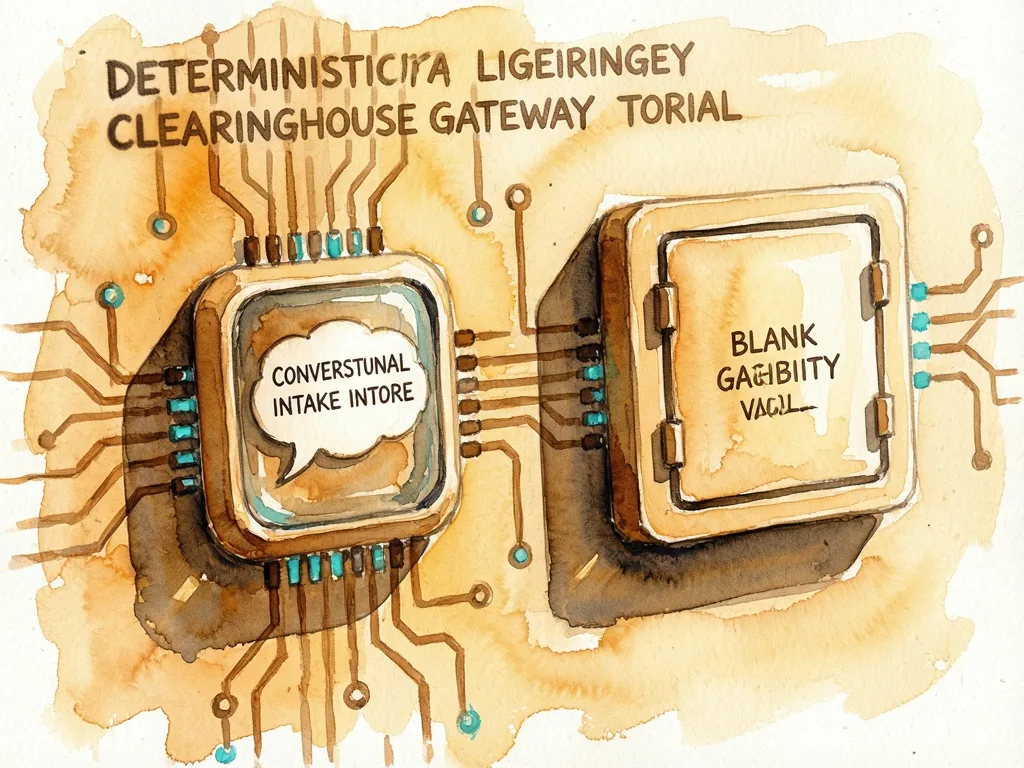
That structured intent is handed to a deterministic gateway that constructs an industry-standard ANSI ASC X12 270 real-time benefit inquiry and dispatches it over a secure clearinghouse endpoint such as Change Healthcare, Availity, or Waystar. When the clearinghouse returns an X12 271 payload, a deterministic rules engine — not an LLM — parses it and enforces three invariants:
- Active coverage flag equals 1 on the date of service.
- Deductible balance is at or below the target threshold.
- Service-level authorization requirement is evaluated — specifically that EB01 equals '1', EB03 equals '30', and the prior-auth flag is false.
If any invariant fails, three things happen. The conversational thread is bound: the LLM is instructed to tell the patient their insurance details are on file and under review by the billing department, and that a financial counselor will confirm exact responsibility before the visit. The scheduling workflow enters a PENDING_AUTH state, and no definitive coverage confirmation is emitted. An exception ticket is pushed to the clinic's revenue cycle team with the raw 271 payload attached.
Only when all invariants pass does the system emit the exact copay and deductible owed and authorize booking. The math is computed in deterministic code, never in a prompt.
What this means for engineering leads
If you are deploying autonomous agents into healthcare administration, four rules keep you out of the $82,410 club.
RAG is for reference; EDI is for reality. A document vector store tells you what an employer group contracted on paper. A clearinghouse inquiry tells you what will actually be paid on a claim.
Never let an LLM calculate patient financial responsibility. Co-insurance accumulators and tiered networks cannot be reliably evaluated through prompt engineering.
Conversational agents must never make unilateral financial commitments. If an intake bot reassures a patient without out-of-band verification, your organization assumes the liability.
Stop building demo-grade wrappers around static documents. Build deterministic invariant gateways that survive the revenue cycle.
The follow-up question for any health system piloting intake automation is simple: when your agent says "you're covered," what transaction actually stands behind that sentence? If the answer is a vector search over a PDF, the next denial code is already in the mail.





Comments (0)