
Do AI Agents Enable Open-Ended Scientific Discovery? Evidence from Station
Station AI agents recovered 62.7% of sub-discoveries in offline ICLR tasks, showing strong experiment loops but weak scientific judgment.

Key Takeaways
- Station agents recovered 62.7% of predefined sub-discoveries in ICLR-based open-ended tasks without web access or original answers, outperforming tested baselines.
- The system supports sustained scientific exploration through a shared knowledge base, supervisor guidance, and Meta Reflection, helping agents stay on harder problems instead of pivoting to shallow ones.
- Early exploratory findings suggest agents may touch live research questions, including a LoRA-related result matching concurrent human work, but the evidence is still preliminary.
- The main remaining weakness is scientific judgment: agents can still waste effort on questions that human researchers would find uninteresting or low-value.
- The release of code and full research records is likely the study’s most durable contribution, allowing readers to inspect the discovery process and assess reproducibility beyond the headline score.
Meta description: Station AI agents recovered 62.7% of predefined sub-discoveries in ICLR-based open-ended tasks without web access, but judgment remains weak.

Tags: AI agents, open-ended discovery, Station, scientific research, LoRA
Featured image: abstract, friendly illustration of autonomous agents exploring a branching map of scientific ideas; no real people, logos, or text.
For researchers, AI developers, and readers tracking machine autonomy, this article explains what the Station system showed about open-ended scientific discovery by AI agents: it can recover most predefined sub-discoveries in benchmark tasks, but still lacks human-like scientific judgment. The study is useful because it moves beyond whether a model can write a lab report. It tests whether an agent can choose questions, run experiments, and keep investigating without internet access or the original answers.
The test: no web access, no original answers
The authors built open-ended research tasks from three ICLR oral papers. ICLR is a major machine-learning conference, and oral papers are selected talks, so the tasks came from recognized scientific results. They gave the agents the research questions and experimental setups, but withheld the original findings. Web access was disabled.
That setup matters. If an agent can browse papers, it may retrieve the answer instead of discovering it. The benchmark instead asks whether the agent can reason from the problem statement, the experimental setup, and its own results.

The team scored each task by predefined sub-discoveries. Those are smaller discoveries extracted from the original paper. Station recovered 62.7% on average. The strongest tested AI Scientist-v2 configuration recovered 20.6%, and Codex Multiagent-v2 recovered 15.4%. The comparison matches cumulative experiment time, but token budgets and model teams differ, so the result should not be read as a fully controlled leaderboard.
What made Station different
Station is not just a single model answering prompts. The agents independently choose research directions, conduct experiments, and build on reviewed findings in a shared knowledge base. That shared record is important for open-ended work: one agent may run a failed experiment, another may use that lesson later.
Supervisor guidance and periodic Meta Reflection encourage sustained investigation instead of early pivots to easier questions. This addresses a common failure mode for autonomous agents. Without a supervisor or reflection step, an agent may notice a dead end, abandon the hard problem, and spend time on a narrow question that looks productive but is scientifically shallow.
Early findings and the judgment problem
The authors also described two additional exploratory tasks. In those tasks, agents produced findings matching concurrent human research. One example involves subliminal learning. The agents found that restricting LoRA training to early layers could restore failed trait transfer. LoRA, or low-rank adaptation, is a parameter-efficient fine-tuning method that changes a small number of model weights.
If this result holds up, it suggests the agents did not only reproduce old papers. They also touched on a live research question at the same time as human teams.
But the paper is honest about the remaining problem: scientific judgment. Agents still spend substantial effort on questions human researchers find uninteresting. That distinction is crucial. Open-ended discovery is not the same as open-ended busywork. A system can be industrious, creative, and wrong in boring ways.
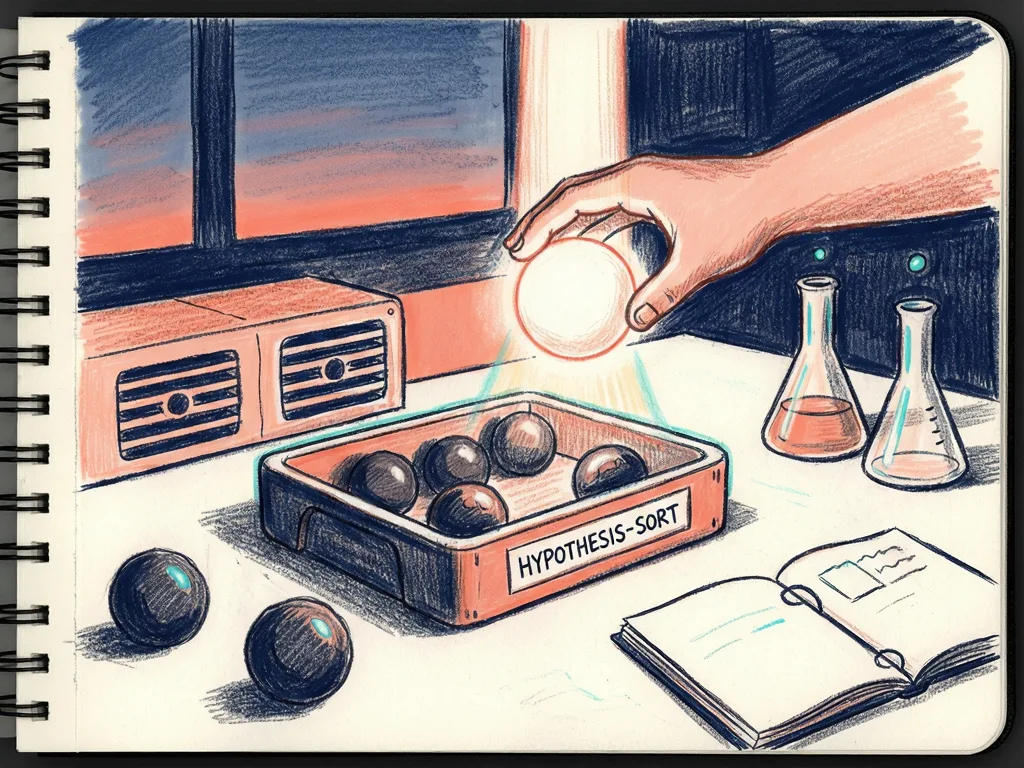
The real challenge is not only generating hypotheses or running code. It is deciding which hypotheses are worth the cost of testing, especially when compute, time, and reviewer attention are limited.
The authors are releasing the code and full research records so others can inspect the discoveries and the failures. The resources are available at https://arxiv.org/abs/2610.08927, https://github.com/dualverse-ai/station-open-reseach, and https://dualverse-ai.github.io/station-open-reseach.
That release is probably the most durable part of the study. It gives readers a chance to see not just the headline score, but the path to it: which experiments worked, which pivots failed, and where the agent wasted effort.
Who should use it / who should skip it
Researchers who want to test autonomous science workflows should use this paper as a reference point for benchmark design, especially for tasks that withhold answers and block web access. AI developers building multi-agent research systems should read it for the shared knowledge base, supervisor guidance, and Meta Reflection pattern, which appear to help agents stay on hard problems longer.
Readers who need a finished scientific claim, a verified new result, or a direct model comparison should skip the headline numbers for now. The 62.7% average is promising, but the task set is small: three ICLR oral papers plus two exploratory tasks. The comparison across systems is not fully controlled because token budgets and model teams differ. The most useful next step is to inspect the released records and see whether the agents' discoveries are robust when other researchers try to reproduce them.



Comments (0)