
Which Should You Use for Python LLM Applications: Model Context Protocol or API Calls?
Compare Model Context Protocol and API calls for Python LLM apps by setup, reuse, discovery, maturity, and infrastructure.
Key Points
- Model Context Protocol (MCP) addresses the scaling problem of repeatedly building custom tool integrations for different Python LLM apps and model providers.
- MCP adds a standardized discovery layer, allowing clients to find, inspect, and call tools without hard-coding each integration into a single app.
- Direct API calls remain simpler and require less infrastructure, but their integration work tends to repeat whenever a new app needs the same tool.
- Choose MCP when a tool is reused across multiple applications or providers; choose direct API calls when shipping one app with minimal setup.
- MCP does not replace API calls; it changes where the tool lives and how many clients can reuse it.
Meta description: A news-style look at Model Context Protocol versus API calls for Python LLM apps, with setup costs, reuse, maturity, and a package lookup tool example.

Tags: Model Context Protocol, API calls, Python LLM apps, tool integration, package lookup
Featured image: An abstract friendly illustration showing one tool connecting to several app shapes through a central protocol bridge, with no real people, logos, or text.
Anthropic open-sourced the Model Context Protocol in November 2024 to address a scaling problem: every new tool a model reached for needed its own integration, built on direct API calls. A year later, more than 10,000 public Model Context Protocol servers were running, ChatGPT, Gemini, Cursor, and Microsoft Copilot had added support, and Anthropic had donated the protocol to the Linux Foundation. For Python LLM app developers, the practical question is whether the Model Context Protocol versus API calls choice saves time across projects or adds unnecessary infrastructure.
Why the protocol spread quickly
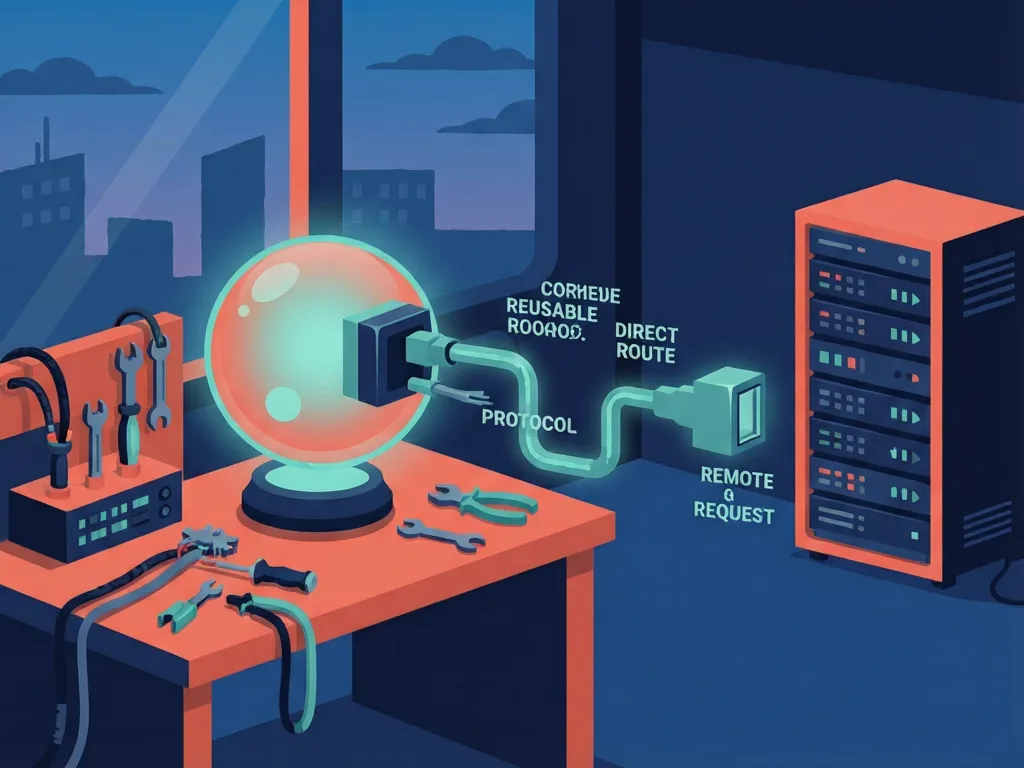
The protocol does not remove the older method. A server that exposes a tool still reaches its own backend through ordinary hypertext transfer protocol requests. The added layer is discovery: a client can ask what tools exist, learn their inputs, and call them without custom wiring for each model provider. That makes the comparison less about “new versus old” and more about whether a tool will be reused beyond the application being written today.
If a developer has already integrated the same tool into several apps and kept those copies in sync by hand, the protocol targets that exact burden. The goal is to write the tool once and let every app reuse it. If a developer is shipping one app and wants zero extra infrastructure, a direct API call remains simple and hard to beat.

How the two paths differ
With direct API calls, the developer tells the model provider's API what the tool does, and the app's own function-calling code runs that tool when the model asks for it. With the protocol, the same tool sits behind a small standard server that any protocol-aware client can discover and call. Both paths need a dispatch loop, the code that runs the requested tool and sends the result back to the model. The difference is where the tool description lives and how many applications can reuse it.
| Use case | Choose Model Context Protocol | Choose direct API calls |
|---|---|---|
| You will reuse the same tools across several apps or model providers | Yes | No |
| You are shipping one app and want zero extra infrastructure | No | Yes |
The two approaches offer the same capability, so the separation comes from structure and cost. A single tool call takes about the same time in both. The setup cost is higher for the protocol because it needs a client library, a package that implements the protocol, and a separate server process. Direct API calls need only the client library and a plain function inside the app.
For each tool, a schema is needed: the JavaScript Object Notation description of its name and parameters. The protocol can take a one-line registration and return that schema to any client that asks, while a direct API call usually requires a hand-written schema in each app. The protocol's reach is wider because one server can carry a tool to other model providers and to clients the developer did not write. A direct API call keeps the tool hard-coded inside one app. The maturity gap remains: the protocol arrived in late 2024, and its specification still moves quickly, while function calling has been part of the major model APIs since 2023.
The costs also repeat differently. The protocol's setup cost is paid once, though the server remains one more process to run. A direct API call has smaller upfront cost, but the integration work returns with every new app that needs the same tool. The more applications a developer builds, the more the protocol's upfront cost can pay for itself.
What the package lookup tool shows
To compare the approaches closely, the source tutorial uses one small tool, get_package_info(), which looks up a package on the Python Package Index. The tool is integrated into a Python LLM app twice: once through direct API calls and once through the protocol. The function stays identical, so the only variable is the integration pattern. In this comparison, “model” is shorthand for the LLM that the app sends questions to, and “function” and “tool” are used interchangeably because a function that the model can call is what both approaches treat as a tool.
The examples use Python 3.14 with anthropic 1.4.0 and mcp 2.1.1, and the code runs on Python 3.10 and later. A reader needs comfort with Python functions, dictionaries, and JavaScript Object Notation. The protocol client uses async and await, so a quick look at Python's asyncio helps if those are new. Installing both packages in a dedicated virtual environment created with Python's venv and populated with pip keeps them from interfering with other projects.
The tutorial uses the Anthropic client as an example, and that client requires an API key. A developer can create a key in the Claude Platform and export it as ANTHROPIC_API_KEY in the shell session so the anthropic software development kit can use it.
Real Python publishes the full tutorial at https://realpython.com/mcp-vs-api/. It also offers free Model Context Protocol server and client code, an interactive quiz on the same topic that gives a score upon completion, and a live course titled Build an AI Agent From Scratch in Python, with a waitlist for upcoming dates. The course builds the agent loop by hand, from the model call to the tool, so readers can predict what agents do. The same publisher also runs a Python Tricks newsletter that sends a short Python tip to subscribers every couple of days.
Common mistakes and what comes next
The most common mistake is assuming the protocol replaces direct API calls. It does not; it adds a discovery and calling layer above the requests that many tools already make. Another mistake is forgetting that a server is still a process to install, start, and keep running. That extra step is easy to overlook when a direct API call can hide the same tool inside one application. The opposite mistake is adding the protocol for a single app with no plans for reuse, where the simpler path is often better.
For readers deciding what to do next, the choice follows from the number of apps. If the same tool will appear in several apps or across model providers, a shared server reduces duplicated schemas and hand-maintained copies. If the project is one app and the team wants zero extra infrastructure, direct API calls remain the shorter path. The protocol's donation to the Linux Foundation and its rapid server growth suggest that tool discovery may become a longer-lived layer in LLM apps, while mature function calling through APIs remains the workhorse for each individual integration.


Comments (0)