
Tackling mathematical word problems
Researchers have built a specialized AI system that solves grade school math word problems at nearly double the accuracy of a fine-tuned GPT-3 model, achieving 55% versus children's 60% on the same test. The article explains why multi-step math reasoning is difficult for language models, how targeted training outperforms general-purpose models, and why this progress signals broader advances in AI's logical reasoning capabilities.
If you follow AI progress, you've probably noticed that language models often stumble on basic arithmetic and word problems. A new training approach changes that picture. Researchers have built a system that tackles elementary school math questions with roughly double the accuracy of a fine-tuned GPT-3 model, bringing machine performance close to that of actual children. In this article, we'll break down what was achieved, how the numbers compare, and why this matters for the future of reasoning in AI.
What the New System Can Do
The research team set out to address one of the most persistent weaknesses in large language models: multi-step math reasoning. Rather than relying on a general-purpose model alone, they trained a purpose-built system designed specifically to work through grade school math problems.
The headline result is striking. When measured against a fine-tuned GPT-3 model on the same set of problems, the new system performed at nearly twice the accuracy level. That's a significant leap, especially considering how much attention GPT-3 has received as a general-purpose language model.
To put the improvement in perspective, solving math word problems requires more than memorizing facts. A typical question might describe a shopping trip, a set of quantities, and a final question that demands several reasoning steps: identify what's being asked, figure out which operations to apply, keep track of intermediate numbers, and arrive at a final answer. Errors at any step derail the whole solution. This is precisely where traditional language models tend to fall short, and where the new approach shows its strength.
How It Compares to Real Kids
Numbers about model performance only mean so much in isolation, so the researchers added a human benchmark: a small group of children aged 9 to 12 took a test drawn from the dataset used to evaluate the system.
The results were close. The children solved 60% of the problems correctly, while the AI system answered 55% of the same questions accurately. In other words, the system now performs at roughly 90% of the level of real elementary school students on this material.
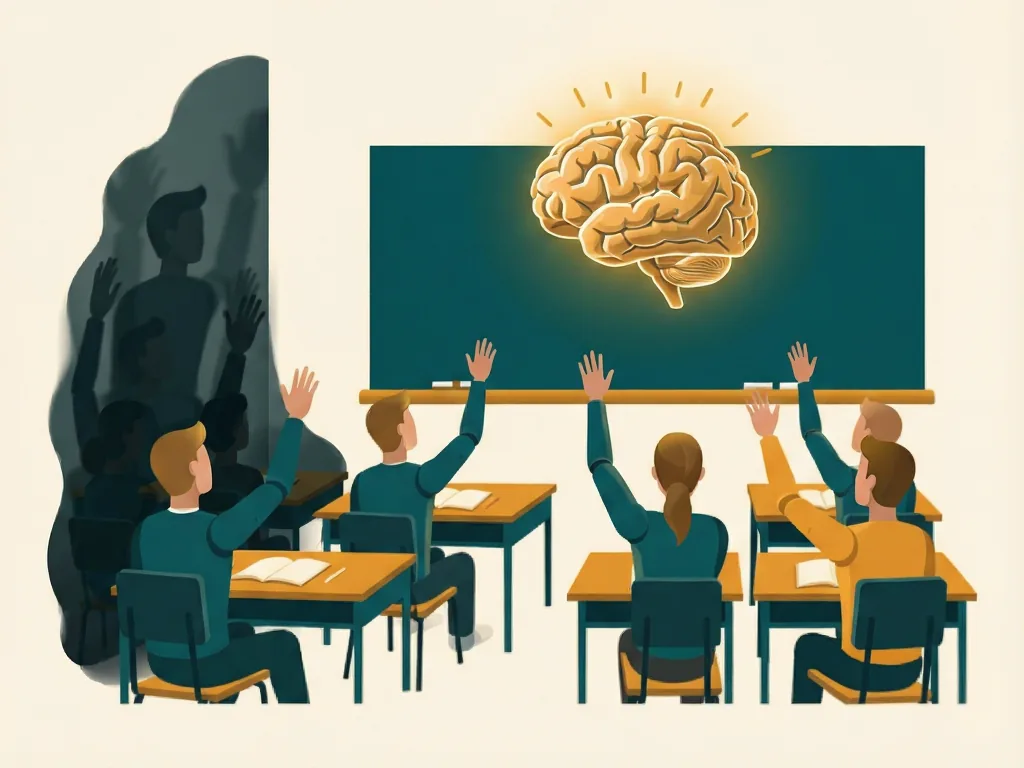
That comparison is notable for a couple of reasons. First, it gives the benchmark a concrete, intuitive anchor. Instead of an abstract accuracy score, you can picture a classroom of nine-to-twelve-year-olds and know the machine is not far behind them. Second, it highlights how far the field still has to go. A 55% score is impressive for an AI system, but it also means the system fails on nearly half of the problems — puzzles that many children handle without much trouble.
Why Grade School Math Is Harder Than It Sounds
It's tempting to assume that elementary school math should be trivial for a machine. After all, computers have been able to crunch numbers for decades. The difficulty lies not in the arithmetic itself but in understanding the problem.
A written math problem arrives as natural language, full of context, implied relationships, and sometimes deliberate distractors. The model must parse the story, translate it into mathematical operations, and then execute those operations in the right order. Each stage can introduce errors, and because the steps build on one another, early mistakes cascade.
This is why the gap between the new system and a fine-tuned GPT-3 is meaningful. It suggests that targeted training on this kind of reasoning — rather than general language ability alone — can produce substantially better results on tasks that require logical, step-by-step thinking.
What This Means Going Forward
Progress on grade school math may seem like a modest milestone, but it serves as a useful proxy for reasoning ability more broadly. If models can learn to handle multi-step logical problems reliably, the same techniques could improve performance across many domains where chains of reasoning matter, from helping students with homework to assisting with everyday planning and analysis.
At the same time, the comparison with children is a healthy reminder of the limits. The kids who took the test represent a small sample, and 9-to-12-year-olds are still developing their own math skills. A system matching or approaching their performance is a genuine research achievement, but it doesn't indicate that AI can reason at the level of an educated adult across all subjects. There's still a long road between solving elementary word problems and handling the layered, ambiguous reasoning that real-world problems demand.
The key takeaway is methodological: specialized training on reasoning tasks can deliver large, measurable gains over general-purpose fine-tuning. As researchers refine these techniques, we can expect the gap between machine and human performance on structured reasoning tasks to keep narrowing — step by step, much like the math problems themselves.
Meta description: A new AI system solves grade school math problems with nearly twice GPT-3's accuracy, scoring 55% where kids scored 60%.
Tags: AI research, GPT-3, math reasoning, language models, machine learning
Featured image: A friendly, abstract illustration of a chalkboard with floating numbers and puzzle shapes, rendered in soft pastel colors with a smiling calculator character — no real people, logos, or text.
Comments (0)